
- Fixed Line Narrowband
- Fixed Line Broadband
- Wireless Broadband
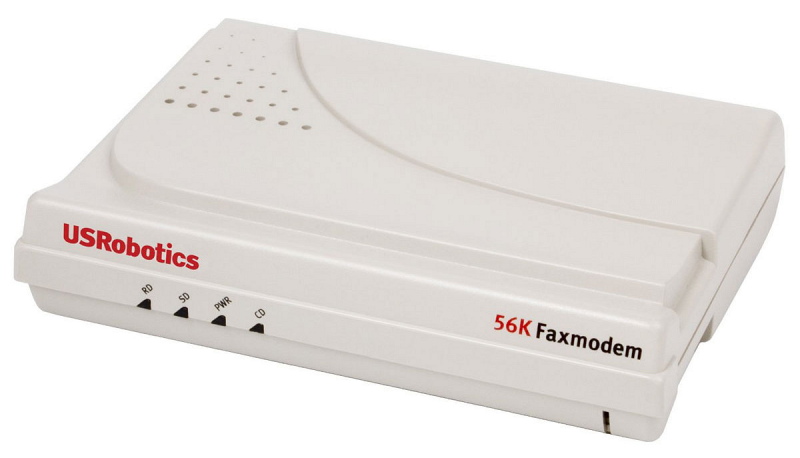
The modem converts a computers digital data signal into a transmission that can be sent over the voice line for communication with a remote computer (ISP). Dialup connections incur the standard voice call charges of your existing telephone operator, which varies depending on the number dialled and or call bundle.
This form of Internet access is extremely slow (speed and latency) and highly susceptible to line interference, running at a theoretical maximum of up to just 56Kilobits per second (Kbps) downstream and 48Kbps upstream using the last v.92 standard (details).
Thankfully its ability to plug in to almost any phone line makes it very flexible and useful as a temporary backup solution for when your broadband service fails, though you cannot make separate voice calls while using it.
Dialup Standards and Headline Connection Speeds
Modem 0.3Kbps (Bell 103 or V.21)
Modem 1.2Kbps (Bell 212A or V.22)
Modem 2.4Kbps (V.22/26 bis)
Modem 4.8Kbps (V.27ter)
Modem 9.6Kbps (V.32)
Modem 14.4Kbps (V.32bis)
Modem 28.8Kbps (V.34)
Modem 33.6Kbps (V.34)
Modem 56Kbps (V.90)
Modem 56Kbps (V.92)
Dialup's top speed of 56Kbps (0.05Mbps) could take anything up to one minute to load most modern web pages. Some UK ISPs enhance this by using server-side compression, which makes the connection appear to be several times faster, although it has no impact on pre-compressed images and files. Users can also make use of web browser cache or separate compression applications (e.g. Opera Turbo) to improve performance.
Today Dialup has been largely replaced by fibre and DSL (e.g. ADSL) technologies, which are two of the world's most popular forms of broadband connectivity and can also make use of existing telephone lines; albeit at considerably faster speeds of up to 8Mbps (ADSL), 24Mbps (ADSL2+) and 100Mbps+ (FTTC/H/P).
- Fairly easy to setup, if sometimes a bit fiddly.
- Cheap hardware.
- No subscription fee needed for local calls.
- Cheap unmetered calls (monthly fee).
- High latency.
- Local call rate costs can mount up.
- Fewer ISPs offer unmetered dialup.
- Dialup market is now virtually dead.
Related ISPreview.co.uk Content:
* Dialup Discussion Forum
* GUIDE: New Modem Standard v92 (v.92)












Latest UK ISP News
Helpful ISP Guides and Tips



















- FTTP (5525)
- BT (3518)
- Politics (2541)
- Openreach (2298)
- Business (2264)
- Building Digital UK (2246)
- FTTC (2044)
- Mobile Broadband (1975)
- Statistics (1789)
- 4G (1666)
- Virgin Media (1621)
- Ofcom Regulation (1463)
- Fibre Optic (1395)
- Wireless Internet (1390)
- FTTH (1382)