Southern Water harness Openreach’s UK fibre broadband network to detect leaks
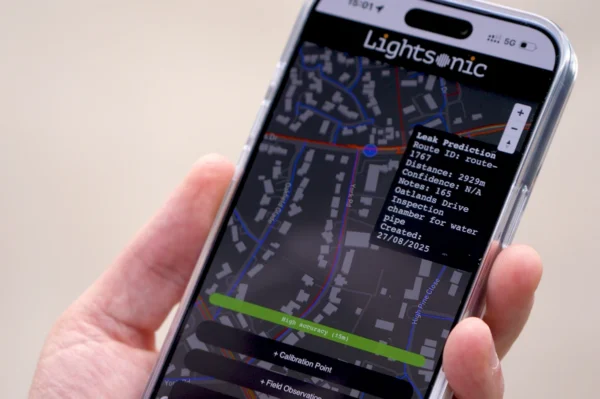
Utility company Southern Water, which supplies drinking water to millions of customers across the South of England, has announced that they’ve deployed Lightsonic’s technology that works by harnessing Openreach’s (BT) existing fibre optic broadband network to help detect underground water leaks in pipes.
As we’ve reported before (here, here, and here), fibre optic cables aren’t only useful for transmitting data using pulses of laser light. Such cables can also be used to detect subtle changes in those light signals (e.g. polarisation) as they move along the fibre, which can help to monitor Earthquakes, Tsunamis and even with locating underground water leaks via Distributed Acoustic Sensing (DAS) or Distributed Fibre Optic Sensing (DFOS).
Earlier this year we reported on how Lightsonic and Openreach had been trialling such a technology in the UK with Affinity Water, which in its first three months had already been used to pinpoint 100+ leaks and was estimated to have saved 2 million litres of water a day. Since then we understand that the solution is now saving “over” 4 million litres of water per day and that’s across just 650km of the UK’s water network.
Advertisement
The trial used “spare” fibres in Openreach’s network to create a system capable of providing real-time data for multiple utilities, allowing costs to be shared. But the future plan always envisaged this solution being expanded to work across Openreach’s active fibre network too (this hasn’t happened yet), rather than having to install a dedicated sensing fibre network.

The latest development is that Southern Water have now deployed a more mature version of this technology. This announcement comes as almost three-quarters of England is in drought, which has made it even more important than usual to find and plug water leaks in the network.
Currently around 2.6 billion litres of water is lost through leakage across the country’s network every day. England also has an ageing water network with 60% of water mains 45 years old and 13% more than 100, which are prone to leaks.
Advertisement
Trevor Linney, Director of Network Technology at Openreach, said:
“The results of our existing pilots with Lightsonic show that our new full fibre infrastructure can deliver value far beyond broadband – and could prove to be a real game changer in solving real-world challenges like water conservation.
Combining Lightsonic’s technology with the reach of Openreach’s Full Fibre network makes continuous utility monitoring genuinely scalable, without the cost and disruption of building a separate sensor network.”
Wayne Novelli, Leakage and Network Strategy Manager at Southern Water, said:
“We’ve reduced leakage across our network for three consecutive years and continue to invest in innovative techniques and technologies to find and fix leaks even more effectively.
We’ve been impressed by the leakage reduction metrics and proven success of Lightsonic’s technology and are looking forward to working with the team as we head into winter – when colder conditions can result in more leaks – to trial a new way of detecting and tackling them.”
At present the language above suggests that Southern Water may initially be deploying this as a “trial“, much like Affinity Water did, before later expanding its availability across more of their network. Developing the technology to work well at scale was a key focus of the earlier trial and this contract suggests they may be able to deliver on such a promise.
Lightsonic said their solution with Openreach typically detects 1.2 million litres of water leaks per day per 100km of network covered annually. Southern Water supplies an area of c.4,450 sq. km and serves 2.7 million customers, so there’s a huge potential for leak reduction, although it’s unclear how much of that this method could actually reach (not every area will have fibre or even spare fibres in the vicinity).
However, it’s worth remembering that Openreach aren’t the only fibre game in town, and it’s possible that we might also see rival networks – belonging to several different operators – being harnessed in the future in order to further improve such systems or to provide a bit of competition to Lightsonic. But for now, it’s an Openreach dominated solution and that makes sense given the size of their UK fibre network.



Mark is a professional technology writer, IT consultant and computer engineer from Dorset (England), he also founded ISPreview in 1999 and enjoys analysing the latest telecoms and broadband developments. Find me on X (Twitter), Mastodon, Facebook, BlueSky, Threads.net and Linkedin.












« New study benchmarks Malware blocking by free third-party DNS providers
Advertisement
Leave a Reply
Privacy Notice: Please note that news comments are anonymous, which means that we do NOT require you to enter any real personal details to post a message and display names can be almost anything you like (provided they do not contain offensive language or impersonate a real person's legal name). By clicking to submit a post you agree to storing your entries for comment content, display name, IP and email in our database, for as long as the post remains live.
Only the submitted name and comment will be displayed in public, while the rest will be kept private (we will never share this outside of ISPreview, regardless of whether the data is real or fake). This comment system uses submitted IP, email and website address data to spot abuse and spammers. All data is transferred via an encrypted (https secure) session.
















Sensible move considering the ducts are usually under water anyway – I guess as long as the cables are not they will work?
you cant do that with a wire hung from a wooden pole!
This use of underground fibre to detect water leaks does sound a positive thing rather than the fifteen metre wooden poles Connexin have been installing to house LorAWan equipment supposedly to do the same function for water companies
So Openreach are selling dark fibres directly to end users now?
Ive seen this in its testing phase . il be honest it wont help much but it may be better for more rural areas where it can be more difficult to detect a leak.