TP-Link Launch First Wi-Fi 8 Broadband Routers with Speeds up to 22Gbps
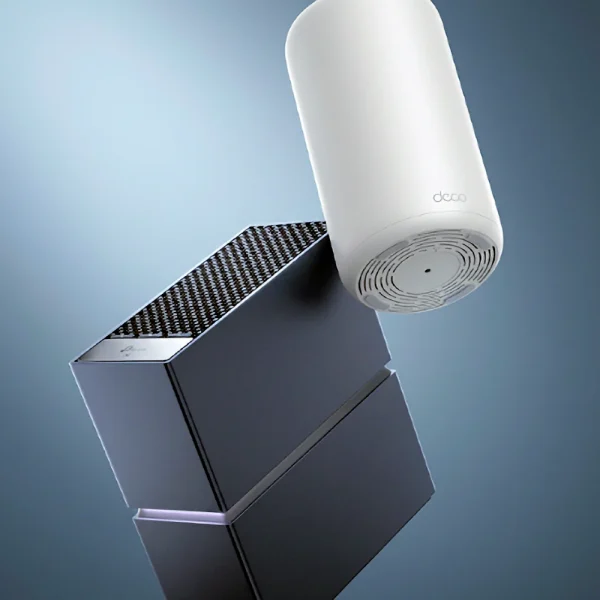
Networking kit manufacturer TP-Link, which builds a lot of broadband routers, WiFi extenders and smart home devices, today claims to have soft launched the “world’s first” commercial Wi-Fi 8 products – the Archer 8 Ultra router and Deco 8 Ultra mesh Wi-Fi system. But the kit will use a draft specification, since the full standard isn’t due to be ready until May 2028.
Just to recap. The next gen Wi-Fi 8 standard (802.11bn – “Ultra High Reliability“) will focus more on improving network reliability than boosting raw throughput speed (Wi-Fi 8 technology summary and here). But the fact that this standard is still some way from being ratified means that TP-Link will initially be launching their new kit without a few key features, which are due to be added later in future firmware updates.
TP-Link’s First Two Wi-Fi 8 Devices
Archer 8 Ultra BN19000: A tri-band Wi-Fi 8 router delivering up to 19Gbps of wireless speed via 2.4GHz, 5GHz and 6GHz (10Gbps wired connectivity – 6 Multi-Gig ports and two of those are 10Gbps WAN/LAN), featuring 18 internal antennae to ensure consistent coverage across 3,600 sq ft (3,000 sq ft in the EU).
Deco 8 Ultra BN22000: A tri-band Wi-Fi mesh system delivering up to 22Gbps* of wireless speed via 2.4GHz, 5GHz and 6GHz (10Gbps wired connectivity – 4 Multi-Gig ports and two of those are 10Gbps WAN/LAN). A three-pack provides 9,800 sq ft of coverage and supports 200 device connections. The kit uses an antennas configuration of 5T5R.
* Apparently the Deco’s wireless speeds will drop from 22Gbps to 19Gbps within the EU (due to regulatory differences in spectrum), where it’s model name will also change from BN22000 to BN19000.
TP-Link said both devices will be underpinned by what they’re calling a ‘Wi-Fi 8 StabilityEngine‘, which uses various features to strengthen coverage, manage congestion, and reduce interference for a more consistent connection throughout the home. This is set to draw on the following “suite of next-generation technologies“, although we should point out that most of this will form part of the wider Wi-Fi 8 standard (it’s not all unique to TP-Link).
Advertisement
Key Features of TP-Link’s Wi-Fi 8 StabilityEngine
Enhanced Long Range (ELR) and Distributed Resource Units (DRU) extend coverage at the edges of the home and improve uplink performance for distant, low-power devices.
Non-Primary Channel Access (NPCA) helps keep the network responsive as more devices connect at once.
Unequal Modulation (UEQM) and New Modulation and Coding Schemes (MCS) help maintain consistent throughput even in challenging interference conditions.
As mentioned earlier, some future Wi-Fi 8 features will be missing at launch. For example, Dynamic Sub-band Operation (DSO), Enhanced Long Range (ELR), Dynamic Power Save (DPS) is currently targeted to be added into the firmware during Q3 2027, while you’ll have to wait until sometime in 2028 if you want to benefit from Distributed Resource Units (DRU), Multi-Access Point Coordination (MAPC) and Improved Seamless Roaming.
In terms of the design language, TP-Link said traditional routers “get hidden away because of their looks, limiting the very performance they are meant to bring” and so they claim to have re-designed the new kit in a way that “invites people to place it where performance peaks“. But we don’t think the new kit looks all that different from some others we’ve seen over the years.
Nevertheless, the announcement states that the Archer 8 Ultra takes a “minimalist, architectural form“, while the Deco 8 Ultra ”refines the familiar Deco form around a sense of duality“.
Gary Chang, Lead Industrial Designer at TP-Link, said:
“We stopped building a piece of networking equipment and started designing for the home. When a router’s design becomes something people want to display, it ends up exactly where it performs best.”
The Archer 8 Ultra BN19000 will be available to pre-order from 30th of September 2026 via the TP-Link Store and should ship in October, while the Deco 8 will follow in Q1 2027. But as usual, bleeding edge kit like this tends to be very expensive, buggy, power hungry and is inherently flawed by the use of an incomplete standard. Not to mention that there isn’t much point in rushing to upgrade until Wi-Fi 8 devices have become more widely available (many people aren’t even using Wi-Fi 7 yet).
Advertisement
Lest we forget the usual health warning about those figures for wireless speeds above, which represents peak theoretical performance. Real-world speeds often come in many times slower than that due to signal degradation over distance (i.e. it’s always wise to take manufacturer-sourced figures with a big pinch of salt). Wi-Fi 8 may deliver improvements here, but there are limits to what can be done with a finite spectrum resource.






Mark is a professional technology writer, IT consultant and computer engineer from Dorset (England), he also founded ISPreview in 1999 and enjoys analysing the latest telecoms and broadband developments. Find me on X (Twitter), Mastodon, Facebook, BlueSky, Threads.net and Linkedin.













« Virgin Media and Openreach Fail Property Owner Over Cable Damage and Repair
Advertisement
Leave a Reply
Privacy Notice: Please note that news comments are anonymous, which means that we do NOT require you to enter any real personal details to post a message and display names can be almost anything you like (provided they do not contain offensive language or impersonate a real person's legal name). By clicking to submit a post you agree to storing your entries for comment content, display name, IP and email in our database, for as long as the post remains live.
Only the submitted name and comment will be displayed in public, while the rest will be kept private (we will never share this outside of ISPreview, regardless of whether the data is real or fake). This comment system uses submitted IP, email and website address data to spot abuse and spammers. All data is transferred via an encrypted (https secure) session.

















As far as appearance goes the “can of beans” look is passable and the black box is unobjectionable. At least they’ve avoided the “let’s make it look like a spider” look along with “has anyone put fifteen aerials on a router before”.
‘the Deco 8 Ultra ”refines the familiar Deco form around a sense of duality“.’
i.e. is it a router, or is it an air freshener?
If they want the routers to not be hidden away they should do things like huawei have done with the mesh x3 pro. that is a good looking bit of kit.
1. The Wi-Fi 8 standard hasn’t even been started yet, this is the fake branding that manufacturers are pushing these days, no Wi-Fi Alliance certification = no full feature set.
2. We don’t buy with the promise of future features that never show up.
Poor advertisement.
Hence why its called ‘draft’.
yeah have to echo similar sentiments to Jack. even now, we are how many years since the first wifi 7 routers became available
guess how many to date actually do what they say on the tin? (proper MLO)
zero. the answer is zero. the whole wifi industry at this point is a massive scam, akin to the snakeoil of ‘gold plated HDMI cables’
we need leading industry experts and reviewers to not platform or if they do platform, make extensive negative coverage of the lack of their features – lest consumers get hoodwinked into purchasing this junk.
i still suggest the flint 2 to people, because it works well and likely will perform just as good or better than any wifi 7 or 8 device.
Yep completely agree, I bought an RS700 and Netgear on their support forum just lock posts asking where these features are that were advertised as “coming soon”.
Disgusting way to treat customers but Netgear don’t care.
EE Smart Hub 7 Plus does proper MLO on a MLO device
All the YouTubers will big the ‘draft rubbish’ up though because they will get them for free and they are earning money from the vids.
I used to buy Netgear and TP-Link routers in the past. Due to issues with firmware bugs and lack of support I eventually stopped buying them.
I don’t want to spend hundreds of pounds on equipment that doesn’t get timely software updates with bug fixes and that doesn’t let me run OpenWRT which I can use after the manufacturer ends support.
One of my Flint 4s arrived on the weekend and I am loving the 10gb switching on it. I can run OpenWRT on this router should Gl-iNet stop supporting it.
Whilst I wait for my next Flint 4 to arrive I have to deal with my TP-Link ArcherAX11000 which spams my router with DHCP requests when used as an AP with a dynamic IP set instead of static IP.
I used to use this as a router but it occasionally would lock up the internet, stop working and require a restart. I tried beta firmwares and a replacement unit and in the end I stopped buying TP-Link products.
I did not think Netgear was still going, not that I have looked for their products. I used to have a Netgear ADSL router, it was good, it worked fine.
As for TP-link, I have had two of their routers, one from years agao I used with a wireless broadband network, and still used it when I changed to FTTC and the one I use now.
I have been using the one I have now for over 3 years, had an update for it last week, so still being updated.
For the majority of people these routers work, most people will stick them where ever they stick them, set them up and will never touch them again until they go belly up or they change to provider that insists on their own router.
I don’t touch mine that often these days, I check for a update now and again and if I add anything to the network I give it a fixed address, but I don’t add much these days.
Only people like you will pay £300 for a router that they can do what ever you want to do with it.
I must admit I did think at one point in mucking about with a home made router, get a minicomputer, that sort of thing, but then I thought, WHY?
I also have a few TP-link switches, I know they are pretty basic, but some of them are over 5 years old and still working fine.
Used TP-Link and Decos for years – they started to get old and the signals started to get worse. I already had a ASUS router so I got a 2 pack of BD16 mesh pods and wow – full 8Gbps all over the house thanks to 10Gbps backhaul options.
I never thought WIFi7 could be so good
@simon, they started to get old and the signal got worse? The Wi-fi don’t get worse as the unit gets older. I know of people running routers that are over 5 years old, the signal the same, the only thing is, new devices don’t connect to their full speed. Which for most of the time, makes no difference.
The only reason I took my old TP-link out of line was because could not cope with the amount of devices i have, also only 2.4Ghz.