CEO of Broadband ISP Wessex Internet Talks UK Competition and Consolidation
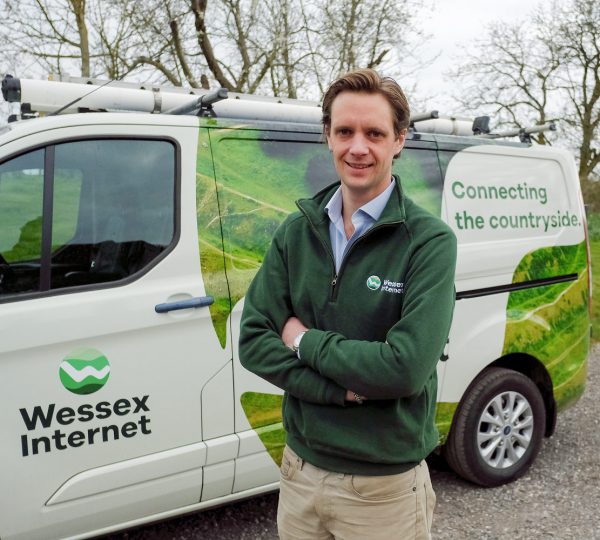
The CEO and founder of alternative UK rural broadband provider Wessex Internet, Hector Gibson Fleming, has today spoken to ISPreview about how they turned their family business – funded out of their own pockets for the first 7 years – into what it is today and how they’re navigating the many challenges of today’s full fibre market (consolidation, competition and rising costs etc.).
We think it’s fair to say that Wessex Internet is a familiar name around these parts and has long focused upon serving a rural niche in Southern England. In fact, the company has technically been around since 2010, when Hector’s father, the late James Gibson Fleming MBE, first established the business after building a Fixed Wireless Access (FWA) network to bring better broadband to his farm, before taking that idea to a wider audience.
“With prohibitive upfront costs quoted by a mainstream provider it was impossible to connect our home and farm office to broadband therefore he created a solution using innovative wireless technology to fix our telecoms challenge. Realising this wasn’t an isolated issue, he grew the wireless solution farm-to-farm in the local area over the next 5 years, before transforming the business into a rural focussed full fibre broadband provider,” said Hector.
Advertisement
In the 15 years since 2010, they’ve installed nearly 8,000km of fibre cable and employ over 350 staff – the majority of whom live locally and so “really understand the importance of the broadband service we provide, as well as the challenges of rural network build“, added Hector.
Today the provider, which also holds several publicly subsidised Project Gigabit build contracts (valued at £72m to deliver full fibre [FTTP] across over 53,000 properties by 2029), covers 50,000 premises (Oct 2025) across rural parts of Dorset, Hampshire, Wiltshire and Somerset (inc. 16,000 customers – Mar 2026). But existing deployment plans aim to expand this to 137,000 premises (here).
Suffice to say that Wessex Internet, which is now predominantly focused on building Fibre-to-the-Premises (FTTP) infrastructure and also maintains a significant wireless network, is far from being a major provider in terms of premises passed. But their geographic reach is fairly significant (mainly covering a huge area of Dorset and Somerset) and their accounts often seem to be heathier than many other altnets (here).
On the flip side, the provider is far from being the cheapest of ISPs (reflective of their remote rural focus as such builds are much more expensive) and they’re facing an increasing threat from overbuild by rivals (primarily Openreach). According to data supplied to ISPreview by Thinkbroadband at the end of 2025, some 17% of Wessex Internet’s full fibre network has been overbuilt by gigabit-capable broadband rivals. Despite this, the ISP maintains a good level of take-up (“exceeding 30% overall and 50% in our most established networks“).
Advertisement
The position that Wessex Internet occupies in the market thus makes them an interesting subject for our latest interview.
The Wessex Internet Interview
Q1. Firstly, can you offer an updated summary on Wessex Internet’s current network coverage (premises passed), customer take-up and total level of funding/investment?
Hector said:
We’re highly focussed on building a dense rural network to reach some of the most remote and rural communities across Dorset, Somerset, Hampshire and Wiltshire.
We have connected over 16,000 customers and passed over 50,000 properties – a take up of over 30%, which is unheard of given we are in the middle of our rollout phase. This shows strength in our business model that prioritises a rural network build.
We were awarded the first Building Digital UK (BDUK) Project Gigabit contract in 2022, and subsequently have been awarded 3 more contracts, totalling £72 million, and last year we obtained £50 million in funding from the National Wealth Fund (NWF). In particular we are incredibly proud to have recently completed our first contract, North Dorset (Lot 14.01) which was finished on time and within budget.
Q2. I thought I’d start off by noting your latest annual accounts to the end of 2024, which seemed to be a bit healthier and more stable than those of some other alternative networks we’ve seen. Most other altnets have been much more heavily impacted by issues of high interest rates, rising build costs and competition. As a result, quite a few of those providers have had to stop their deployments and focus more on commercialisation.
Some of this may be down to the fact that Wessex Internet has higher prices for some of their broadband packages than rivals (e.g. £79 per month for 900Mbps + £49 activation), which is no doubt partly a reflection of your rural focus. Some of it may also be down to the decent level of take-up you’ve reached at over 30% and rising.
Advertisement
However, few altnets are completely immune to the challenges of this market and I wondered if you can share a bit more about how Wessex Internet is doing better, financially, and able to continue building, when others are now struggling?
Hector said:
Our unique background, as a company that was born out of frustration and necessity rather than a concept justified by a ‘financial model’, continues to keep us focussed on serving rural communities and building a network that is not just for now, but also built for the long term.
We are certainty not immune to the inflation challenges faced by the industry, but we recognise ourselves as a niche operator who focuses heavily on our operational execution and customer experience within that niche. We still have to remain disciplined, and like the rest of the industry some costs are outside our control, but we believe this focus gives us a fundamentally viable model.
Wessex Internet has always been a family run business, and our network build was funded by my family for the first 7 years and so we’ve always needed to have a strong focus on cashflow and business sanity. This has helped us focus on a reasonable, long-term price for our product from the start.
Since we have won four Project Gigabit contracts, we have been able to roll out to more properties, faster. The grant funding supports our roll out where the build would be commercially unviable without it. However, it certainly doesn’t cover all build costs, therefore we continue to invest significantly in our network expansion.
Critically, the funding doesn’t change the sheer volume of work required per property in rural areas and as a result, we will always be a smaller player in the broadband market with lower scale, as a result we have to carefully consider how we spread our cost base as we grow.
We believe our success is the result of many factors including a focus on rural build, strong engagement with local communities, working closely with landowners and a focus on the customer service experience that we provide using local staff who understand the challenges of rural life and really buy in to our purpose, mission and values.
Please flick over to Page 2 in order to finish reading the full interview.






Mark is a professional technology writer, IT consultant and computer engineer from Dorset (England), he also founded ISPreview in 1999 and enjoys analysing the latest telecoms and broadband developments. Find me on X (Twitter), Mastodon, Facebook, BlueSky, Threads.net and Linkedin.










« Nexfibre Confirm FTTP Broadband Upgrades for 7 Further UK Locations














Interesting interview. Thank you.
An interesting piece Hector. As I mentioned when we caught up over coffee, Matthew and I are very proud of what we built with your father through the joint venture between our business, M12 and Ranston, your family business. Together we achieved much in those first years. What you have achieved since has been impressive, a tremendous internet infrastructure legacy for our region (Wessex), never mind North Dorset where it began.