The End of Ground-based Astronomy – UK Gov Responds to Broadband Satellite Fears
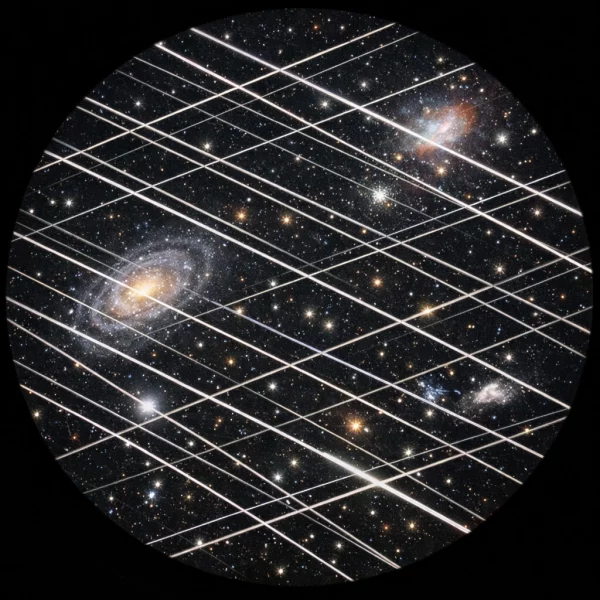
The UK Government’s Department for Science, Innovation and Technology (DSIT) has confirmed to ISPreview that they’re “actively engaged in international efforts to find solutions” to the problem raised by a recent study, which warned that ground-based telescopes might soon become useless if the number of satellites in Earth’s orbit exceeds 100,000 (i.e. those with below naked eye visibility).
Astronomy is one of the most important sciences, not least because it helps to teach us about our place in the universe, how it all works and warns about threats from dangerous asteroids etc. Much of this knowledge cannot be obtained in any other way and astronomical observations have repeatedly led to major breakthroughs in physics and technology.
The problem is that the rising population of satellites in orbit around the Earth, particularly in LEO, has a nasty tendency to pollute many of the images that we take of the night sky using ground-based telescopes. Such pollution typically shows up as bright streaks across images, which can result in the data becoming unusable. The more satellites that get sent aloft, the greater this problem becomes.
Advertisement
Space telescopes do exist too, which avoid the problem being talked about today, but they’re hugely expensive to launch and cannot replace the massive impact of ground-based observatories.
Some companies, like SpaceX, have been trying to adapt their hardware and approach to balance against this problem. But so far they haven’t been able to completely mitigate the issue and the challenges seem to be growing as LEO constellations expand. Not to mention that many other satellite networks are being planned that seem not to be doing anything significant to mitigate the negative impacts they could have upon global astronomy.
ESO’s Study
Earlier this month the European Southern Observatory (ESO) – in collaboration with the UK’s Royal Astronomical Society (RAS) and the International Astronomical Union (IAU) – published a new study (summary) that brought this debate back into a sharper focus and warned of the “devastating consequences for astronomy” if existing plans were to reach even a fraction of their targets.
Current proposals exist to launch over 1.7 million satellites into orbit (1+ million of these could form part of SpaceX’s orbital data centres plan) and yet, according to the new study, no more than 100,000 faint satellites, below naked eye visibility, should orbit Earth in order to “safeguard our ability to observe the night sky with modern telescopes“.
Advertisement
The big problem is that, thus far, major world governments and regulators haven’t really seemed to acknowledge the seriousness of the problem and continue to approve the launch of new mega constellations without much obvious consideration for the wider ramifications. Today’s situation certainly isn’t helped by the lack of international agreements and cooperation on such matters.
In addition, many state communications regulators simply don’t have a remit that extends beyond authorising and managing the use of relevant radio spectrum.
A spokesperson for UK telecoms regulator, Ofcom, told ISPreview:
“These satellites are deployed to serve global demand, not the UK alone, which accounts for only a small share of the overall market.
More broadly, the impact of satellites on visible light is a matter for the UK Space Agency and international bodies, with whom we work closely”.
One of the key problems here, as indirectly alluded to by Ofcom above, is that countries like the USA, China and a few others are generally the ones looking to launch new satellite mega constellations, yet often they seem to have little regard for the negative impacts they may have on other countries as a result. In this country it’s the job of the UK Space Agency (UKSA) to represent our interests on the international stage, which falls under the government’s Department for Science, Innovation and Technology (DSIT).
A DSIT spokesperson told ISPreview:
“The UK continues to take its responsibilities as a global leader on space sustainability seriously. We support the protection of Dark and Quiet Skies and are actively engaged in international efforts to find solutions that balance the enormous benefits of satellite services with the need to safeguard astronomical observation and protect the wonder of the night sky for people everywhere.”
The Government points out that it has also funded three studies to better understand the issue and inform policy decisions, including work on International Organisation for Standardisation standards for visible-wavelength satellite brightness, satellite ephemeris data requirements, and the aggregate brightness of satellite constellations.
Advertisement
The UK also remains a committed member of the United Nations Committee on the Peaceful Uses of Outer Space (UN COPUOS) and hosts the Square Kilometre Array Observatory (SKAO) headquarters. SKAO is an intergovernmental organisation building the worlds’ largest radio telescopes and a permanent observer of COPUOS, so it certainly has a stake in the matter, although it’s unclear how much influence they would be willing or able to wield over bigger countries.
In terms of solutions, there are some potential options that could be explored beyond direct satellite modifications, such as to require a kind of environmental impact assessment before approving new constellation launches (this could extend beyond optical telescopes, such as to cover radio telescopes, space debris and collision risk etc.) and setting down standards to help limit the brightness of certain satellites.
At the more extreme end we could perhaps see a per-satellite orbital environmental levy being applied to bright satellites to help fund astronomy mitigation. But applying this retrospectively would be extremely controversial and applying it to new satellites may not even be necessary, provided good standards can be established first.
At the end of the day the solution is not to blanket ban LEO broadband satellites or future launches, but rather to secure international cooperation and standards, so that no company is allowed to deploy a constellation whose cumulative impact pushes the global astronomical environment beyond a scientifically determined point of no return. Easier said than done, particularly in today’s climate to conflict and division.






Mark is a professional technology writer, IT consultant and computer engineer from Dorset (England), he also founded ISPreview in 1999 and enjoys analysing the latest telecoms and broadband developments. Find me on X (Twitter), Mastodon, Facebook, BlueSky, Threads.net and Linkedin.













Advertisement
Leave a Reply
Privacy Notice: Please note that news comments are anonymous, which means that we do NOT require you to enter any real personal details to post a message and display names can be almost anything you like (provided they do not contain offensive language or impersonate a real person's legal name). By clicking to submit a post you agree to storing your entries for comment content, display name, IP and email in our database, for as long as the post remains live.
Only the submitted name and comment will be displayed in public, while the rest will be kept private (we will never share this outside of ISPreview, regardless of whether the data is real or fake). This comment system uses submitted IP, email and website address data to spot abuse and spammers. All data is transferred via an encrypted (https secure) session.
















Don’t think we have to worry too much about the million+ in orbit data centres. They appear to make absolutely no sense and seem just to be a way of boosting Space X’s IPO (which is now tanking).
At the end of the day the solution is not to ban LEO broadband satellites or future launches,
Yes it is or at least cut it down and also make satellites last longer.
So much waste
let corporations now just pollute space with junk and sod all folks on earth who had cleaner skys.
Governments just accepting what corps do regardless of environmental good practice, just pollute now and worry about it later, typical but so sad.