Vodafone Test 5G Mobile Mast Controlled by Robotic Arm and AI Brain
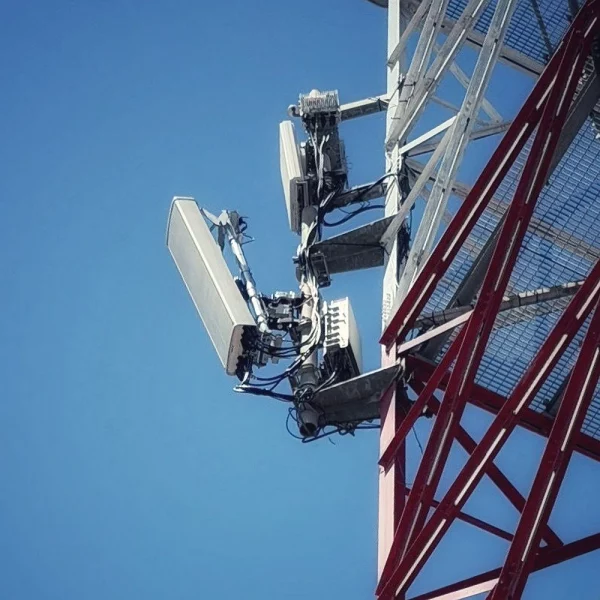
Mobile network operator Vodafone has revealed how a new trial have seen them add an AI brain and robotic arm to one of their mast sites, which can be used to autonomously analyse where customers need signal coverage the most and then automatically adjust the radio antenna to improve the signal toward that area.
The test of a “self-thinking mast“, which uses an algorithm developed by Vodafone’s engineers and a robotic arm manufactured by South Korean firm HUMAX Networks, is currently taking place at a site in Tirana (Albania). The trial is being monitored to see how effectively it can evaluate demand and local conditions, including weather, to decide where to focus its strongest signal (e.g. on sunny days it directs the signal to boost outdoor reception, while on rainy days it sends it more toward indoor environments).
The robotic arm adjusts for this by rotating or tilting the radio antenna to optimise 4G/5G coverage and performance as required. “It continues to think, learn and adapt and can make decisions almost instantly without human intervention,” said a spokesperson for the mobile operator.
Advertisement
The trial site is said to overlook a major shopping centre. During the day, the antenna serves shoppers, but at night it automatically shifts coverage to focus on a nearby residential area instead, adding capacity when evening internet use rises and the shops are closed. The process to move the antenna takes around 20 to 30 minutes, which is by design to conserve energy and avoid a sudden service disruption.
Making this sort of change manually would have taken days or weeks to arrange, due to the need for certain planning or other permissions to be secured first (sometimes even months if you need to add a new antenna). Not to mention any potential need for road closures and delays due to unsafe weather conditions etc. But that’s not a problem for the AI and its robotic arm.
Francisco ‘Paco’ Martin Pignatelli, Vodafone’s Director of Mobile Access Engineering, said:
“This is an early example of Physical AI in telecoms. By analysing network demand and making autonomous decisions, the AI algorithm can adjust radio antennas to optimise coverage and capacity without human intervention. This enables us to deliver superior connectivity for our customers.”
The trial is said to complement Vodafone’s existing rollout of satellite-guided sensors in new mobile mast antennas, which began last year and helps the operator to confirm whether antennas have been installed correctly to maximise radio performance. In the “coming months” the operator will also test systems that can physically move small components inside the antenna to alter the signal, rather than the whole unit, and thereby reducing energy use. But quite when all of this might be deployed is another matter, and it’ll no doubt add some cost when first installed.






Mark is a professional technology writer, IT consultant and computer engineer from Dorset (England), he also founded ISPreview in 1999 and enjoys analysing the latest telecoms and broadband developments. Find me on X (Twitter), Mastodon, Facebook, BlueSky, Threads.net and Linkedin.













« ISPA Reveal First Finalists for the 2026 UK ISP Internet Industry Awards

















so an algorithm and a couple of motors is now AI and a robotic arm
It’s basically a reinvention of what HUMAX was already doing for satellite dishes in the ’90s, if not earlier.
I’m not sure this is practical,what’s the point of this when they can already achieve a degree of directionality using current Phased array antenna technology. Anything mechanical working on a mast and exposed to all the elements would be another point of failure, why not just add more phased array antenna’s. BT are experimenting with Rydberg atomic radio-frequency receivers, which are far more sensitive, maybe that’s the way to go.
Next they’ll “invent” AI to keep an eye on it, report when it’s broken, and call it yet another “innovation.”
Agreed, this feels a bit “Heath Robinson”, probably to save money on an additional phased array and mounting hardware on tjhe building.
I could just about see the point to deal with sites where there isn’t the ability to hang more antennas for physical reasons, or a site where there are a few major events in the year in a different direction to predominant use (e.g. a festival in fields near a town cente), but still a niche solution.
You get a lot more for your money when used in a “dish” configuration instead of general antenna. Simply put you get more good of everything but only in a certain direction. You can have Omnidirectional (all round) that works 360 but at a very limited everything compared to one direction.
lol, they reinvented the wheel and called it AI. Why not simply install additional antennas instead of relocating one from one area to another just to call it “innovation”?
What a joke.
So you’ll get an excellent signal at home at night, then a terrible signal during the day… seems like progress!
I thought remote adjustable antenna on some masts had been around for years?
Correct – I worked on a project installing SBT for O2 about 8-9 years ago, enabling RET control.
Yeah you are exactly right, search Antenna RET control
This sounds very half baked. Signal should be dependable and predictable. Having a variable signal like this would be frustrating for anyone who works around the residential areas.
Absolutely this.
Altering coverage on an hour-by-hour basis sounds like optimisation for the sake of it.
That shopping centre needs a dedicated coverage solution, except that wouldn’t generate the same “AI” nonsense masquerading as PR.
I am glad i am not the only one who think this is a load of bull and is not A.I at all, but they are calling it AI, because AI is the thing these days.
Vodafone would be better dealing with the lack of signals cause by them taking over 3
Not entirely true to say this would have previously taken weeks to access and physically move.
That’s fair for mechanical tilt, but remote electrical tilts have been installed since many years and are standard.
Any reason they can’t just add a 4th sector to masts!!!
Seems like a PR stunt, too many big companies looking for hits from PR stunts but not actually getting any work done to serve the clients or customers.
#vanityprojects.