Study Finds Amazon Leo’s Broadband Satellites are a Bit too Bright

A new study has provisionally found that Amazon Leo (formerly Project Kuiper), which is in the early stages of launching a new mega constellation of ultrafast broadband satellites into Low Earth Orbit (LEO) for the UK and globally, suffers from an all too familiar problem of being a bit too bright – potentially enough to disrupt observational sciences (astronomy).
The new service is currently in the commercial beta phase and will start to launch properly through 2026. The service currently has approval to deploy and operate their own initial constellation of 3,236 LEO satellites (altitudes of between 590km to 630km). A total of over 180 Kuiper satellites have already been placed into orbit (they need at least 500 for basic global coverage) and many more are due to follow over the next few years.
However, a new study from a group of astronomers affiliated with the International Astronomical Union (IAU) suggests that Amazon’s service, which is designed to compete with the likes of SpaceX’s Starlink constellation, also appears to suffer from the same brightness problem that we’ve seen occurring across various LEO satellite networks – some more than others.
Advertisement
Just to recap. The IAU recommends that LEO satellites should have a maximum brightness of magnitude +7 at altitudes of up to 550km. On this scale, the brightest objects actually have the smallest numbers (e.g. brilliant Venus can reach up to -4.6, while the North Star is dimmer at +2). If satellites are too bright then that can make it much harder to picture the night sky and do other things, such as to spot dangerous asteroids or detect key celestial events.
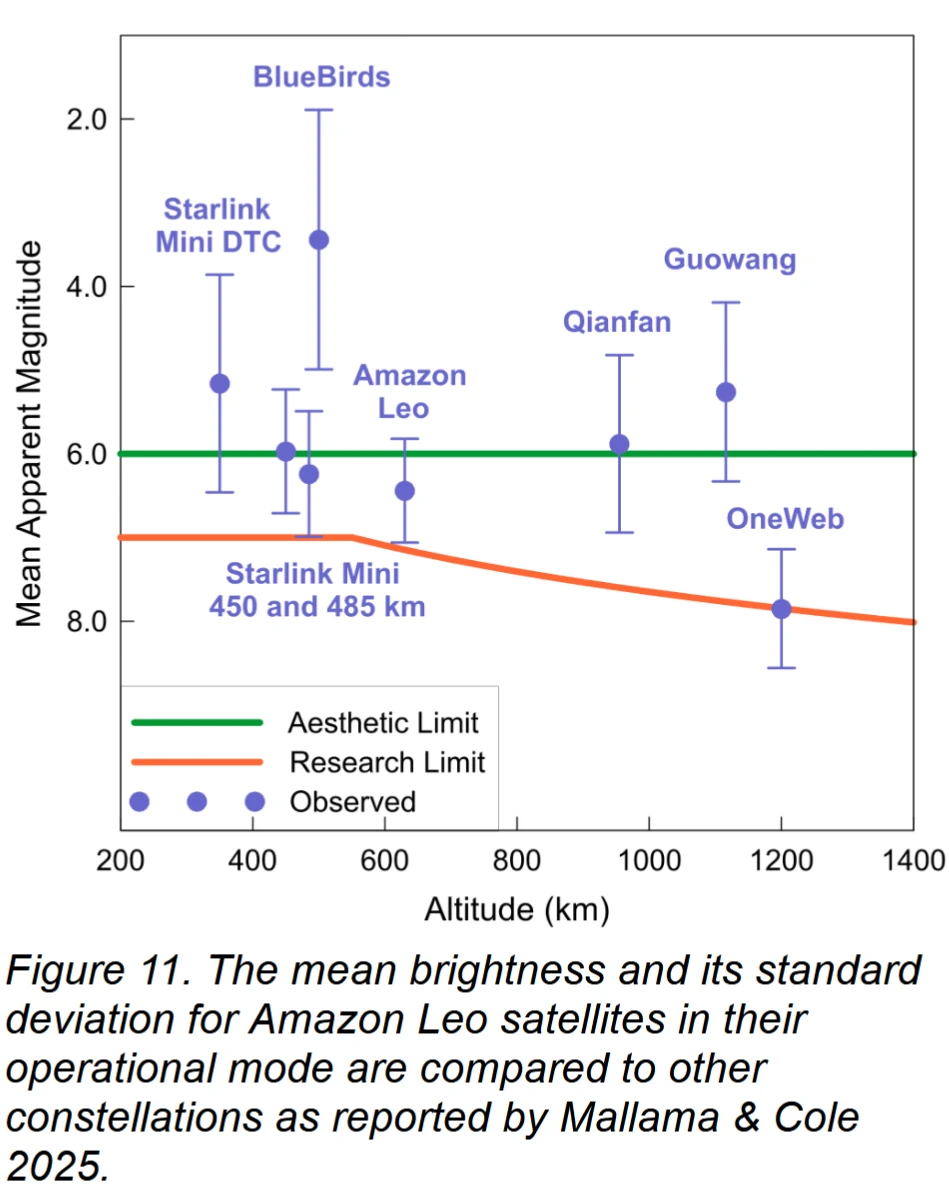
According to the new study, which used data collected from nearly 2,000 observations of Amazon’s new satellites, the brightness distribution of satellites at 630km was compared against the IAU’s recommended limits. “For satellites in their operational mode, 92.0% of observations exceed the research limit, while 24.7% exceed the aesthetic limit,” said the study.
The aesthetic limit reflects a Magnitude of 6 (i.e. objects that can be seen at locations where the sky is minimally affected by light pollution). You can see how the various constellations compare below.
Advertisement
Study Conclusion
The mean apparent magnitude of all Amazon Leo satellites is 6.28 based on 1,938 observations. For spacecraft in their operational mode, 92% exceeded the IAU brightness limit for interference with research, while 25% distract from aesthetic appreciation of the night sky.
The reflective characteristics are similar to Version 1 Starlink spacecraft. Both strongly scatter sunlight forward and backward. Based on private communication, Amazon is working on reducing satellite brightness.
The Amazon Leo constellation spacecraft are potentially impacting astronomical research and aesthetic appreciation of the night sky.
Brightness statistics for all major satellite constellations are kept up to date at our website, https://satmags.netlify.app/ .
At present this is less of a concern because Amazon has only launched 180 satellites, but it becomes more of a problem once thousands are up in the sky. For its part, Amazon Leo says they’re working with astronomers to help reduce the brightness problem, which has included “applying a custom dielectric film and non-reflective coating on all of our operational spacecraft,” said a spokesperson (credits to PC Mag). But by the sounds of it, this is already present on their existing satellites. Suffice to say, more changes may be required.






Mark is a professional technology writer, IT consultant and computer engineer from Dorset (England), he also founded ISPreview in 1999 and enjoys analysing the latest telecoms and broadband developments. Find me on X (Twitter), Mastodon, Facebook, BlueSky, Threads.net and Linkedin.













« Common Wholesale Platform Sells UK Assets and Brand to Digital Destiny

















I know it will never happen, but it is a shame that we just don’t have one network up there and then the others use it, instead of sending a load of crap up there like they are doing now.
The problem would be who would run the network, and it would have to be a non-profit-making company.
As I said, sadly it will not happen, with Musk and others wanting more and more control, hopefully they will start smashing into each other.
Long operating supplier Inmarsat started operations as just such an entity.
What is needed to control the sprawl is taxation of orbital space (similar to charging for airport slots). Geostationary over a country? That country gets to levy a tax. Non geostationary or geostationary over water outside of maritime economic zone? UN should levy a tax to part fund UN budget.
Humanity owes an astonishing amount of technological advancement to astronomy old and new: the ability of satellites to be up there at all relies on essential discoveries from astronomy from hundreds of years ago right up to the modern day. The speed of light being a speed at all, orbital science, proof of relativity, stuff that makes GNS and GPS work to millimetres not miles… the list goes on.
At the time, all those discoveries seemed like boffinry; the incredible future advances were not yet visible.
For Kuiper (and ×thers) to drive for profit over progress —stuff your kids’ futures, I’m making my money now— is a stain.