Netgem TV Drops UK Price of PLEIO Freely Streaming Box Back to £99
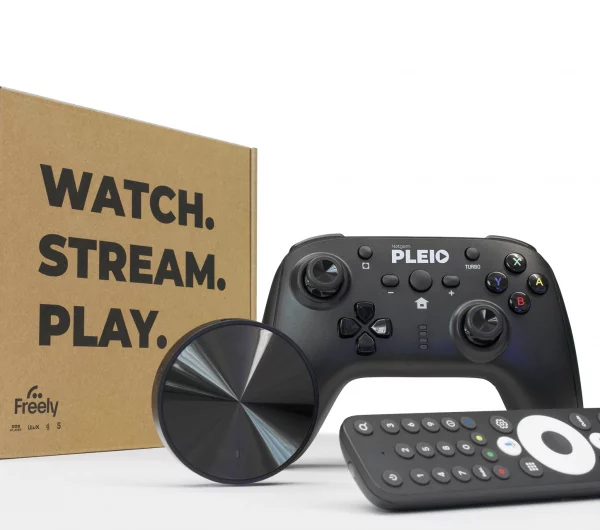
Digital entertainment platform Netgem TV appears to have responded to British company Manhattan TV’s recent launch of Aero (here), which is a budget friendly (£69.99) 4K set-top-box that supports the new broadband-based live TV streaming service – Freely, by dropping the price of their own rival PLEIO box back from £ to its original launch price of £99.
Until a few short months ago there weren’t any streaming set-top-boxes with support for Freely, but over the past few months we’ve seen a bunch of new kit enter the market, including at the premium end with the Humax FHR-6000T (Aura EZ 4K Freely Recorder) for £249.
By comparison, neither Netgem TV’s PLEIO (retail via Amazon – affiliate link) nor Manhattan TV’s Aero are designed to fully record TV shows. Both are fairly standard but capable set-top-boxes with Freely support, while the PLEIO also ships with the added bonus of 12 months subscription to their premium content service (you don’t have to keep the subscription after it ends); this normally costs £9.99 per month. The PLEIO subscription includes access to 250+ Cloud Games and 150+ extra channels.
Advertisement
Netgem TV previously had to raise the price of PLEIO due, we understand, to issues with the rising cost of RAM (system memory) and other components. At the time of writing, RAM costs remain high and yet the company has now been able to drop their price back down to £99 and while still retaining the inclusive subscription offer. This is said to be part of a special “Valentine’s offer“, but it could also be seen a response to competition.






Mark is a professional technology writer, IT consultant and computer engineer from Dorset (England), he also founded ISPreview in 1999 and enjoys analysing the latest telecoms and broadband developments. Find me on X (Twitter), Mastodon, Facebook, BlueSky, Threads.net and Linkedin.










« O2 UK and Ontix Enhance 4G and 5G Mobile Network Capacity in North Wales

















Is there an official reason not to just make Freely available as an app on existing devices?
I can speculate sure, but I’m curious about any officially stated reason.
I was thinking the same. If they want people moved over to Freely by the early 2030s, surely getting out to an Android, iOS & webOS would be a good way to gain quicker adoption.
There has usually been a vague reference to the need for specific hardware in order to support Freely’s modern features, although they’ve rarely been specific. Some issues of exclusivity may also be at work.
Old school thinking involving device whitelisting, manufacturers paying licensing fees, and the content owners not paying for their own development. It’s why there are still TVs coming on the market that lack a random app like Channel 4 or, occasionally, iPlayer.
@Alastair
That would be my guess along with copy protection concerns, but I was curious if there is anything officially stated, especially if there is actual technical reasons I may not know of like Mark talks about.
Current business model, the next step will be either an app or administration.
Might also be some clumsy attempt at geofencing too.
Freely is not available on mass-market streaming devices like Fire TV or Roku, and that’s completely by design. The PSBs (BBC, ITV, Channel 4 and Channel 5) spent years distributing their services as apps inside other peoples’ ecosystems, where they were just more apps competing for attention and subject to platform rules. That meant limited control over prominence, user experience, advertising and future strategy.
Freely changes that. Free from platform restrictions, it gives the PSBs a unified EPG, a broadcaster-controlled environment for dynamic FAST channel line-up changes and ad-supported monetisation and — crucially — a guaranteed prominence layer. In effect, it’s the IP successor to Freeview rather than just another streaming app.
That also explains why some TV manufacturers — mainly at the budget end — were quick to collaborate with Freely. Unlike Samsung, LG or Sony, they don’t run their own TV platforms and instead rely on third-party systems such as Android TV or TiVo, with all the limitations that brings. Freely gives them a ready-made, PSB-approved live TV platform that aligns with Ofcom expectations, avoids app-store negotiations entirely and clearly differentiates their TVs from the sea of generic Android TV devices.
@Roger_Gooner I expect you are right but if they want to turn off the transmitters they’ll have to make an app eventually. If Freely is not ubiquitous they’ll never be able to turn off the terrestrial broadcast system. Not many are going to buy a special box just for Freely.
Millions of people did exactly that for Freeview.
Yeah but analogue to digital was a very different situation. Freeview was offering a big carrot with way more channels and better picture quality over analogue. Freely offers nothing over Freeview and in some ways is worse (although can be fixed). Most people already have smart boxes and/or smart TVs with Freeview available through an aerial so there’s few reasons to buy a specialist box for Freely. Analogue was not switched off until basically everyone already had digital. So how is Freely going to achieve the same mass adoption in order to be allowed to switch off the digital transmitters? They will have to make an app. IMO they will eventually get designated by Ofcom as being required to support a full range of devices as they have done with the PSB apps.
Is there an official reason not to just make Freely available as an app on existing devices?
=> I think that one of the official reasons is that this type of hardware screens much better against streaming piracy (movies and games)!
@john_r: The government is not going to turn off the transmitters any time soon as Freeview is regarded as fundamentally important for free access to television for millions of older, disabled and low-income households, and bear in mind it’s much more reliable in bad conditions which can cripple fixed or mobile networks. Also bear in mind that these people do have voting power and campaign groups on their side.
However there is certainly a market for a cheaper Freely device and Cord Busters reported in 2025 that “BBC has confirmed to Cord Busters that they’re exploring something completely different – a separate, simplified Freely device designed specifically for people who find modern streaming technology overwhelming.” So, what will such a device provide? Not much by design, little more than a menu, EPG with live Freely channels plus catch‑ups from apps of PSBs, UKTV Play and possibly STV Player in Scotland. So, no Netflix, no Prime Video, no Disney+, etc.
I expect the device to run embedded Linux and PSB-controlled middleware which will almost certainly be a cut down variant of Freely OS (so no Android TV like Netgem’s Pleio), and the remote will be simplified. The device itself will be a puck about the same size of Pleio and have only Wi-Fi (so no Ethernet port).
The retail price will likely be £39.99 minimum and up to £49.99 from major retailers, but possibly subsidised to £20-£30 from councils, Age UK and similar charities and housing associations. In short, most who have broadband will be able to get Freely by a variety of TVs, boxes and pucks.
You also said “Freely offers nothing over Freeview”. Actually what is happening is the exact opposite: most live TV channels inside the next five years will migrate to FAST (Free Ad-Supported Streaming Television) channels, leaving only the main channels (BBC One, BBC Two, ITV1, Channel 4, Channel 5), live news and major sports and smaller niche ones. And as a sign of the times Channel 4’s 4Life, 4Homes and 4Reality launched exclusively on Freely (so not on Freeview or the Channel 4 app) and will either remain on Freely for a long times (likely) or be available also on Channel 4’s app on catch-up (less likely).
I would say the problem is more political than technical. The manufacturers producing Freely TVs are only going to be squirting custom firmware into a standard chassis. They aren’t likely to be making custom hardware for a relatively small market like the UK.
why is the PLEIO Puck not available for sale on Currys?
One of the official reasons is the hardware’s screening against streaming and game piracy.
The availability of a dedicated box from a recognised brand for £69 surely kills off the idea of paying £30 more to play cloud games. It didn’t work for Ouya in 2013 (I bought one of those to have an Android box connected to my bedroom TV back in the day), didn’t work for Google’s Stadia, and won’t work for the Pleio.
I will be waiting for the Manhattan, Currys lists it as out of stock & and it is yet to appear at Amazon or John Lewis. Unless you want the games it seems the far better option.
@Alastair: I have to disagree. For starters Netgem is a well-established and reputable box maker, and is most certainly recognised by those who matter – its customers like ISPs and Everyone TV.
There isn’t a comparison between Ouya and Pleio as Pleio isn’t a games platform – it’s a cloud-gaming endpoint. Ouya failed because it needed developers to build games, users to buy them and a store to succeed. Pleio needs none of that as the games already exist in the cloud and its gamepad is ready to work immedaitely as it auto-pairs with the puck. So, no downloads, no installs, no patches and no console updates.
There also isn’t a comparison between Stadia and Pleio as Stadia was targeted high-end gaming needing ultra-low latency, high bandwidth whilst Pleio is for casual gaming needing normal latency.
In other words Pleio is a TV platform with optional gaming and with a £30 price difference between Pleio and Aero, it’s reasonable to assume that much of the premium is for Pleio’s bundled wireless game controller – which looks pretty good value to me.
Look what is offered:
“Unlock 12 months of the PLEIO subscription — and get the Freely-enabled PLEIO Puck included at no extra cost.
PLEIO brings you all the Freely features, and access to the Google Play Store, for all the streaming apps imaginable.
==> Access to Freely does not require any subscription and is always freeeeeeee.
==> The PLEIO subscription (12 months included) brings you 150+ Extra Channels and 250+ Cloud Games with no console required.
They’ve even thrown in a wireless gamepad.
It works on the TV you already have. Plug it into any HDMI port in any room to access a full entertainment experience. No aerial needed, no complicated installation, no hassle. All you need is WiFi.
More information at pleio.tv”
Still too much need to be £50-£60
“This is said to be part of a special “Valentine’s offer“, but it could also be seen a response to competition.”
Well, at the moment @ freely.co.uk/products/streaming-devices/netgem-pleio-4k-puck,
they say that “VALENTINE’S OFFER: £99 ENDS 16/02/2026”!