Openreach Trial Trenchless Drilling Robot to Boost UK FTTP Broadband Build
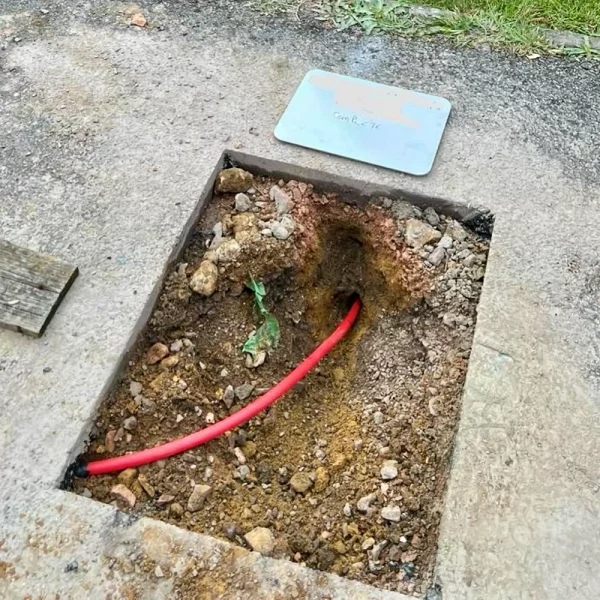
Network operator Openreach (BT) has revealed that they’re conducting trials of a new “advanced robotic … space-age” trenchless drilling technology, known as MicroBORE, to help accelerate their ongoing rollout of Fibre-to-the-Premises (FTTP) based broadband ISP lines across the United Kingdom. It could also cut civil engineer costs and reduce disruption.
The system, which is claimed to have originally been “designed for lunar and Martian exploration“, was developed through a 5-year collaboration between BT Group, UK-based engineer firm Synthotech and the University of Surrey to translate space research into real-world infrastructure innovation.
The robotic MicroBORE is designed to bore narrow channels beneath pavements and driveways, allowing fibre optic cables to be laid from the main duct to residential premises “without the need for traditional open trenching“, which is of course the most expensive and disruptive part of underground street works. But preciously how much “faster” and more cost-effective this is than traditional methods remains unclear (that’s what the trials are for).
Advertisement
There is also potential for long-term savings from reduced restoration and traffic management costs. In dense urban areas, where traditional methods would require road closures and extensive digging, MicroBORE can drill from one small access point to another, threading fibre cables beneath roads and pavements. By avoiding large-scale excavation, MicroBORE also helps preserve green spaces and reduce carbon emissions.
Violeta Novakovic, BT Research Manager, said:
“Through our partnership with Synthotech, we’re taking cutting-edge engineering and applying it to one of the UK’s biggest infrastructure challenges. The MicroBORE could be a game-changer for Openreach by enabling faster, greener, and less disruptive fibre installations that benefit customers and communities nationwide.”
Simon Langdale, Engineering Director at Synthotech, said:
“The new drilling technology will significantly reduce the cost and accelerate the execution of key civil engineering tasks. This is a hugely exciting application of advanced robotics that will completely transform how underground fibre connectivity is managed and delivered.”
The scale of civil engineering required in areas lacking existing duct infrastructure is substantial and Openreach, alongside the developers of this new technology, are currently seeing if they can prove that the new technology can be made to work at scale. Testing at BT’s R&D centre in Suffolk is said to have already confirmed the system’s “operational viability“.
Assuming all goes well, then we could also see MicroBORE being adopted to support other sectors that require low-impact underground access, such as for the deployment of electric vehicle (EV) charging and utility connections. At present, we don’t have any other pictures or videos of the new robot, but we are trying to locate some.






Mark is a professional technology writer, IT consultant and computer engineer from Dorset (England), he also founded ISPreview in 1999 and enjoys analysing the latest telecoms and broadband developments. Find me on X (Twitter), Mastodon, Facebook, BlueSky, Threads.net and Linkedin.











« New Cyber Security and Resilience Bill Introduced to UK Parliament












“Space-age” = 1970’s
How very boring.*
* This pun was bought to you by the Pun Marketing Board. Other tunnel-based puns are available.
At last! An actual trial that is valid, rather than pointless because everyone else has deployed it. Validity in a trial for this.
Hopefully this will enable BT to tackle the not spots
History repeating its self. They made the mistake of laying copper cables direct to the ground 50 years ago. They are doing it again. Other utility companies or private individuals digging expecting to hit a duct before the cable. But instead the cable gets damaged. Not to mention earth moved that will damage the fibre first instead of the duct. Short term saving , with a long term costly problem.
It’s possible they could install a small diameter duct and then pull the fibre through that but I suspect that you’re right. After all, spending money today to save a few bob 50 years from now when the shareholders want results in this quarter just doesn’t make sense. Cynical?* Me?
*Cynical definition; an acute view of reality.
No, this is not direct buried cable. It’s micro duct that the fibre is blown through. The fibre can easily be replaced.
Surely they would use a duct liner, such as the type used in plumbing to re-line a water pipe behind the bore.
Openreach installs round here have a ~10mm duct and the fibre cable inside it.
Niche ideas always bite you on the bum further down the road. Keep it to either poles or traditional ducting its the best way to supporting the infrastructure in the long run.
You mean they’ve discovered moling 50 years after everyone else?
Exactly what I was thinking
That is okay as long as there is nothing in the way, like say gas or water pipes. They dig through them when digging a trench, so not being able to see where they are going could make things worse.
We will see, but yes, in theory it is a better idea if it works.
Others have mentioned the actual boring part is old tech so there must be something significantly new about this. Maybe it is the capability to detect and route around obstructions?
I wonder if this poses issues for the “competition” who rely on Openreach PIA to do the hard work for them. I presume these microducts would by definition have no space for them to fill up with duplicate infrastructure.
Not that this should come into it of course, but I look forward to the “competition” demanding that Openreach use proper ducting…!
I was thinking along similar lines. If the microbore duct is not suitable for PIA sharing, it could make more direct-in-ground areas commercially viable without installing poles.
In DIG areas where there is no competing service, the current commercial incentive is for Openreach to do nothing and maintain 100% market share. If they build expensive new ducts, they risk an altnet or nexfibre using them without paying a proportionate share of the cost. Openreach could end up with lower revenue despite paying for the work to be done. Building microbore lead-in ducts that can’t be shared would solve that part of the problem.
BT Ivor, BT/Openreach do get paid by other ALTNETS for PIA, and it’s not cheap……
We had our gas meter moved in 1985 and they dug 2 holes and mole bore between the 2 holes and pushed the yellow pipe through. That was 40 years ago! Cutting edge stuff!!!
Moles have been around for a long time, problem is when you hit a big stone or some other obstacle. The water companies use moles regularly.
Here’s a video of a similar technology in use.
https://www.youtube.com/watch?v=DwsXGwGONh8
It’s from 2014 for people worried about a ‘niche’ technology and for obvious reasons it has to use a duct of some sort. This is an evolution and a very clever one. Great to see the research of a British university productised by a British company.
I used to deliver training on thrust borers (Grundomat) in the late seventies
Dig 2 holes. Aim and fire off grundomat. Dig third hole when you hear it hitting the house foundations.
BT open reach might well have an ambition to extend fibre broadband to 30m households by 2030…but they might start by giving me a target date for my rural property.
“No current plans” is as precise as I can get.
Mark Sells, Warboys, Cambs
This isn’t space-aged or niche. This is how I had FTTH installed 10 years ago when I lived in Germany.