Telesat’s Lightspeed satellites to provide automated backup for subsea cables
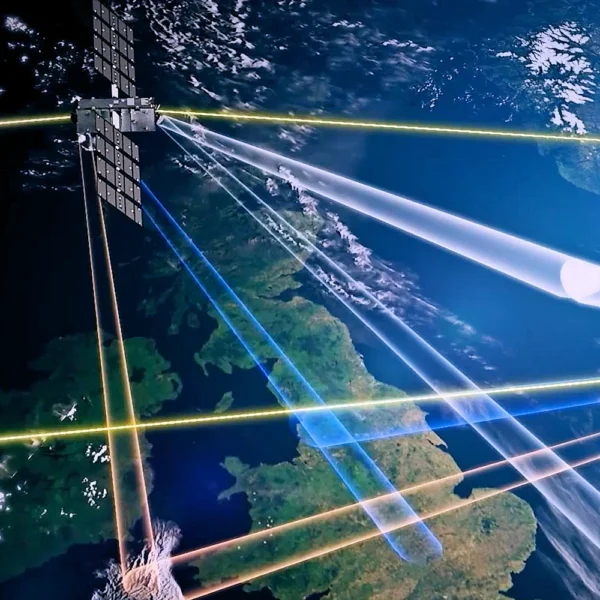
The European Space Agency (ESA) has chosen satcom specialist neXat to lead a new €1.5m (£1.28bn) project that aims to create an automated satellite backup (failover) for when submarine fibre optic networks suffer outages (cable breaks). The new system will be supported by Telesat’s future Lightspeed constellation of ultafast broadband satellites in Low Earth Orbit.
The idea of using satellite as a backup for such connections is nothing new, although the extremely high data capacities of modern subsea fibre lines often meant that this could only be done to an extremely limited degree. Not to mention the high increase in latency times, which were a serious performance impediment via older satellites in higher orbits (GEO).
The reality today is that satellite backup tends to be less of an essential requirement, due to the above performance caveats and the fact that it’s often better to just relay traffic across alternative fibre routes. Nevertheless, situations still arise where such a capability would be desirable (e.g. not every location or service has access to alternative subsea fibres), which is a gap that the new project aims to fill.
Advertisement
The development of neXat’s new system, called CableShield, will be carried out and funded under the Space Systems for safety and Security (4S) programme, within ESA’s Advanced Research in Telecommunications Systems (ARTES) programme. This is to be supported by satellite operator Telesat and Colt Technology Services, which will work to design, build and field-demonstrate a system that “detects submarine cable interruptions and switches affected traffic to satellite connectivity without manual intervention“.
CableShield will tie together three layers of infrastructure through a common framework, rather than relying on a single vendor’s network, involving Detection and decision layers, as well as Terrestrial and Satellite control layers.
Caroline De Vos, COO of neXat, said:
“Submarine cables carry an estimated 99% of global connectivity, so when they go down, entire regions can lose access instantly, disrupting business, public services and other critical communications. Satellite provides the lifeline that keeps essential services online when their primary connectivity is gone. Having a dedicated multi-orbit platform like neXat’s ensures service providers can access and manage backup connectivity effectively when it is needed the most.”
The satellite platform for this is expected to involve multiple satellite providers in a so-called “Pooling & Sharing” mode. In the event of an interruption, the platform would select and allocate the necessary resources by interfacing with pooling and sharing mechanisms, and reroute a “controllable, scalable subset of data” over the selected satellite capacity. This will be achieved by establishing an end-to-end connection with appropriate routing and traffic prioritisation protocols.
The future Lightspeed constellation from Telesat, backed by more than $4bn in committed funding, is expected to help feed all this. Telesat are in the process of building a fleet of 225 satellites in Low Earth Orbit, which are designed to deliver secure and resilient broadband connectivity services in both commercial and military Ka-band (Mil-Ka) frequencies. The satellites also support modern features, such as optical laser links (ISLs).
Advertisement
CableShield is currently operating on an 18-month development and validation programme ahead of a targeted commercial launch of the backup service in 2028, which roughly aligns with the commercial availability of Telesat’s new network. Telesat are expected to launch their first LEO satellites on SpaceX Falcon 9 rockets at the end of this year and their network should be ready by the end of 2028.






Mark is a professional technology writer, IT consultant and computer engineer from Dorset (England), he also founded ISPreview in 1999 and enjoys analysing the latest telecoms and broadband developments. Find me on X (Twitter), Mastodon, Facebook, BlueSky, Threads.net and Linkedin.



















Privacy Notice: Please note that news comments are anonymous, which means that we do NOT require you to enter any real personal details to post a message and display names can be almost anything you like (provided they do not contain offensive language or impersonate a real person's legal name). By clicking to submit a post you agree to storing your entries for comment content, display name, IP and email in our database, for as long as the post remains live.
Only the submitted name and comment will be displayed in public, while the rest will be kept private (we will never share this outside of ISPreview, regardless of whether the data is real or fake). This comment system uses submitted IP, email and website address data to spot abuse and spammers. All data is transferred via an encrypted (https secure) session.