  Bright shafts of warming sunlight streak through the leaves of a nearby tree, swaying only slightly amid a soft summers breeze, surrounded by lush green meadows and the calming scent of morning dew that nestles almost poetically against a sea of glistening grass matched by the clear blue sky above.
A content smile carves its way across your face, but as you glance down the smile fades. That YouTube video stream you started 5 minutes ago still hasn't begun and you're only half way through sending an email with last week's office work attached. Sadly BT's 2009 data estimated that slow internet access is still a way of life for approximately 2 Million UK households (7%), where broadband ISP speeds of at least 2Mbps have yet to reach; Elsewhere Ofcom's own 2009 data suggested that the figure could actually be closer to 15%. It's also a common misconception that issues like this should only be confined to the green and pleasant land of our British countryside. In realty many suburban areas and bustling towns can and often do suffer from similar problems. These are typically areas where the old telecoms infrastructure of copper and aluminium wire, which is still predominantly owned and managed by BT, have a hard time keeping pace with the latest technological advances.
The reasons why some areas get good broadband and others not are many and varied, which is complicated by the patchwork of different UK telecommunication operators and their competing infrastructure solutions. Areas like those described during our introduction are also far more susceptible to any issues inherent with living at the furthest reaches of your local telephone exchange. 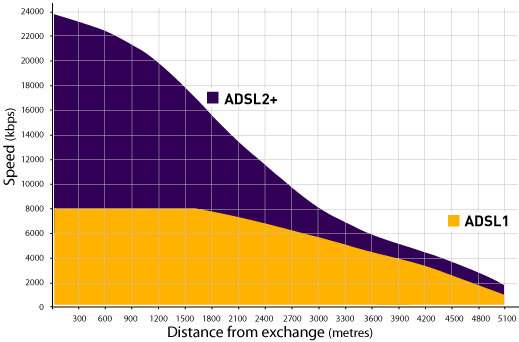
For example, the most common form of broadband delivery, over existing telecoms infrastructure, in the UK is still Asymmetric Digital Subscriber Line (up to 8Mb ADSL or 24Mb ADSL2+), which effectively splits your telephone line into separate voice and digital data channels. However the laws of physics and signal degradation (interference) often combine to mean that any ADSL line longer than 6.5 Kilometres (km) is unlikely to receive a good speed or stable service, assuming you can even get a connection in the first place (some people live too far from their local telephone exchange).
Sometimes even those who live near to their exchange cannot get a good broadband speed because the copper or aluminium telecom wire loops around so much that the real length ends up being significantly greater than the straight line distance from your home/business (premises) to the exchange. This can also result in slow connection speeds, as can poor home wiring. There are other causes too but our focus today is primarily on infrastructure. Smaller communities can also be left at another disadvantage due to simple economics of scale and issues of taxation. As commercial companies, the big operators would only have a minimal incentive to invest in such areas. It could end up costing hundreds of thousands of pounds to upgrade broadband services for tiny communities where any return on such a significant investment would be very difficult to achieve. 
|