
- Fixed Line Narrowband
- Fixed Line Broadband
- Wireless Broadband
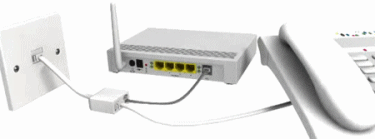
ADSL offers speeds of up to 8Mbps (Megabits per second) downstream and 448Kbps upstream (832Kbps on business lines). The technology is cheap, fast and easy to install (doesn't require an engineer) and reasonably reliable, although performance can suffer due to ISP congestion, distance from the local exchange (shorter lines are faster but anything over 6.5km is usually slow), poor home wiring and interference from other electrical devices. Each connection is fixed to a specific telephone line.
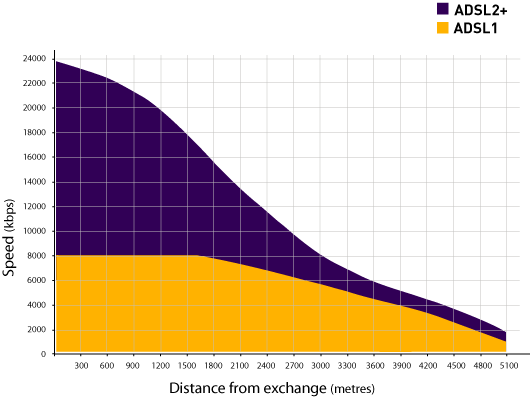
The latest ADSL2+ (ITU G.992.5) technology is capable of pushing download speeds at up to 24Mbps and uploads at up to 1.4Mbps, it also supports port bonding (linking several lines together for faster speeds) and has an improved range over ADSL. Both ADSL and ADSL2+ are "best efforts" broadband services, which means that bandwidth is shared between many users and can be highly variable - especially over long distances and at off-peak times (i.e. busy afternoons will slow the performance). The following graph shows what impact distance can have on speeds.
Users of these services should learn to understand common router statistics, which can help in diagnosing line problems. Figures for the following items will change depending on your line condition (e.g. expect them to be worse during thunderstorms that will cause extra interference):
ADSL/ADSL2+ Router Terms and StatisticsElsewhere some businesses still use Symmetric DSL (SDSL) technology, which is similar to HDSL via a single twisted-pair wire and can carry 1.544Mbps (U.S. and Canada) or 2.048Mbps (Europe) in each direction on a duplex line (the speed is the same in both directions). In addition, those looking for information on VDSL and VDSL2 (FTTC) services should look under our Hybrid-Fibre section above as this is somewhat of a mixed technology.* Line Profile / Sync Speed
This is the speed (usually in Kbps) at which your router connects to the local telephone exchange. The actual performance of your line will usually be around 20% less than this, possibly even lower due to ISP-side limits or environmental factors (e.g. interference from Christmas tree lights, microwaves and AC adaptors).* Line Attenuation (dB)
High attenuation usually means you live further from your local exchange, thus lower is better (e.g. an attenuation of 60dB might give you a best speed of around 2Mbps).* SNR / Signal to Noise Ratio (dB)
A high SNR usually means that faster speeds are possible and upgrading to a faster connection will often cause the SNR to drop. SNR can be improved by installing a special filtered faceplate on the line, such as BT's iPlate (Broadband Accelerator) device (not to be confused with Splitters / MicroFilters).* SNR Margin (dB)
Related to the SNR above, an SNR Margin is a measure of the difference between your current SNR and the SNR that is required to keep a reliable connection speed. SNR Margins tend to range from around 6db to 12db, with higher being better. The figure will fluctuate during the day, especially at peak times. Note that significant fluctuations (e.g. going from 8db to 4db) may cause connection problems. It is sometimes possible to tweak this figure and keep it higher, depending on what make of router you have. Using your homes mastersocket for the broadband router is also helpful.
Furthermore BT has also introduced a special long-reach style of DSL called Broadband Enabling Technology (BET), which is based off Symmetric Hi-Speed Digital Subscriber Line (SHDSL). This is designed to deliver speeds of up to 2Mbps into rural areas that can reside up to 12km away from their local telephone exchange, where normal DSL services would fail. But this method is extremely expensive (costing up to £1,094 +vat to install), poorly supported by ISPs and requires two phone lines (twisted pairs) to achieve the best performance.
- Cheap services.
- Good ISPs offer high speed and low latency.
- Strong coverage.
- Well supported.
- Variable service quality from many UK ISPs.
- Switching ISP can be confusing due to different platforms.
- Complicated to troubleshoot.
Related ISPreview.co.uk Content:
* Broadband ADSL2 ISP Listings
* Broadband ADSL2 ISP Reviews
* Broadband Fixed Line Discussion Forum
* Broadband Coverage Checker
* GUIDE: ADSL Broadband Internet Connection Tips and Tweaks
* GUIDE: How to Choose a Broadband Internet Provider




Latest UK ISP News





Helpful ISP Guides and Tips







- FTTP (6621)
- BT (3833)
- Politics (2991)
- Business (2689)
- Openreach (2589)
- Building Digital UK (2469)
- Mobile Broadband (2400)
- FTTC (2126)
- Statistics (2079)
- 4G (2038)
- Virgin Media (1962)
- Ofcom Regulation (1729)
- 5G (1655)
- Fibre Optic (1569)
- Wireless Internet (1561)