Latest UK ISP Reviews
 |
Youfibre (Hadley) | Broadband Fixed Line | By: Hadley | 
|
 |
Community Fibre (mlika) | Broadband Fixed Line | By: mlika | 

|
|
Youfibre (BeethovensHairdo) | Broadband Fixed Line | By: BeethovensHairdo |
|
View: Top 10 ISPs | Review Your ISP
See our '
Best UK Broadband ISPs for 2025
' guide for help choosing an ISP.Most Popular UK ISP News (Week)



Cheapest Big ISPs for 100Mbps+


Latest UK ISP and Telecoms News

8th Apr 2026 (0 Comments)
The UK telecoms regulator, Ofcom, has today provisionally found “reasonable grounds for believing” that wireless broadband operator IX Wireless (supported by UK ISP 6Gi / Opus Broadband) broke its rules by failing in its duty to minimise the visual impact of a 15-metre metal mast / pole when it was installed in Rochdale during 2023.

8th Apr 2026 (2 Comments)
Network kit manufacturer Zyxel has revealed that UK network operator Openreach (BT) have now installed 500,000 of their “green” Optical Network Terminals (ONT / ONU), which forms part their ongoing deployment of gigabit speed Full Fibre (FTTP) based broadband ISP technology. The new ONTs use re-engineered casings made from 95% recycled plastic.

8th Apr 2026 (3 Comments)
Internet video streaming provider Disney+ has announced that ESPN’s sports TV content has now becoming available to their UK subscribers, as well as in a further 52 other countries (i.e. extending total availability to 100 countries).
Advertisement

8th Apr 2026 (1 Comment)
Q3. Speaking of pricing, we note that one of the challenges Wessex Internet may be facing is the rising level of competitive overbuild by rival networks, primarily the incumbent player of Openreach.
How much of a problem is this and what sort of approaches are you taking now, or considering for the future, in order to counter it (e.g. consideration of cheaper pricing in the future, faster build, marketing strategies etc.)?
Hector said:
Our network is concentrated on rural communities and so we’ve historically seen less overbuild than others often face in larger towns and cities.
Openreach are the most likely competitor in our area given their existing footprint and the existing fibre footprint from FTTC programs. However, this doesn’t make them immune from the challenges of old and fragmented rural PIA and the costs of overlaying fibre in their direct buried network. Our build methods lend us to being able to deliver new networks in those areas effectively and as a result we still believe our footprint is differentiated from even Openreach in our area.
Overbuild shouldn’t be ignored, but we believe our reliable product with excellent service from a friendly local team is a differentiator even where we do have overbuild. We know these core requirements resonate with many of our customers who have previously felt let down by the service they’ve received from incumbents.
We are confident in our pricing, and it is something that we will always review to ensure that customers pay a fair and competitive price for their broadband. The reasons why customers switch to Wessex Internet (reliability, great product and customer service) remain at the core of our business model and we will always prioritise the customer experience.
Q4. I guess we can’t talk about the current climate without touching on the tricky question of consolidation. Does Wessex Internet now see itself more as being an attractive prospect for being consolidated by a bigger fish, or are you likely to focus on remaining independent while potentially raising fresh investment as interest rates come down – perhaps even doing a little consolidation of your own?
Hector said:
Wessex Internet is a strong, independent local business with roots firmly in the Dorset countryside. Being in an expansion phase with funded plans to complete our projects we feel less pressure or reason to consolidate than others might.
We’ve seen an acceleration of consolidation activity in the industry recently which I think is a good thing for rationalising the sector and creating fewer, stronger businesses. For many alt nets, scale is key in their plans and consolidation is the right next move, especially where pressure is placed on the business to reduce costs and commercialise a stable network footprint. It will be interesting to see how current deals play out and start to steer the industry over the coming 18 months.
Our independence allows us to keep our current focus on building a high-quality network in difficult, remote areas.
Q5. By the time people read this, it’s possible that Ofcom may have published their latest Telecoms Access Review 2026 (TAR), which will look to make changes that “promote competition and investment” in gigabit broadband and business connectivity. As such, I wonder what your thoughts are on the regulator’s draft proposals from March 2025, particularly what you think they got right and where you think it could be improved?
Hector said:
We welcome the support and ambition of Ofcom in the TAR 2026 especially with regards to maintaining the current regulatory framework to support the industry investment in gigabit capable broadband and reducing the digital divide. We’re also supportive of Ofcom’s recognition that switching off copper will be surrounded with challenges, and in many rural communities, it could have the biggest impact – therefore managing the transition is vital.
Irrespective of the success of individual Altnet’s themselves, the pressure that they have added in the market over the last decade has delivered enormous value in forcing Openreach to roll out more aggressively and cheaper, with far less government support than was needed under Superfast contracts. This has delivered huge benefits to consumers of Openreach services before you even look at the benefits to customers of Altnets. This regulatory stability recognises that enormous market benefit and is a vote of confidence for the stronger players in the sector, both the niche independents and the consolidation winners, and will help them leverage further competitive benefit for consumers and the Government over the next decade.
Q6. One of the hot topics of this industry surrounds the general need to increase the take-up of full fibre networks. Do you think there’s anything the industry could be doing differently to aid this, beyond any of the points that we might have already touched on above in some capacity?
Hector said:
We’ve definitely seen Altnets up their game over the past year and it’s encouraging to see the progress across the whole sector.
Our approach to achieving our high levels of take-up, which are over 30% on a network wide basis, including properties delivered last month, is to focus on solid engagement with local communities from the beginning of the build, ensuring we ensure we work with them and understand their concerns, frustrations and any community-wide build ‘red lines’ before we start.
This requires an investment in community dialogue but means we aspire to end up with communities that are happy with our build process and are strong advocates of the business before we start installing. This is trickier to do as you scale, and I will put my hands up and say we don’t always get it right. However, in general I think it is a huge part of delivering successful take-up and something others have often overlooked in favour of rollout speed.
Q7. As a rural focused provider, you’ll no doubt be familiar with harnessing a lot of different and sometimes quite novel build methods to help expand the reach of your network. In terms of construction, what are the most effective methods you’ve found for rolling out new fibre into such areas and which ones, if any, have caused you more hassle than desirable?
Hector said:
Yes, our network build is never without its challenges and deeply rural projects often require entirely bespoke planning from start to finish.
The key thing that differentiates our build is we don’t use mole ploughs and directional drills as an exception to traditional methods; they are the core of how we work and often the first point of call. This means we can leverage them incredibly flexibly using our in-house teams, keeping our hard dig to a minimum and reducing the impact on the local highways as we build. This gives us less of a hockey stick in costs as we get to the ultra-rural prems which has been a key to delivering our BDUK contracts within budget.
Our business model has always been driven by rural build and looking right back to the government’s 2017 LFFN program, we connected Cheselbourne Village School as a well-publicised example of their outside-in approach. The school was 14km from the closest point to our network at the time and Wessex Internet have since built out full fibre to virtually every village on that route. It’s a great example of working with farmers and communities to deliver in difficult areas and how an early project pushing our network extent has subsequently been leveraged to deliver enormous benefit to the whole area.
Q8. Staying on the theme of build. Wessex Internet recently generated some positive headlines by becoming one of the first altnets to complete a Government backed contract under the Project Gigabit scheme (here) – specifically the £6m publicly funded contract for North Dorset (Lot 14.01), which extended full fibre into 6,490 hard-to-reach premises. You also hold three more contracts like this, which are much bigger and due for completion in the future.
Aside from no doubt being very pleased with the outcome, this was also achieved during a period when much of the industry is under economic significant strain. The current environment has already resulted in a few other altnets dropping out entirely from similar contracts or scaling-back their deployments.
In terms of delivering such complex and challenging contracts, both on-target and on-budget, what advice would you have for other network operators that may currently be in the process of taking on the delivery of such contracts for the government?
Hector said:
My key advice for any of company that is that you should only bid for BDUK funding because you want the coverage but it would be uncommercial without support, rather than because you want the funding.
Whilst the funding seems attractive, if the company doesn’t want the coverage, or isn’t geared up to manage the complexity of delivery in that particular geography, then the stringent conditions of the funding will become a distraction and controlling costs is likely to be difficult and painful.
Our roll outs are not without challenge, and we have always aimed to work openly with BDUK about the risks we face and how we are progressing, this two-way dialogue not only enables us to keep them informed on our operational progress but also allows us to remain flexible to the contract changes driven by the OMR process. Each contract is unique and carries its own unique considerations that you should understand before bidding. We pay very close attention to the geography of the area before we bid, and I think that has enabled us to have a deliberate target area that we know works well for our build methods. We didn’t for instance bid for work across the Somerset Levels as it would require a different network configuration and build processes due to the extensive flooding and ditch networks.
On an overall basis we are comfortable with our progress and if there is opportunity for suitable further contracts within our region, we would remain a keen bidder.
Q9. Speaking of civil engineering, the government recently kicked off a new consultation on reforming planning rules, which is seeking feedback on whether they should make further changes to the rules and update policy guidance to help “accelerate the deployment” of digital infrastructure.
The call for evidence identified several areas where further reforms to planning rules may be necessary to support the government’s nationwide coverage ambitions. These policy areas include:
temporary redeployment after a Notice-to-Quit (NTQ)
expanding permitted development rights for larger rooftop infrastructure on protected land
expanding permitted development rights for ground-based masts
bringing fibre-exchanges into permitted development
small cell systems and lifting restrictions on size
updating the Wireless Code of Practice
new build connectivity – mobile
rail connectivity
assessing the impact of previous planning reforms
Do you have any thoughts on this and where you think the government should be focusing most of its efforts, while of course still trying not to upset landowners and communities too much in the process? A difficult area to balance, as recent protests over the deployment of new telecoms poles (vs underground infrastructure) and disputes by landowners has already shown.
Hector said:
Anything that can be done to accelerate processes within build are hugely important and much needed within the industry. We support the ability for companies to move faster in areas where permission is generally given but jumping through the bureaucratic hoops is more onerous than necessary.
Looking to operators, I think there also has to be a balance of responsibility on telecoms companies to engage with local communities and farmers and ensure the work they are doing is in keeping with the local area. I think the MNOs have made enemies of landowners with their forced changes to mast site rental values and it’s something we often hear used as a reason Landowners shouldn’t trust telecoms companies. Overlooking parish councils, landowners and residents rarely ends up working well for companies in the long run. As I’ve said above, we don’t always get it right, but where we have engaged well with all stakeholders we often find it is as instrumental in getting work done efficiently as improved statutory rights are.
Q10. Toward the end of last year the Independent Networks Co-operative Association (INCA) announced the creation of a new Infrastructure Sharing Framework (here), which is intended to make it easier for altnets to share access to the infrastructure they build amongst each other and thus reduce duplication, cut costs and speed up deployments. The move is also designed to complement Openreach’s PIA product, something altnets can already access.
What are your thoughts on this and is it something Wessex Internet plan to harness?
Hector said:
Were always keen to look at ways we can promote infrastructure sharing, particularly in a world where cost is at the forefront of everyone’s mind, there are definitely significant practicality challenges of sharing assets at a small scale and automating processes.
We have had a number of direct conversations about infrastructure sharing and inter-altnet service provisions over the years. Often it has been very manual, with complexities that have meant it’s not worked. Therefore, anything that can be done to standardise the processes is a useful step to unlocking this opportunity.
Q11. Finally, when considering the biggest challenges and opportunities coming down the road, where do you see Wessex Internet being in 5 or 10 years time?
Hector said:
Our biggest opportunity is to continue to build a high penetration, local network that serves rural communities with reliable full fibre broadband.
Our biggest challenge is continuing to get the strategy right. Rolling out at the right cost in the right locations where our customers need us and where communities are being left behind.
My late father and I have always been passionate about the impact the business has in the local area, both on people’s enjoyment of rural life and the ability for people to start and run businesses in rural locations, strengthening the local economy. I hope Wessex Internet continues to deliver on this legacy in our 4 rural counties over the coming decade.
We’d like to finish by taking a moment to thank Hector for agreeing to be interviewed and for providing such useful insights into how Wessex Internet is run and has evolved to cope with today’s many challenges.
7th Apr 2026 (4 Comments)
Network operator nexfibre, which shares some of its parentage with Virgin Media (harnessing the same build teams) and giffgaff, has today followed up the recent announcements for Crawley and Bradford (here) by announcing a further seven UK locations – reflecting a total of 226,000 premises at a cost of £31.7m – that will benefit from an upgrade to their latest full fibre (FTTP / XGS-PON) broadband technology.

7th Apr 2026 (2 Comments)
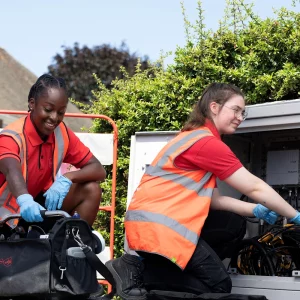
Network operator Openreach (BT), which is busy rolling out their new full fibre broadband network across the UK, claims to have reduced missed engineering appointments and inbound contact volumes by one-third after they adopted proactive AI (Artificial Intelligence) agents from NiCE Cognigy – redesigning customer engagement across some 15 million customer journeys.
Advertisement

7th Apr 2026 (0 Comments)
Kent-based UK ISP Orbital Net (Orbital Internet Group), which operates the Vfast sub-brand that sells broadband packages to consumers via a mix of fixed wireless (FWA) and full fibre (FTTP) networks, has today announced that they’ve acquired a key provider of connectivity solutions to the UK holiday park sector – Leisure Park Internet Solutions Limited (LPIS).
7th Apr 2026 (22 Comments)
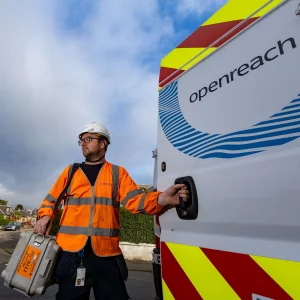
A couple of years have passed since we last published a summary of the key consumer ISP choices for 1Gbps home broadband packages on Openreach’s Fibre-to-the-Premises (FTTP) network – currently available to around 22 million UK homes and businesses. Suffice to say that we’ve today published an updated list and examined how prices have changed.

4th Apr 2026 (8 Comments)
The UK telecoms and internet content regulator, Ofcom, has just increased the payment amounts that are issued to consumers under their automatic compensation system, which requires supporting home broadband ISPs to compensate customers (cash or bill credits) for serious internet connectivity outages and delivery delays.
Advertisement

3rd Apr 2026 (1 Comment)

2nd Apr 2026 (3 Comments)
Network operator TfW Ffeibr (TFW Fibre), which is an arm’s-length initiative setup by Transport for Wales (TfW) and thus the Welsh Government, has today announced that their railway based full fibre broadband and Ethernet network has been extended off the Core Valley Lines train-tracks and into the heart of Cardiff’s city centre – all the way down to Cardiff Bay.

2nd Apr 2026 (14 Comments)
The UK telecoms and media regulator, Ofcom, has today published their annual Media Use and Attitudes 2026 report, which among other things found that the proportion of UK adults without home internet access remains unchanged at 6%. Some 83% of that group are aged 65+ (66% for those aged 75+).
Advertisement

2nd Apr 2026 (4 Comments)
The £85.5m legal dispute between UK mobile and broadband giant Vodafone and a group of 62 current and former franchisees (here) took another turn this week after a High Court judge agreed to split the trial, with both sides appearing to agree that a single trial would have been too “complex and unwieldy”. But the decision may have a cost impact.

2nd Apr 2026 (0 Comments)
The SHiFT Group (Safety & Health in Fibre Telecoms), which was established to improve health and safety practices / standards across the UK’s fibre broadband industry, has informed ISPreview that they will be holding their 3rd annual (2026) conference on 23rd April 2026 at the Heart of England Conference and Events Centre (Meriden, CV7 8DX).

2nd Apr 2026 (2 Comments)
Mobile operator Vodafone (VodafoneThree) has announced that they’ve deployed their fastest 5G Standalone (5GSA) based mobile broadband network (indoors) across Terminal 2 and Terminal 3 Departures at Manchester Airport, while also improving existing 4G and general 5G network coverage. The move should help to cope with busy periods and deliver better performance.

1st Apr 2026 (0 Comments)
The Horsham-based Telecom Acquisitions Group (TAL), which is a holding company for a number of familiar retail UK ISP brands (Home Telecom, Eclipse Broadband etc.), has announced that they’ve just acquired another small batch of 3,000 broadband customers from the remaining part of TalkTalk owned provider Origin Broadband.

1st Apr 2026 (5 Comments)
Following on from this morning’s announcement of nexfibre’s network expansion across Bradford (here), we’ve now spotted that the operator also appears to have announced a similar £6.8m deployment to reach “up to” a further 42,000 premises in the West Sussex (England) town of Crawley with their full fibre (FTTP) network.
Latest ISP Reviews
|
Youfibre (Hadley) | Broadband Fixed Line | By: Hadley |
|
|
Community Fibre (mlika) | Broadband Fixed Line | By: mlika |
|
|
Youfibre (BeethovensHairdo) | Broadband Fixed Line | By: BeethovensHairdo |
|
Top ISP News of the Week
Sponsored Links
Latest Forum Topics

Cheapest ISPs for 100Mbps+


Sponsored Links
Helpful Tips and Guides









Latest UK ISP News




Promotion
Helpful ISP Guides and Tips
Promotion
Cheap Unlimited Mobile SIMs


Latest Interviews




Sponsored
Copyright © 1999 to Present - ISPreview.co.uk - All Rights Reserved - Terms , Privacy and Cookie Policy , Links , Website Rules , Contact