Digital Scotland Lauds Fibre Broadband for 950K Extra Premises

The original £463m (public and private investment) Digital Scotland project with BT (Openreach) is arriving at completion and as such the scheme has today celebrated the fact that it has helped over 950,000 extra premises to access “fibre broadband” (FTTC and FTTP) services (pushing “superfast” 24Mbps+ coverage to 94%+).
The project, which has focused its efforts upon areas that either wouldn’t have been upgraded by commercial projects or might have otherwise had to wait years longer (if left up to the market), also notes that the contract has so far delivered 110,000+ more premises than originally planned (thanks in part to lower than expected costs and a reinvestment of funding via gainshare – example).
The figure itself is only an increase of around 10,000 homes and businesses from around 10 months ago, but that’s partly because the main work had already completed and many of their final extension areas have focused upon building gigabit-capable Fibre-to-the-Premises (FTTP) instead of slower hybrid Fibre-to-the-Cabinet (FTTC) technology. The FTTC service dominated much of Digital Scotland’s primary roll-out, until last year.
Advertisement
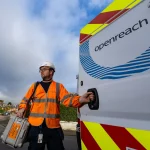
Across the country, Openreach engineers have now laid a whopping 16,730km of fibre optic cable – enough to stretch to the South Pole and beyond – including 400km of sub-sea cable, while 5,078 new FTTC street cabinets (DSLAMS) are also now live. Part of the funding for all this also came from the Building Digital UK programme.
Paul Wheelhouse, Minister for Connectivity, said:
“I’m delighted that the programme has far exceeded its expected delivery target at the outset of and has gone on to provide better broadband technology to more than 950,000 homes and businesses all over Scotland – an amazing achievement. In the Scottish Borders alone, access to superfast broadband has also increased from 21% of premises in Jan 2014 to almost 88% now and, while we are putting in place investment to complete coverage, the progress made since 2014 is something that the DSSB team can be rightly proud of.
Having fast and reliable internet is absolutely vital to communities across the country. As we emerge from lockdown, it helps businesses stay connected with customers and colleagues, as well as helping families to stay in touch, learn, work, play and shop – over 65% of people who have fibre available to them have already signed up to receive services and that is more than double the take up that had been modelled.”
Robert Thorburn, Openreach’s Partnership director for Scotland, said:
“Bringing better broadband to nearly a million [extra] homes across rural Scotland – on time and on budget – has been a massive team effort.
We’ve seen how invaluable connectivity has been to our communities during lockdown – and it’s just as vital to help rural economies and businesses like Ridelines during recovery. The fibre cables reaching deep into rural Scotland will also help to extend other technologies, like 4G and 5G mobile services.
There’s more to do – and the success of our Digital Scotland partnership gives the nation a far-reaching fibre platform to build on for the next stage of the journey.”
Meanwhile Scotland and BT are currently busy entering the deployment phase for their £600m R100 (Reaching 100%) programme, which has been split across three LOTS. At present engineers are expected to reach around half of the target premises in LOT 2 and 3 – approximately 23,000 in Central and 12,000 in the South – by the end of 2021, with the majority of the build completed by the end of 2023 (LOT 3 by summer 2024).
The R100 programme is currently running around two years behind its original plan and, more recently, the award of the largest LOT 1 (Northern Scotland) contract to BT has been placed into limbo by a legal challenge from rival ISP Gigaclear (here). The LOT 1 area is important because it represents the largest one (valued c.£384m) and reflects about 100,000 premises across the Highlands and Islands, Angus, Aberdeen and Dundee.
The related court case is currently going through the motions and there is hope of an outcome being reached before the end of 2020, when the current state aid agreement comes to an end (missing that deadline would cause further delays).
Advertisement



Mark is a professional technology writer, IT consultant and computer engineer from Dorset (England), he also founded ISPreview in 1999 and enjoys analysing the latest telecoms and broadband developments. Find me on X (Twitter), Mastodon, Facebook, BlueSky, Threads.net and Linkedin.












« Gigaclear Claim 1 in 5 Brits Wait 30 Mins for a Web Page to Load














Comments are closed