Government Reject Calls for Cheaper Rural Access to Openreach’s UK Cable Ducts
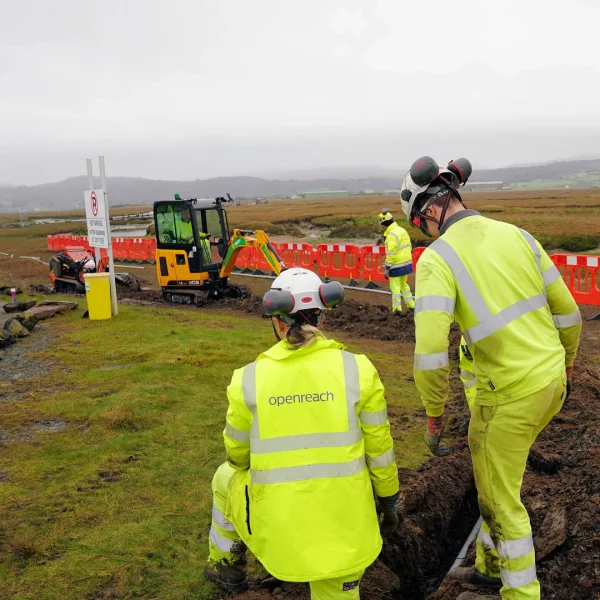
The Government’s recently published Statement of Strategic Priorities (SSP) for telecommunications (here) appears to have rejected calls by some, but not all, alternative UK broadband networks for Ofcom to make access to run new fibre optic cables via Openreach’s (BT) existing cable ducts and poles cheaper in rural areas.
Network access provider Openreach is required to provide access to their existing cable ducts and poles via the regulated Physical Infrastructure Access (PIA) product, which has been extremely successful. This enables rival networks (altnets) to run their own fibre optic cables via the incumbent’s existing infrastructure – cutting down on build costs, disruption and speeding up rollouts of gigabit-capable full fibre (FTTP) broadband.
However, some altnets have consistently argued (here, here and here) that such deployments are being hampered by the rules and high costs of harnessing the PIA product in rural areas. For example, the founder of Fibrus, Conal Henry, previously stated (here) that altnets must pay for the use on a per-metre basis, which he said was “disproportionately impacting rural areas“.
Advertisement
Rural properties are on average 200 metres away from their nearest neighbour, compared to just 10m in urban areas. As a result, Henry says it can cost altnets “almost twenty times more” to deploy new gigabit broadband lines to rural areas than in towns and cities.
The counterargument
On the flip side, the fact that rural builds cost significantly more than urban ones is nothing new, and it’s worth bearing in mind that Openreach will also suffer that impact when they build the infrastructure (they still need to gain a fair return on the investment for it to be viable).
The incumbent is also not magically immune to the realities of rural deployments being disproportionately more expensive than urban ones. This is partly because there are fewer premises to reach, and they’re often dispersed over a much wider area of difficult terrain. Finally, the incumbent has maintenance, repairs and other upkeep costs to consider too.
Openreach has previously argued that the prices they charge for PIA may actually be too low and that rivals don’t share access to their own infrastructure in the same way (note: altnets that receive public investment are often obliged to offer a degree of infrastructure access, but this is rarely as attractive as PIA). On the other hand, smaller altnets carry a lot of risk and often desire to protect the value of their asset vs those with Significant Market Power (SMP), such as Openreach – it’s not an even battlefield.
Advertisement
However, the argument over this – as spotted by the Telegraph (paywall) – appears to have already been partly settled inside the depths of the Government’s recently published SSP, which rejected the idea of Ofcom moving from a ‘No Undue Discrimination‘ (NUD) approach to an ‘Equivalence of Input‘ (EOI) approach.
In a NUD approach, Openreach must treat all the networks in a fair and transparent, but not necessarily identical way: different terms could be offered to different customers if the difference is justified. In an EOI approach, the same terms must be offered to all customers. One altnet proposed that, for the 20% of premises for which PIA charges are the highest, operators should pay a discounted price based on a national average price, that is, based on the total PIA cost Openreach needs to recover for all premises and the total number of premises. But the government disagreed.
Government Response
The government’s view is that a continuing with a NUD approach is the most appropriate and proportionate means by which to achieve a fast roll-out of fibre. We believe a change of approach could have a negative impact on roll-out if it leads to significant organisational and structural changes within Openreach. Additionally, a change would only have a limited positive impact on competition as Ofcom’s interpretation of NUD requires strict equivalence where possible, as set out in the regulator’s consultation on the Telecoms Access Review. Ofcom set out that any difference of treatment between Openreach and their competitors must not put the latter at a disadvantage in terms of cost, time or uncertainty. For new or upgraded services, Openreach would only be able to offer different terms in “exceptional” circumstances. We believe any change of approach would therefore create disruption for limited benefits. We also note that some altnets do not support a change of approach.
We do not agree Ofcom should move to a per-premise model of PIA charging for the most expensive rural areas. PIA charges are set so that Openreach can recover the cost of its physical infrastructure used by third parties, which we believe is an important principle of regulation. The changes proposed by the respondent mean that Openreach would no longer recover the full cost of its infrastructure. While they argue that the loss to Openreach will be negligible, these costs would accumulate over time and, even accounting for their SMP, it would be unfair to mandate Openreach to rent their infrastructure at a discounted price over any substantial period of time.
The proposed discount would also only apply to the 20% premises which use the highest length of the infrastructure network. This would be unfair to networks which connect premises which use a slightly shorter length of the network, as they would end up paying more for less use of the network.
Some stakeholders have shared changes to PIA rental charges could lead to lower prices in rural areas. DSIT has seen no evidence that higher operating costs (including PIA charges) in rural areas are driving up prices for consumers in those areas. Evidence suggests instead that price differences are more likely to be driven by overbuilding that is more common in urban areas, leading to operators offering discounts to gain market share. Furthermore, we have seen no evidence that lower PIA prices for operators in rural areas would lead to lower prices for consumers in those areas.
Conal Henry has already warned that the above decision may “all but put a stop to competitive rural broadband rollout … Decisions being made by this government are likely to establish a permanent digital divide between rural and urban Britain“, although wider economic challenges (e.g. rising build costs, higher interest rates and competition) have already resulted in quite a few altnets needing to scale-back or stop their FTTP builds in both urban and rural areas. Similarly, a number of altnets have, over the past 12-18 months, either withdrawn or scaled-back their Project Gigabit contracts in rural areas.
The future of PIA pricing and regulation for the next 5 years will be set next month, when Ofcom publishes their final Telecoms Access Review 2026 (TAR) statement. The expectation is that this may contain some tweaks for PIA pricing too (this is set by Ofcom, NOT Openreach), albeit clearly not the sort of major shift that has been discussed above.
Advertisement






Mark is a professional technology writer, IT consultant and computer engineer from Dorset (England), he also founded ISPreview in 1999 and enjoys analysing the latest telecoms and broadband developments. Find me on X (Twitter), Mastodon, Facebook, BlueSky, Threads.net and Linkedin.









« Vodafone UK Deploys 5G Mobile Broadband to Aberdeen International Airport

















Does it cost Openreach less per metre to deploy & maintain PIA in rural areas? There’s your answer. If the altnets don’t like what Openreach are charging them for PIA then they are perfectly at liberty to build their own (although they may well bankrupt themselves doing so).
Does it cost Openreach less per metre to deploy & maintain PIA in rural areas? There’s your answer. If the altnets don’t like what Openreach are charging them for PIA then they are perfectly at liberty to build their own (although they may well bankrupt themselves doing so).
Does it cost Openreach less per metre to deploy & maintain PIA in rural areas? There’s your answer. Ofcom set the price of PIA at what they think is a fair price.
If you don’t like the price that’s charged for PIA feel free to build your own (although it probably bankrupt you if you did), especially since the price is set by Ofcom & not Openreach. The only other alternative would be to take all PIA assets from all networks into public ownership (obviously paying their current owners a fair price) & renting them out to anyone who wanted to use them.
“Extremely successful”
PIA is an absolute nightmare for all involved, especially for developers that need openreach infrastructure moved, PIA are charging what they please
There is a PIA price list.
Why should every downstream user of Openreach assets have to subsidise a rural focused altnet, majority owned as part of an investment portfolio? Pricing duct access based on the amount of space you’re using within the duct and the length of that duct you’re taking up is the fairest way of doing things.
If PIA is such a huge barrier then speak to B4rn and lay your own network.
Totally agree, if OR were restricting access or charging mire because it was “in the country” then they may have a complaint. As it is the cost per mile seem to be standardised. The altenets seem to want to be priced for an inch but take a mile.
They should be asking nextfibre for access to the Virgin/Netomina ducts at PIA rates too.
Well my line comes cross country on poles, so theres No rural infrastructure build required, just the fibre but even that’s not viable so..
Poles are infrastructure and covered by PIA.
If Fibrus had been successful in their push, which always looked a bit self serving, what would the solution have been? The rest of industry effectively fund the fibrus rural build, no thanks! Especially since they have already received subsidy for it? Someone has to pay so everyone else’s prices for PIA go up so that they get charged less. Also I note that since this campaign started fibrus have won another deal from BDUK – PIA prices were not a concern in that bid I assume.
Rural build being expensive shouldn’t be a shock. I think this is more about the finances looking difficult and chasing a moonshot to save them.
Not sure why the altnets ever thought this argument was going to fly. Openreach has to maintain more physical infrastructure per property served in rural areas, so why should it be prevented from charging for PIA use on the same basis?
Openreach is already required to be far too generous to its competitors, and perhaps the altnets have become too addicted to allowing someone else to do all the hard and expensive work, but at least this bit of insanity has not been allowed to come to pass.
PIA is not successful, all we have is duplicate networks in busy cities and rural have been left for government grants
A village near me has 3 FTTP. My City street only got a 2nd FTTP a couple of months ago.
Rural areas have often had better rollouts than Urban areas, and I wish the myth stopped they disadvantaged in the current FTTP Rollout. Look at America if you want to see what a Rural rollout looks like with market manipulation. Then be grateful for how good Rural FTTP is in the UK.
Urban areas dont even have a BDUK equivalent.
On the article itself the PIA costs per metre, I think thats reasonable, the solution is just to charge rural residents more for broadband. It should be a choice of pick the perks of living in a village, but worse broadband access, or vice versa for Urban. There is a sense of entitlement from Rural peeps.
“There is a sense of entitlement from Rural peeps.”
Not sure how impressed those city folk would be if some of those properties were flattened allowing farmers to bring their land into the better connected areas. It would certainly make modern farming easier with access to vets over streaming, quicker and more reliable access to the gazillions of forms and regulations etc.
Trouble is the price of the land in the city would push up the cost of the veg.
However, should the flood, drought or insects give a moment of respite, at least they’ll be able to get Netflix in HD.
We can’t continue with the Failed model of using, creaking BT ex-copper Infrastructure, in Rural left behind areas. New FTTP should be installed underground, futureproofing the FTTP network and protecting it from what is expected to be in the future, increasingly wet and storm laden weather. The idea we are going to re-purpose, ex-copper Infrastructure for a modern age is frankly bizarre. Luckily here, Gigaclear have installed their FTTP network underground. The replacement of Creaking ex-copper Infrastructure must be mandated by government. Continuing, to treat Rural left behind areas like second class citizens, has to stop…
And Gigaclear can’t afford their debts. It’s unrealistic to expect someone to build multiple miles of underground infrastructure to support less than ten customers. I’m only aware of this working with the community non-profit providers that have a lot of the wayleave and construction labour costs taken out.
Underground cabling replaces one set of hazards with another, as well as additional costs if new ducting is required (how are Gigaclear doing financially, anyway?). It’s a bit more work for a JCB driver to take out overhead cabling, for example. Fibre is less bothered about getting wet than the copper is.
Openreach are not unique in using what’s already there. In my area, which is far from rural, Openreach *and the two altnets* are doing just that. In the former case this sometimes means the altnet having their own ducting to an Openreach or electricity company pole.
Or, put another way – wetter, windier and shakier countries than ours make extensive use of overhead fibre without too much incident.
It’s a laudable aim, but simple economics come into play. Is it really reasonable to expect every remote property to be served fully by underground plant? Are you willing to pay more to have that? If not, who do think should pay for it?
So you didn’t read the story then and don’t know what PIA is?
Are you prepared to pay the very high cost of putting it underground? The economics of that simply do not work
What am I missing here?
No one disputes it’s more expensive to roll out fttp to rural areas. But if they are talking BDUK contract fulfilment, then PIA costs are allowed as part of the capex in the bid. Surely, then, their argument is moot: if PIA prices come down then that will be reflected in the contract tenders and, consequently, in the amount of money BDUK hand out (i.e., if PIA costs go down so does the amount of money BDUK hand out). The only time it won’t be moot, surely, is if the altnet(s) concerned didn’t factor PIA costs into their tenders for contracts. And then one would hope that whomever in BDUK analyses the bids points it out to the bidders/rejects their bids.
If they are not talking BDUK contracts and then it becomes uneconomic to install fttp somewhere at least partly due to PIA costs then properties in those areas should be white listed as per previous BDUK OMRs, and then we are back to the situation in my first paragraph.
No. It seems to me what’s being said here is that the rural population density is up to 20 times less than in towns and cities and so the opportunity to maximise profit will be reduced accordingly unless they can charge 20 times more for the product (which is a sure-fire way of no-one taking up their product offering).
Given the choice between greater competition in commercially viable rural areas and Openreach building to more of the marginal rural areas, it looks as though government is favouring the latter.
Governments priority is to get everyone up to gigabit access. Openreach looks like the most viable way of achieving this.
How much price differential is there for rural customers? I have not spotted much. I am sat surrounded by fields but have access to products at the same price as in the near by cities. That is a poor pricing model? I would expect to pay more than i am tbh.
yep, crazy. is this a regulatory restriction?