Freely on Track to Overtake Freeview and be in 10.5 Million UK Homes by 2034
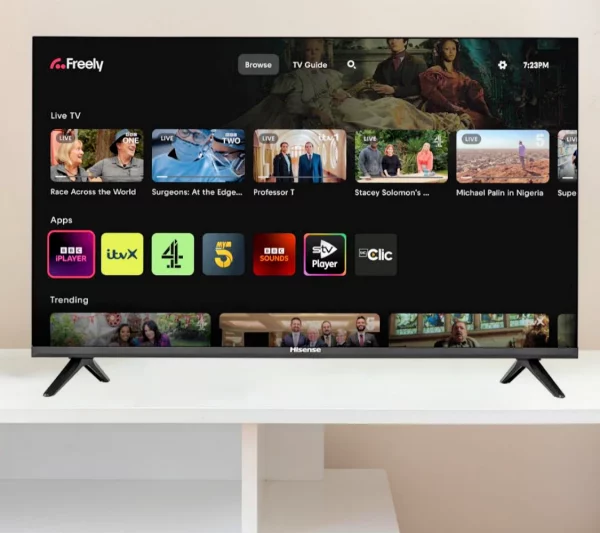
Broadband-based live TV streaming service Freely, which is backed by the major UK TV broadcasters and is an evolution – not (yet) a replacement – for the existing Freeview platform (inc. Freeview Play and Freesat), has revealed that they now have well over 1 million users (up from 500,000 from Sep-Dec 2025) and the number of Freeview homes in 2034 is forecast to fall to 860,000.
The latest forecasts from ‘3 Reasons’ show that the number of homes without broadband are projected to fall to 220,000 by 2034, which equates to 0.8% of TV households. Meanwhile, as audiences increasingly switch to viewing online and replace or upgrade existing TVs with Freely, the new platform is expected to be in 10.5 million UK households by 2034.
Instead of falling a predicted 10% between 2023 and 2025, the number of homes without broadband actually fell 30% and stands at 1.2 million today. The updated forecasts for homes without broadband in 2034 (220k) now represent around a quarter of the 800k originally forecast in a report for DCMS from 2024.
Advertisement
At the same time, data from Barb shows the number of homes connecting their TV to the internet is also growing at pace, 84% today up from 66% in 2020. “Together, the figures underline the growing readiness of UK audiences for internet-delivered television,” said Freely, just as the UK Government prepares to set out their proposed plan for switching off terrestrial TV signals in the future (here).
Key Figures
· Freeview is in 9.7m households today on main TV sets – 73% of these homes are also watching TV over the internet as well as DTT (BARB Q1 2026)
· 2.6m households rely on Digital Terrestrial TV (DTT) to watch TV today either because they don’t have access to IPTV or broadband (BARB Q1 2026).
· DTT accounted for 29% of viewing in 2025 (BARB’s 2025 ‘What People Watch’ Annual Review).
· Key UK TV market dynamics that have impacted the forecasts are:
o The launch of Freely: Earlier analysis pre-dated Freely’s launch and assumed that free live TV within a traditional programme guide could only be accessed via DTT, satellite or cable. Freely delivers live TV channels over IP.
o Faster-than-expected broadband adoption: Broadband take-up in 2024 and 2025 exceeded previous projections. Earlier forecasts estimated around 1.5 million TV homes without broadband in 2025 whilst the actual figure is 1.2 million. The forecasts for non-broadband homes in 2034 were originally 0.8m vs the 0.2m now predicted on the basis of recent broadband take-up rates.
o Shifts in platform propositions: New internet-only channels have joined the Freely line-up while some existing channels have left Freeview. Earlier forecasts did not account for any change in the DTT proposition.
· The updated forecasts assume a transition to television delivered primarily over broadband by 2035 but do not assume any formal government announcement to that effect, nor any new measures to support broadband affordability or take-up. Were such interventions to be introduced, 3 Reasons assert that the number of unconnected TV homes could fall even more quickly.
· 3 Reasons and parent company MTM worked on the forecasts that were part of the Exeter University study commissioned for DCMS in H1 2024. The study was used to inform the workings of DCMS’s TV Stakeholder Forum looking at the future of TV distribution which concluded at the end of 2025.
The above is relevant because the Government have been particularly concerned about how to deal with people (particularly vulnerable TV viewers) who still aren’t connected to broadband by the time the DTT switch-off arrives (an official date for this has yet to be set). The issue is perhaps less about coverage and more about take-up (30Mbps+ broadband is expected to reach at least 99.65% of homes by 2030 – at the end of 2025 it was around 98.5%).
Jonathan Thompson, Everyone TV’s CEO, said:
“The way audiences engage with TV is changing and these updated forecasts reflect that clear direction of travel. It is vital that any future change in TV distribution is carefully planned and managed, that issues of connectivity and affordability are addressed, and that no viewer is left behind.
Freely provides simple, trusted access to live, linear channels and on-demand content from our public service broadcasters and combines this with innovation that can benefit all audiences. It can be a gateway for people to safely and easily enter into an increasingly digital society and not be excluded.”
Obviously, it should go without saying that Everyone TV has a vested interest in putting a positive spin on the challenges, while the Government ultimately have to deal with the reality of bridging any gaps in reach that may remain. One of the other challenges will be in getting Freely into more homes, given that a lot of people can hold on to their existing non-Freely TVs and devices for many years.
The Public Service Broadcasters’ (PSBs) currently support a transition to IPTV in the mid-2030s as it will become increasingly challenging for them to bear double costs from running multiple distribution platforms. At present the UK Government has committed to the future of DTT until 2034, although some Arqiva-based (vested interest in UK tower sites) campaign groups would like to see this extended (possibly to at least 2040).
Advertisement






Mark is a professional technology writer, IT consultant and computer engineer from Dorset (England), he also founded ISPreview in 1999 and enjoys analysing the latest telecoms and broadband developments. Find me on X (Twitter), Mastodon, Facebook, BlueSky, Threads.net and Linkedin.





« YouGov Find Limited Support for Nationalisation of UK Broadband and Phone















Even if it ends up in 10.5 million homes by 2034.. surely it won’t be very relevant and hardly anyone will be using it.
I’m 32 and I don’t know a single person who watches linear TV channels. Not sure why anyone would? aside from some people watching sport. Same stuff is on catch up and even then the content the channels have is pretty crap. The likes of Netflix, Disney+ etc are much better.
This, i am a Sky Stream customer but that is purely for Sport,
Nearly Everything else i watched via on-demand etc*
*Certain shows like Traitors and Dr Who i do watch live!
Old people. Seriously. Other than that, I have seen people watch FASt channels simply for background noise.
“I’m 32 and I don’t know a single person who watches linear TV channels.”
Probably a generational thing.
I’m 60 and rarely watch VoD. I prefer browsing through an EPG – probably because that is what I have always done.
I am over 60 and I know a fair few people who do, but I also know a fair few people who don’t. It is normally the younger one who don’t watch linear TV, but they are also the ones who don’t bother with BBC, ITV and that sort of thing. If they have their own place they normally don’t bother with a TV licence either.
I don’t bother with linear TV and have not for a fair few years, so just because i have my TV connected to the net, don’t mean I am going to have freely.
Can you record from freely? If not I will carry using free view.
All the great comedies, documentaries and a lot of British drama, are from BBC/ITV/C4 and C5 so I definitely disagree that Disney and Netflix with very limited catalogues are better for TV. In terms of Disney and Movies, then that’s probably yes, but I can’t stand most American dross TV shows on Disney and Netflix. There are only a handful of American shows worthwhile.
I only watch certain things linear, but that’s because I record to watch when I want to.
I find those numbers hard to believe unless “Freely” stops insisting on the purchase of new equipment. I have a “Freeview Play” TV, which was supposed to be the peak of merging of terrestrial and internet streaming, but it can’t do “Freely”. I have a Freesat box which can’t do “Freely”. I also have an Apple TV that can’t do “Freely”.
Digital switchover necessitated a new box or a new TV for obvious reasons, and it was well timed with the desire for flat screen TVs anyway. There’s no reason why they can’t work like any other streaming service and come out with apps for the devices people already own!
2034 is 8 years away.
In that time, more Freely enabled TVs will come on to the market and many, (most?), people will choose or need to replace their existing TVs sometime in the next 8 years.
I think in the end they will be forced to make an app for the major platforms. In the same way the PSBs are now being required to make apps available to platforms and in turn the platforms required to place them prominently. If Freely is to become the way to watch ‘free’ live TV then I think it will come under the same regulations.
Not sure about everyone replacing their TVs in 8 years. Admittedly we had a flurry of big advancements in the last couple of decades but tech lasts a lot longer nowadays because the pace of progress has slowed down so much. HD then 4K along with HDR were big steps up in picture quality. But what is coming next to drive replacement? Nothing I can see on the horizon. 3D failed. 8K not really a thing.
I bemoan the expectation that the replacement cycle for TVs has shrunk to 3-5 years, generating consumerist e-waste for what used to be considered a consumer durable.
And there has been a consequent reduction in durability and repairability of TVs, especially at the lower end/smaller screen, and a leveling down of quality as lower end “branded” models tend to be made by 3rd parties that also make cheaper “no brand”/”license brand” products.
It is possible now to get a dongle type thing that have Freely in, so for people who don’t have Freely and for some reason wants it can get one of these dongle things.
I think the only reason most people would get one is if their TV is in a place where there is no aerial or they can’t get a decent Freeview signal.
Samsung still don’t have Freely on their sets and I don’t think they are going to, they will do what they have done with Freeview and have their own version
It should be remembered that TV isn’t the only reason to get all households connected to Broadband. SOTAP For Analogue for instance is only a transitional product for landline only customers and is only expected to last 5 years or so. In many places by 2034 FTTP will be the only product available to customers.
Anyone know if this box can get the official PS Remote Play app from the Play store? If it can I think I will get this to replace my firetv stick.
Sorry, I meant the Netgem PLEIO 4K Puck
If you want Liner TV and Freely
then get the Humax Aura Mark II Box
https://humaxdirect.co.uk/products/humax-auraez-4k-freely-recorder
If they really want this be adopted, they need to release it on every mainstream platform. (Web, Apple TV, LG WebOS, FireTV, Chrome, Android, iOS et al)
Limiting it exclusively to a few bargain basement TV brands is never going to get adoption numbers up any significant amount.
Exactly that. If backing this project broadcaster want to stay afloat then, this is the only way to attract 30+ spectators.
Hisense and TCL TVs are good brands.
Samsung and LG don’t want Freely as it competes with their own IP services. They are trying to do their own deals with the PSBs
I have it on my JVC TV – every time I turn it on I am asked if I want to install Freely. I was told when i first got it that I needed an Ariel – but this then changed to IPTV only
My opinion is, this is back door enforcement of TV Licence, audit trailing if someone watches (streams) live TV from any source. Currently being monitored by Licence authorities on just BBCiPlayer. Doorstep visit with audit of viewing iPlayer.
Easy enforcement sitting at a desk or masterful AI monitoring in the future.
It may make it easier to enforce the licence, but then again, it may not. People may use a VPN to hide their IP address and may not even need that since a lot of ISPs are using CGNAT. Not all ISPs have IPv6 at the moment, so freely will have to use IPv4.
People can also put a false postcode and an email address that can’t be traced to them. I have done that with the BBC account. Not because i am using it for anything illegal, but because it is none of their business.
ITV is at the moment the only channel on Freely that requires people to have an account just to watch normal TV, which I think is ridicules and is the reason why two people I knmow have decided not to bother with Freely. They have don;t see why they should send info to ITV just to watch normal TV.
So unless that type of thing happens with Freely itself, it will be not so easy to check on people. They could go back to what they used to do and get peoples addresses when they buy a new TV.
The BBC pushing Freely as they are, may bite them in the backside. If everyone have to access the BBc online, then there is no reason why not to have a subscription
You think CGNAT obfuscates physical building addresses?
Holy cow.
@84.08khz, Am I wrong? If I am, then say, I don’t really know a lot about CGNAT, only that it allows people to share an IP address or something like that.
Maybe I should look more into it, I have had no reason to, but I may just for info.
Unlike some people on here, I am not scared of admitting I may be wrong, just a shame other people like you are total nits about it. I put nit, because what I want to post would not be allowed to be posted.
CGNAT hides your devices on your home network from the (wider) Internet; it does not hide your physical address. (It also blocks port forwarding, which if you need as a facility you have to use a workaround.) All the internet traffic leaving your router is assigned a temp shared public IP address by your ISP, who keeps a strict time-stamped log of that address and port, from which your physical address can be obtained on execution of a legal warrant.
And (mock) shock & horror, VPN use does not necessarily mean that your physical address cannot be ascertained. Your VPN provider can see your true IP address and your online activity. If they keep connection logs/are located somewhere they are legally compelled to then they may/can hand the data over to authorities. If you’ve signed up to a VPN using any means that can be directly traced back to you (e.g. email, DD, credit card, paypal, …), you can be directly linked to the account. Add in cached data, persistent cookies, unencrypted metadata, and a probably a host of other things and you can be traced if someone thinks it would be a good idea. Of course, there are ways to obfuscate some/most of this if you are so inclined.
The BBC doesn’t even link user accounts to the TV licencing database, even though it would be technically trivial and arguably a good idea (no licence = no iPlayer). What makes you think they’ll be doing this?
DaveP – What’s bad about that? If you consume live tv or iPlayer then that’s completely fair and not anything unexpected. Those that genuinely don’t use those services won’t be affected will they? Can’t expect to consume for free, it’s currently a TV license at the moment, not broadcaster specific license. It may mostly fund one broadcaster agreed.
@Ivor – Actually they do, people have been sent emails/letters for using iPlayer while having declared they do not need a TV licence.
I’ve got 2 Freely Tvs, a Panasonic and a Hisense but they’re both prone to dropping the signal particularly the Panasonic. I have Vodafone superfast broadband. Are we not rushing forward with new technology before it’s truly ready?
what is not truly ready here is your wifi.
Something is wrong with your WiFi. Nothing to do with broadband readiness.
If I were to want and use freely, which I don’t, then I would ensure I could connect with cable. wifi is not the best way to connect.
I won’t be switching to Freely unless I absolutely have to. I’m perfectly happy using my Manhattan PRV to record programmes and be able to fast forward the ads. Something you can’t do on the catch-up apps. I also don’t have to worry about content being removed from the apps before I get round to watching them.
Freely has no recording facily,because they don’t WANT us recording stuff. It’s all a way to make more money by ad revenue or subscription fees.
It is possible. Youview used to allow recording from IPTV years ago. But freely don’t want to.
If Freely offered some worthwhile channels that were not available on Freeview, I might get a freely box/puck to supplement my Freeview recorder, but that certainly doesn’t seem to be the case at the moment.
I do have Freely however, in order to watch it I have to hard wire my tv direct from my broadband device. This is because the area that I live in Swindon is still using copper in order to use the internet. Unfortunately Ofcom have constantly failed to impose fines on Openreach to establish a faster way of delivering a full fibre option. The type of property is a communal property and this was built in 2013. This has been deliberately overlooked by Openreach. A new bus boulevard was constructed which was completed last year, in that construction at least 8 Openreach vechiles were seen helping to build the new infrastructure, but as yet their website indicates that they have no plans to upgrade. Swindon is a vibrant area and Openreach have failed to recognise this factor.
Why can you not use a wifi connection? Many other supplies who could choose to supply you.
Surely Ofcom would need to fine every provider for not supplying your house, not just Openreach?
or indeed perhaps they should fine your “communal property” owner/manager if they are blocking this. MDUs are a nightmare for any operator since they can’t go in without permission.
Swindon was among the first places to get Openreach’s mass fibre rollout and several Swindon area exchanges are in stop sell, so most Swindonians can get what you can’t.
Not that you need fibre to the premises to stream TV. I have no idea how this has anything to do with your needing to run an ethernet cable to your TV (?)
Freely is just a portal to access a TV guide to watch TV channels, with app culture now truly ingrained in most people, and most of the PSB’s and commercial subscription operators putting out decent apps, I doubt you’ll need what is a glorified TV guide soon.
People still watch linear, the hard and loose survey of one or two readers here (my mates and I don’t watch linear so therefore everyone doesn’t use it) is a bit of a misnomer of a webpage dedicated to people who enjoy reading about broadband and broadband news.
I met a mixture of people having worked in retail who still watch linear via DTT, Satellite and apps with a mixture on-demand as well, some just want to watch the channels and the age gap stretches from teenagers to the elderly.
There’s still space in the mix for a hybrid product of linear and on-demand and as always broadcasters (or content providers) will adapt to the current situation.
I remember when I everyone said radio was dead when the internet came along and that is proving to seeing listener increase with its on-demand and live linear model.
And when the WiFi goes out what are you meant to do? Left with zero TV. People forget not everyone lives in the city with perfect WiFi all the time
You could connect your TV to your router with a cable, thus avoiding any WiFi issues. Or do you mean something else when you say “WiFi”?
More seriously, Freeview transmitters go down from time to time too, either for maintenance or due to a fault. Some transmission masts have collapsed (most recently in North Yorkshire) leading to months of disruption. You wouldn’t believe that streaming dongles/boxes were among the options offered to those who couldn’t get signal from the temporary mast!