Report Criticises BT, Sky, Virgin, Vodafone and Others for Confusing UK Social Tariffs

A new study has highlighted how some of the UK market’s largest fixed broadband ISPs, including BT, Sky Broadband, Virgin Media and Vodafone, appear to be failing in their commitment to making cheaper Social Tariffs easier to access (available to those on state benefits). Instead the providers were found to make the tariffs and their details hard to find and often with unclear contract terms or pricing.
Social Tariffs are typically only available to those consumers in receipt of certain state benefits (e.g. Universal Credit), which can vary between providers. But as both Ofcom and the National Audit Office (NAO) have previously pointed out (here and here), one of the biggest obstacles to take-up remains a lack of awareness (only 34% of eligible broadband users were aware of such tariffs in April 2026).
Little wonder then that Ofcom’s last annual report on this subject estimated that, out of households in receipt of UC, just 532,000 had taken a social tariff (8.6% of those eligible). A standard commercial broadband plan usually costs an unemployed person claiming UC an average of £27 per month (8.3% of their monthly disposable income), while a social tariff costing c. £15 reflects just 4.6%.
Advertisement
Both Ofcom and the government have long been putting pressure on ISPs to improve awareness of such tariffs, not least via the recent Telecoms Consumer Charter (TCC). The TCC required member ISPs (BT, Virgin Media / O2, Vodafone, Three UK, Sky Broadband, TalkTalk, KCOM, CommunityFibre, WightFibre, Hyperoptic and Olilo) to ensure such tariffs are “easy to find and signposted to eligible customers in communications“.
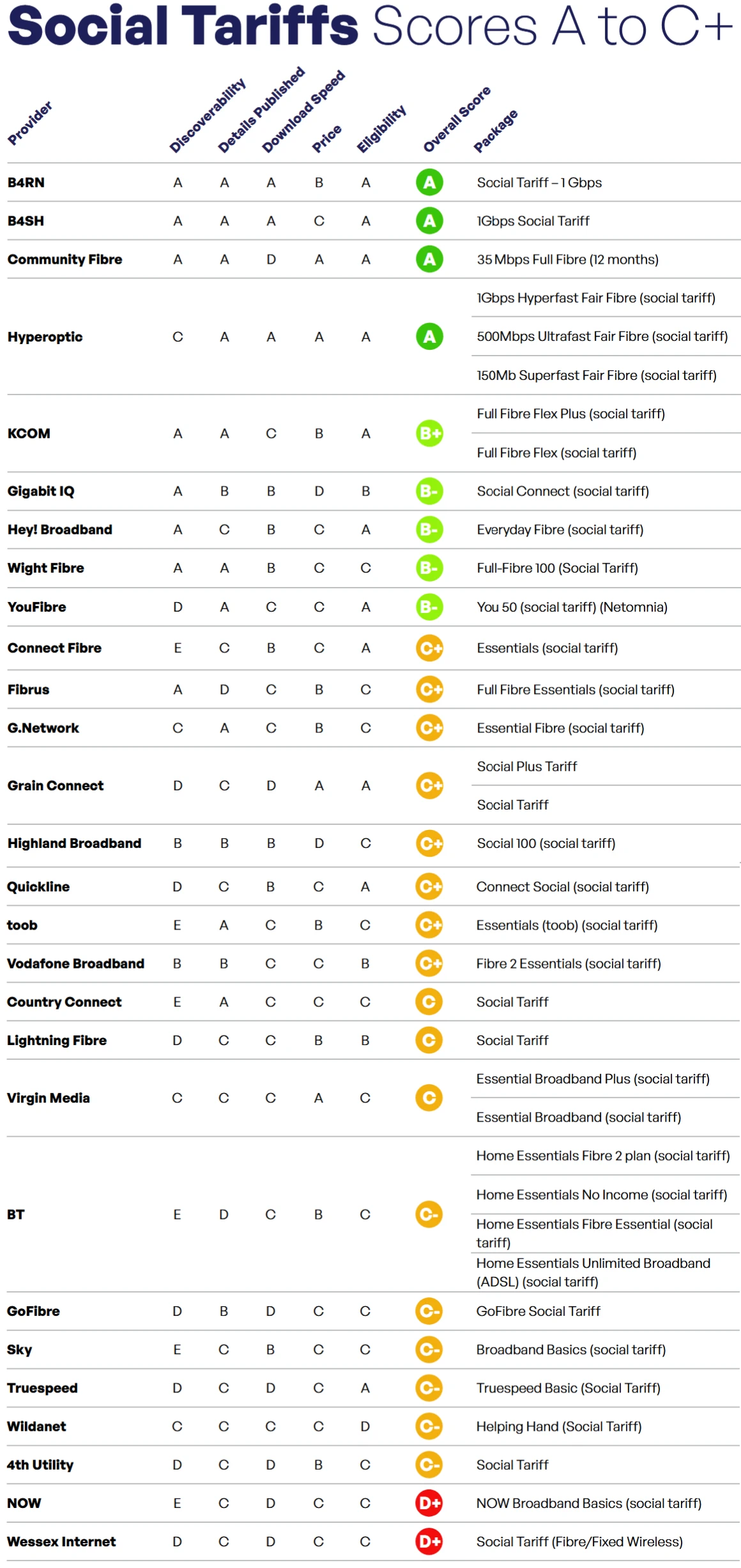
The new Thinkbroadband study set out to test this by ranking a number of broadband ISPs with Social Tariffs by how easy the packages themselves were to find, the quality of details they make available to consumers (i.e. pricing, T&Cs, contract limits etc.), download speed, price and how flexible each tariff was when it came to eligibility (i.e. some are more accessible than others).
The results found that four of the market’s largest providers delivered some of the lowest scores, although they weren’t the worst. “We would challenge anyone here to go to bt.com and find where social tariffs are without using a search engine. Once you find it, tell us how much it costs? Even if you think you found the answer, you didn’t as BT offers multiple packages, and the details aren’t on that page! This isn’t just a BT problem, but their page is one of the most difficult to find,” said the study. By comparison some of the markets smaller players, such as B4RN, B4SH and CommunityFibre, were the highest rated.
Advertisement
Finally, a quick reminder. We know social tariffs can be a divisive topic for some, but that is not an excuse to abuse the comment system in order to post offensive remarks toward those who take state benefits. Such posts are against our rules and will be removed.






Mark is a professional technology writer, IT consultant and computer engineer from Dorset (England), he also founded ISPreview in 1999 and enjoys analysing the latest telecoms and broadband developments. Find me on X (Twitter), Mastodon, Facebook, BlueSky, Threads.net and Linkedin.











Advertisement
Leave a Reply
Privacy Notice: Please note that news comments are anonymous, which means that we do NOT require you to enter any real personal details to post a message and display names can be almost anything you like (provided they do not contain offensive language or impersonate a real person's legal name). By clicking to submit a post you agree to storing your entries for comment content, display name, IP and email in our database, for as long as the post remains live.
Only the submitted name and comment will be displayed in public, while the rest will be kept private (we will never share this outside of ISPreview, regardless of whether the data is real or fake). This comment system uses submitted IP, email and website address data to spot abuse and spammers. All data is transferred via an encrypted (https secure) session.

















As someone who works in the NHS and sees how poverty affects peoples health. Everything is either online or requires it, yet the poorest are having to go through this, so frustrating.
Not blatantly obvious but from the BT homepage scroll down to Here for You – Supporting your needs, then down to Financial support, then home essentials.
Plans start at £16.50, presumably for 40/10. I guess you have ring up for more price info
Ok, let’s take the figure of 16.50 for a social tariff. The price of a regular broadband is £22-23, according to the list published on top of this website (this price is available for all, so don’t argue that you’re paying more because you want your Netflix or Sky TV bundled in. For these £23 you get a perfectly usable broadband). And let’s imagine I’m cash strapped and I take a social tariff, saving me £7 per month. What can I do with this money? For me personally, that is a price of my daily shop (sometimes two). Doesn’t really help if I can shop for free one day a month. Savings should be made elsewhere.
The takeup figure would need to be viewed alongside the percentage of UC recipients that subscribe to a fixed-line broadband service to get a feeling for how relevant it was – perhaps a significant number only use mobile data, or use shared Wi-Fi provided with their housing etc.
Asking providers to take a loss to provide these tariffs is one thing, expecting them to advertise it front and centre so that the near 20% of the adult population that are eligible are steered towards them is a bit much.
If half of all UC claimants took out a social tariff that’s a subscriber base larger than TalkTalk’s, at some point the discussion has to be whether the DWP run an ISP themselves or resell it so the costs of doing so can be seen, rather than asking nicely if others fancy taking a loss.
I don’t think DWP should be running their own ISP! However, I also think it’s unfair for the burden to fall on their other customers. It is a regressive stealth tax. DWP should offer ISPs a credit say £10 per month for UC customers. That way UC recipients can sign up for regular tariffs and receive a discount equivalent to the DWP funded credit. ISPs then have no incentive to hide discounted tariffs, and the cost to the tax payer is fully transparent.
When I worked for Virgin it was rather poor having to explain to someone (especially elderly) that the only way to take the social package was by going through Live Chat. A lot of them barely understood how to navigate the website or only had “dumb phones”
Id be interested to understand how these social tariffs stack up to wholesale network line rentals. Is that sustainable? No it’s not. Hence it’s no surprised they are hidden tariffs.
hidden tariffs should be banned
BT is confusing customers in other areas such as where BT states customers within the social tariff that has been automatically renewed for another year are now out of contract a few months later and where customers have unlimited calls subject to fair use are now on Pay As You Go.
BT are also offering customers the option to upgrade when the upgrade to full fibre should simply transfer all features and customers optional services without a change in service options and without a price increase.
Worth remembering that the concept of the “social tariff” is mandated by the government but not funded by it, ie it is funded by customers paying full price. Maybe if the government expects better advertising and easier order journeys, they can dish out some cash…?
Hardly surprising then that most of the participants don’t have it advertised front and centre on their home pages, and given the relatively low expected takeup and need for the ISP to verify your status with the DWP, there aren’t automated ordering processes in place.
B4RN gets top marks but I’d wonder how many “social tariff” customers they have, with the combination of their miniscule network and the fact that they tend not to build in highly deprived areas.
If the government want more awareness of these tarrifs.. surely they are ideally placed – and incentivised – to do this themselves. What is stopping DWP sending out a leaflet with a list of common Social Tarriff providers and how to apply for them.
Assuming the DWP actually care about this as they are not mentioned at all.
I’ve been on BT Essentials for about 3 years. You have to call them really as they have to check the DWP database against your NI number anyway. What grates me is I pay £24 per month and only get up to 74/20 when I could get much faster speeds for that price. And looking at the table above, some operators are offering up to 500mbps download!
Why not scrap these ‘social tariffs’ that the rest of us pay extra to subsidise and have lower prices for every one or let DWP handle the social rates?
Id imagine at most big providers existing customer would have to renew a contract and change to an equivalent plan, which will badly affect an agents targets as they could be paying anything from £25>£80 on a standard plan. Customers could walk out paying less than half which would hurt a sales advisors stats/commission.
Regardless of how the social element is funded, the “playing field” needs to be levelled, to create a cut rate “social data & voice phone plan” which can be delivered either via a fixed connection or via a mobile network; for many social purposes a mobile smart phone/tablet (with ability to tether) or a USB dongle would be adequate.
On a related point, to increase digitisation of government services, the UK government could sponsor a “citizens mobile device” to provide strong MFA to validate access government services, with a modest data plan and a “walled garden” of apps and internet connectivity.
Conceptually similar to the French Minitel/Teletel initiative of the 1980s.
Another issue is that we’re not even allowed to mention that such tariffs even exist unless the customer mentions that they are on the relevant benefits or states that they are suffering financial hardship and cannot afford their current package.
That’s wrong, imo.
I would make every isp give a 30mbps connection for £10 as a social. If the UC lot don’t like it then tough. It’s more than enough for claiming UC and job searching.
I think social tariffs just are a mess. They’re great on some operators, like Virgin Media’s is cheap from memory for the basic tier, but they’re just not competitive. I don’t know much about the broadband market but this is especially the case with the mobile market, it’s cheaper taking out a regular plan with an MVNO through a comparison site (or sometimes even the MNO directly) than do a social tariff.