Openreach to harness Allstar’s UK fuel card network to support EV fleet

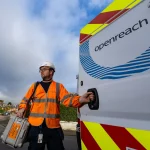
National broadband network Openreach (BT) has confirmed that they’re working to adopt Allstar’s fuel card network to help support their transition to electric vehicles (over 7,000 of their 22,000 vehicles are now EVs). The goal is to make it easier for their telecoms engineers to charge their work vehicles.
Openreach currently aims to upgrade the “vast majority” of their diesel-powered vans and cars to EVs by the end of March 2031 – supporting their Net Zero target for the same date. As part of that they’ve been busy installing EV charging points at operational sites and engineers’ homes (they’ve done more than 4,000 of these) for convenient overnight charging.
However, despite the progress, the broadband operator recognises that charging can still be a problem, particularly with around one in three of their engineers being unable to install a home charger. The company has thus been busy building other partnerships, such as with First Bus, so engineers can charge their vans at First Bus depots, taking pressure off public charging points and making life easier for those who live in flats. Similar deals have since been signed with Sainsbury’s (here) and Source (here).
Advertisement
The new Allstar deal is intended to build on that by enabling engineers with home charging points to use Allstar Homecharge to pay work charging costs directly to their energy supplier, rather than having to pay up front and claim expenses back later. The Allstar Co-Pilot app will also be used to direct engineers to their nearest charging location.
According to EV Infrastructure News, the partnership will also develop access to commercial and shared depot charging for engineers who need additional options during the working day. Excess depot charging capacity is to be offered via platforms such as First Charge and Voltempo.
Openreach’s goal is to enable their telecoms engineers to use a mix of home, workplace, depot and public charging, depending on where they live and how they work. The operator has previously also been busy testing “cross‑pavement charging“, which allows people without access to off-street parking to charge their EVs at home by running a cable through a shallow channel (gully) in the public pavement.



Mark is a professional technology writer, IT consultant and computer engineer from Dorset (England), he also founded ISPreview in 1999 and enjoys analysing the latest telecoms and broadband developments. Find me on X (Twitter), Mastodon, Facebook, BlueSky, Threads.net and Linkedin.











« Broadband ISP Exascale launch new website and prep free UK DNS resolver















Privacy Notice: Please note that news comments are anonymous, which means that we do NOT require you to enter any real personal details to post a message and display names can be almost anything you like (provided they do not contain offensive language or impersonate a real person's legal name). By clicking to submit a post you agree to storing your entries for comment content, display name, IP and email in our database, for as long as the post remains live.
Only the submitted name and comment will be displayed in public, while the rest will be kept private (we will never share this outside of ISPreview, regardless of whether the data is real or fake). This comment system uses submitted IP, email and website address data to spot abuse and spammers. All data is transferred via an encrypted (https secure) session.