Openreach trial could prep UK homes for FTTP broadband during copper repairs
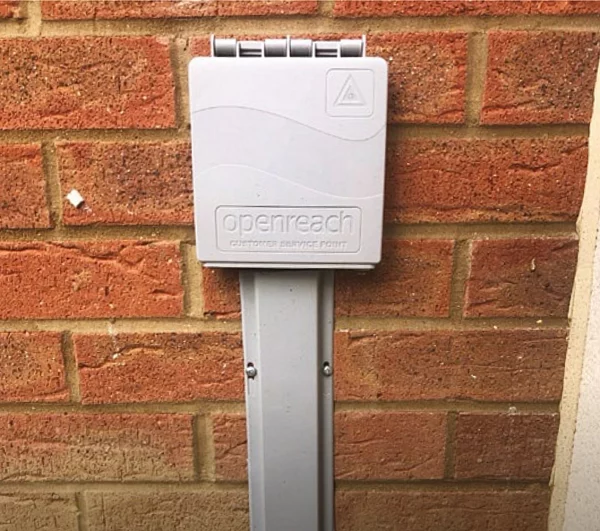
Network access provider Openreach (BT) has revealed to ISPreview that they’re starting a new early-stage Proof of Concept (PoC), which could see engineers who may be visiting homes to repair a copper line service (FTTC / SOGEA etc.) also conduct additional work to help make the property ready for full fibre (FTTP) broadband in the future.
At present engineers who are called out to fix a problem with somebody’s copper-line based phone or broadband service typically only focus on that task and nothing else. But Openreach recently began informing broadband ISPs about a new Proof of Concept (PoC) test called Prep for Provision and we’ve now got some solid details on what this will actually aim to deliver.
In selected trial areas, where FTTP lines are already available, the engineer may discuss FTTP with the retail provider’s customer while visiting the property for an unrelated reason (e.g. while conducting repairs on an older copper line, where the customer hasn’t yet taken FTTP). If the customer is happy to proceed, the engineer would then go ahead and do the internal engineering work inside the home to make it ready for FTTP.
Advertisement
Just to be completely clear. This does not mean the customer is then being forced to take FTTP where it’s available, it just means that if they did order the service in the future then their house would already be prepared – simplifying the final drop installation phase and making the wider roll-out more efficient / faster.
At this stage, the PoC trial is simply testing whether customers are willing to have some of the necessary equipment installed during an existing visit and nothing further. But if the results are positive then we could see this progress toward practical delivery. This sounds like a good idea, although it’s worth considering that it could make it harder to manage engineering resources for other jobs, as there may be uncertainty over whether or not the end-user would agree (i.e. it might be better to ask them the question in advance of arrival).



Mark is a professional technology writer, IT consultant and computer engineer from Dorset (England), he also founded ISPreview in 1999 and enjoys analysing the latest telecoms and broadband developments. Find me on X (Twitter), Mastodon, Facebook, BlueSky, Threads.net and Linkedin.







« Lodestar Networks seek £50k to build 4G network in Warwickshire towns
Advertisement
Leave a Reply
Privacy Notice: Please note that news comments are anonymous, which means that we do NOT require you to enter any real personal details to post a message and display names can be almost anything you like (provided they do not contain offensive language or impersonate a real person's legal name). By clicking to submit a post you agree to storing your entries for comment content, display name, IP and email in our database, for as long as the post remains live.
Only the submitted name and comment will be displayed in public, while the rest will be kept private (we will never share this outside of ISPreview, regardless of whether the data is real or fake). This comment system uses submitted IP, email and website address data to spot abuse and spammers. All data is transferred via an encrypted (https secure) session.
















So the EU is now the customer?
After all these years where Openreach distanced themselves they now want to blur the lines again.
Its always been blurry. Developers and self builders would need to engage directly with Openreach. You can report damaged infrastructure directly to them too.
Even if the cabling is installed (or whatever prep work this entails – its not clear what they would be doing) it would still be up to the ISP to place the service order.
Who cares, the middle man concept makes things awkward and slower, sometimes you just have to cut the retail ISP out.
“Internal engineering work” – does that mean they will install the ONT and fibre to the CSP?
If that is the case I’m wondering if Ofcom will have something to say about it. People are less likely to want to have a competitor’s ONT installed if Openreach have already got a foothold.
At present we don’t know the exact amount of work involved, although the Ofcom angle is an interesting one. Either way you could get a fair bit done even without putting an ONT on the wall itself.
We know that there are other trials with OpenReach for self-install of ONT’s, so I could see them doing work up to the point of having a fibre installed (maybe using a similar presentation to Nexfibre/VM with it terminated in a box on the wall) so the EU only has to install a fibre patch lead and the ONT at a later date if switching.
Doing half a job, such as fibre to external CSP only, is probably not worth doing in advance. If the eventual install needs an engineer visit anyway, for example for drilling through the wall, then they could do all of it at the same time.
Not to mention that the property might have a new owner by then, who has a different idea of where the ONT should go.
I think overhead copper cable was easily replaced by full fibre cable but the underground copper cable was impossible for Openreach to replaced full fibre cable to removed master socket with ONT installed.
I need subtitles for that.
When my ONT was recently upgraded from 1 gig to 2.5 gig the engineer had to call a call centre to register this and would the general public be calling said call centre with the Openreach self install option and i feel this could cause issues as anyone could ring the call centre.
Very valid point, contacting Openreach regarding ONT PoC program will be almost impossible unless Openreach is providing direct contact support for EU
It’d probably make more sense for the ONT to be registered before being dispatched to the customer.
Openreach engineers activate ONT’s on an app. No need to call anyone. But I doubt this would be opened up to customers as it could be used maliciously.
If an ONT is installed when Openreach do the installation work, the OR engineer will register the ONT address with OR at the time of install. When ISPs register for service, OR will already know the serial for ONT and can remotely provision it.
A ONT Swap by “self install” can be handled in a similar way, ISP contacts Openreach to start a ONT swap, Or ships out a new ONT to a customer, noting the serial of the new ONT, customer disconencts old ONT and connects new ONT, the new ONT attempts to connect OR see’s the ONT has dropped off the network and the new ONT is now on the network and can assign the new ONT to the customer.
Openreach are already testing a self-install / upgrade route for end users, as OR upgrades to XGS-PON, ONTs get damaged / lost. Cheaper to ship out a new ONT then it is to send out an engineer. I wouldn’t be surprised to find out that OR are internally testing / aiming to move to ISP supplied ONT’s, like what happened with VDSL (At the start OR installed VDSL modems and ISPs supplied the router)
The reason OR engineers have to call/use an app to register ONTs is because they are not “pre provisioned”, the engineer has a stock of ONTs in their van and the Engineer is basically picking one at random when they fetch it from the van.
Optional (consulted) lightest touch possible installation of CSP and through-wall does make some sense but only if the ONT install becomes self service.
Would have made even more sense if Openreach had developed transitional boxes that could replaced the NTE5mk4 with autoswitchover analog, VoIP and ONT capability. Too late now for forward thinking engineering to accelerate later install work.
Might be better if the Footway demarkation box could also be dug in at the same time, as this is the other significant customer consultation. Not running the fibre, just positioning the box so it’s clear to the later installer the intended routing of the fibre from street to CSP.
Open reach are a bit of a joke. I live in a rural area, our copper runs 2 miles to the nearest junction box, so our fibre speed is a joke. But we have a fibre on the pole running right past our property. Openreach installed fibre (in order to service a couple of businesses), but didn’t install any infrastructure to connect any of the 50 or so properties the fibre runs past. It’s been 5 years and every year we get a letter from openreach telling us we are on their plan, followed up by another saying the plan has changed this year.
Absolute joke of a piecemeal way to manage a network upgrade.
A motorway runs near my home, there’s no junction off of it to my street. What a joke.
A simplification but the same kind of thing. Various reasons why it’s probably a lot harder than just connecting a couple of splitters and you’re about good to go.
Can I ask through your column,I’ve got broadband and phone (not VoIP) from talktalk by fttc ,will the switch off of analog phone affect my phone.Keep your answer simple I’m a simple sort of guy.
Yes!
There’s a support page about this:
https://help-centre.talktalk.co.uk/Telephone/Find_info_or_guidance_about_my_telephone/Digital_switchover_Customer_Support
Taken from the FAQ:
“Will my TalkTalk landline stop working?
No. If you currently have a TalkTalk landline service, your service will continue working as normal.”
However, it is a bit vague in places, using words like “most” and “many” implying some may have to switch depending on circumstances.
There is a support number on the page if you want to ask directly: 0345 172 0088
That said, I don’t know how the BT takeover may affect this, at least in the long term, as I wont be surprised if they try and shift people over to remove the TT equipment.
The correct answer is “No”.
Talktalk have their own equipment in the exchanges which provide the analogue phone signal, and this equipment is not going away. Unlike most other people, your line doesn’t connect to the Openreach “telephone exchange” equipment (which is the thing actually being switched off)
The caveats around “most” and “many” are probably to do with the handful of exchange buildings which are being closed down – this is a trial of only 3-5 exchanges, so the chances are you’re not affected.
Anyway, don’t fret – you’ll be contacted by Talktalk when the time comes.
I wonder how many people, who have tried unsuccessful to get fttp installed, would be ringing up with “problems” to their copper lines to speed up the process.
this presumably relates to premises in FTTP areas but who have not yet upgraded – so I’m not sure who you’re thinking of here. It won’t magically cause fibre to be installed in your street if it is not there already, and if your specific property is too hard then it continues to be so
In a way, this has actually been the case for a long time… “Pre-built to CSP” is shown on quite a few properties on the BTW Checker. This means that the fibre has been installed from the exchange to the CSP, whereas this sounds like from CSP to ONT.
This would make most sense in areas where there are no FTTP competition — thus the chance of future conversion being fairly high.
In areas where there are (or soon to be) alternative FTTP providers, does it really make business sense to spend resources upfront where the EU may not become a customer of your customer?
Assuming the proposed works are an external CSP and a fibre route to an EU-agreed point near a power outlet then leaving a capped connector coiled in a backbox or similar. Likely tying in with a self-install ONT option?
This is something that should have been implemented a long long time ago imo. The trouble I had with my elderly parents being nagged and feel threatened to have something done to there property they didn’t want or need was terrible. When eventually agreed they didn’t show on the first day and turned up at the end of the day from a late morning appointment the 2nd attempt. The end result was leaving BT, now no line to the house and 5g mobile net serving the house permanently instead. I think satellite internet is the future and Land line upgrades have just taken to long to be implemented, technology has moved on now. Be interesting on prices when Amazon launch there own satellite internet alongside Starlink. Sorry rant over.
So, 80% of the UK Telecoms network is in the charge of comedians, thanks to their fellow artistes in HMG who devised the patchwork and piecemeal installation schema and policy.
If that OR and BT had been in charge of assembling the stones and erecting them to form Stone Henge . . we would still be waiting.
We had pre fitted fibre tubing to the wall cap 10 years ago, then fibre tube dropwire with a copper pair for copper service 5/6 years ago. How did they end up?
The premise is understandable and perhaps the premade cables can now make this more feasable. But unless there is a real first through the door takeup advantage I can’t see the extra time and cost being eaten by OR.
A fttp provision on repair job (would require same cp / isp) would be a better route?
Going to be very difficult to get engineers to do this additional work when paid per repair job. Additional work of upgrading to NTE5 from Line Jack was slow going when engineers weren’t paid per job.