New Digital UK Map of Underground Cables to Enter Public Beta in 2025

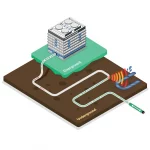
The Government has announced that their new National Underground Asset Register (NUAR), which is a digital UK map of underground pipes and cables (broadband, water etc.) that is partly designed to help reduce accidental damage, will finally be made available as a public beta service by spring 2025.
Both the past and present governments see huge potential for such maps to help improve the way that national infrastructure is planned, built and managed (e.g. future full fibre broadband and 5G mobile networks). The map could also cut the amount of accidental damage that occurs to existing infrastructure (one estimate suggested this costs up to £2.4bn each year) and boost economic growth by “at least £400m” per year due to increased efficiency, fewer asset strikes and reduced disruptions.
The NUAR – developed alongside Ordnance Survey (OS) and Atkins – is the solution they came up with, which has so far only launched in the form of a Minimum Viable Product (MVP), where use is constrained to testing and feedback. But the big news today is that the government plan to push this into a “public beta service by spring“.
Advertisement
From that point the NUAR will be able to be used in real-life situations by any eligible asset owners, their contractors and accredited surveyors to help ensure safe digging and excavation. In addition, the government has announced that Ordnance Survey (OS) will be the future operator of the NUAR; this won’t come as a huge surprise, given their prior involvement.
Otherwise, the Geospatial Commission will retain long-term policy and performance oversight of the service.
Baroness Jones of Whitchurch, Parliamentary Under-Secretary of State (DSIT), said:
“We are committed to unlocking the power of data to reduce disruptions to the public and help deliver economic growth across the UK. From spring, NUAR will minimise the chance of accidental damage to the pipes and cables beneath our feet, protecting the supply of gas, water and electricity to our homes and businesses.
By harnessing the Ordnance Survey’s centuries of expertise in managing critical national geographic data, we will ensure this service can deliver for the public and industry from Newcastle to Newport and Brighton to Belfast.”
Admittedly, all of the positivity around the NUAR does rather ignore the fact that alternative platforms, such as the LSBUD (Line Search Before You Dig) service, already exist to provide a roughly similar facility (although NUAR seems to be aiming to go further).
In addition, the UK Internet Service Providers Association (ISPA) has previously warned the government against putting the NUAR on a statutory footing before it’s truly “fit for purpose, proportionate and can fully deliver on expectations“. Clearly the move to a public beta represents progress, but it will be vitally important that it doesn’t exit that phase before it’s ready.
Advertisement






Mark is a professional technology writer, IT consultant and computer engineer from Dorset (England), he also founded ISPreview in 1999 and enjoys analysing the latest telecoms and broadband developments. Find me on X (Twitter), Mastodon, Facebook, BlueSky, Threads.net and Linkedin.










« Voneus Bring Gigabit Broadband to Tiny Pembrokeshire Village of Dale
















Conversely, used by malicious (state) actors to see where cable paths are and know what is what if easily accessible.
The thing is I’ve seen a huge number of strikes from works on private land or only incurring into verge by a metre or so. These folks usually just check the maps from those who’ve got a way-leave and then strike ducts.
So you’d literally need to make this basically public (builders, pile drivers) like lsbud is (more or less) and yes – it’s not ideal but remember the national grid is all basically open data and thats arguably more sensitive than comms ducts.
ahh all the copper plotting out on a map for the people, how nice of them -.-
This strikes me (excuse the pun) as having potential for being a get out clause for contractors damaging plant.
When issuing C3 / C4 notices to clinets requesting plant enquiries, every industry reiterates the map only shows an indicative route and should not be relied upon to show exact locations.
If any Tom, Dick or Harry can access this system and think they are then digging safely, it strikes me(!) that there will almost certainly be more disputes about ‘Your map said you were in the back of the footway’, ‘Your map said you were 450mm deep’ even more so than there are now.
This system should not be used by contractors / developers / councils to try to bypass the NRSWA Diversionary Works Act and its standard processes
You forgot to include the utilities themselves in your list.
NUAR also doesn’t take away anything from existing legislation/guidance (such as HSG47 – https://www.hse.gov.uk/pubns/books/hsg47.htm ).
NUAR should improve those HA’s, Utilities and major developers to undertake works, report/record apparatus locations (this is part of NUAR) and has certain access restrictions so your “cable thieves” can’t just log in and download maps of everything.
Irrespective of NUAR, people wanting to actively target apparatus will do so, those organised crime gangs don’t need sophisticated plans or maps, just to drive down a road and find the cabinets/access chambers and open them up while wearing a high vis vest at night.
In addition to this, people who are careless or incompetent will still damage or strike apparatus. And last but not least, those who cause damage that isn’t obvious and try to cover things up, will still do so.
I work within Street Works and have had direct experience with such things, and can also say that some of the worst organisations at dealing with location of plant, are the owners of the plant themselves. Known shallow depth plant, newly installed, and not showing on C2 stat plans as being shallow depth, and we’re not talking about your basic fibre cables, but HV cables.
The downside of these and LSBUD (which I often use) is that people will trust these far too much.
The data will have gaps and inaccuracies, sometimes of several meters.
It will be good for doing a basic due diligence and planning, but not for site works.
Good luck relying on some of the AltNet providers, even their engineers are uncertain where their network was planted, they often find it after the third dig.
BT is no saint in that regard either
Another government IT project, they always go well don’t they.
As a user of, and contributor to, NUAR.. it is fantastic.
For a “minimum viable product” NUAR is more finished than some products Google and Microsoft come out with!
Comparing the Gigabit Voucher funding platform with NUAR shows a stark example of a bad and a good government I.T. build. (to be clear: the funding platform is the bad one!).
I can only hope NUAR remains as good as Atkins handled the build and launch.