Amazon Leo Claims Satellite Broadband to Boost UK Economy by £2bn

The Amazon Leo (Project Kuiper) service, which is building a huge constellation of ultrafast internet satellites in Low Earth Orbit (LEO) for the UK and globally, has published the results of a new study – commissioned by itself – from Oxford Economics that forecasts how LEO broadband services could boost UK economic output by £2bn and support more than 24,000 jobs by 2035.
Amazon Leo is currently still in its commercial beta phase and will start to launch properly through 2026 and 2027. The service currently has approval to deploy and operate their own initial constellation of 3,236 LEO broadband satellites (altitudes of between 590km to 630km). A total of c.300 Kuiper satellites have already been placed into orbit (they need at least 500 for basic global coverage) and many more are due to follow.
The new report – titled ‘The Global Value of LEO Satellite Broadband Services‘ – highlights how just 62% of rural UK premises have access to gigabit-capable broadband, which compares with 91% in urban areas (Ofcom’s latest Connected Nations 2025 data). But it suggests that this is where LEO satellite broadband could “make a real difference“.
Advertisement
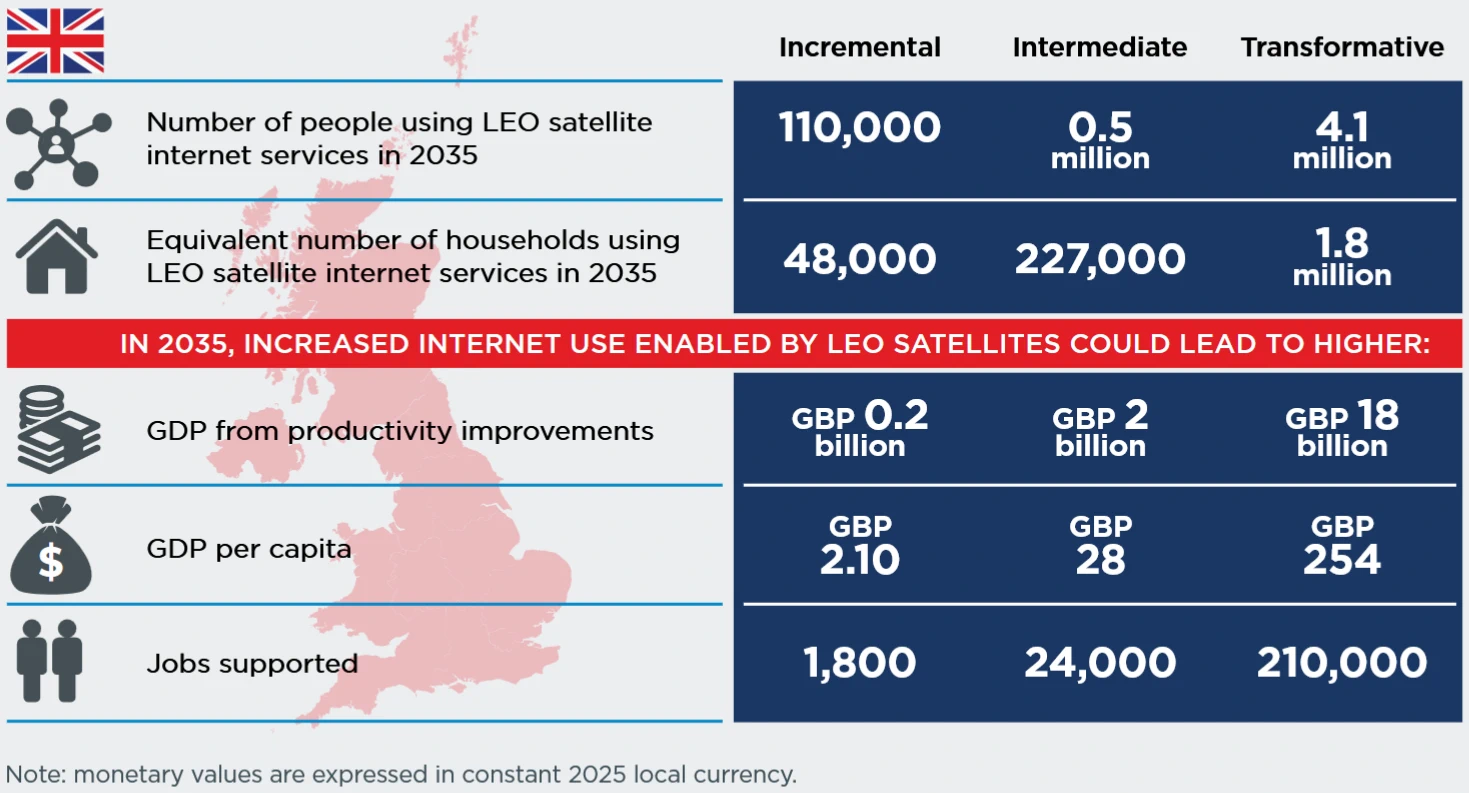
The paper expects that LEO-enabled services will have a relatively subdued effect in its incremental scenario, with an estimated 110,000 UK people using LEO internet services by 2035. As LEO services become more cost-competitive, they expect the number of LEO internet users to increase to almost 0.5 million and 4.1 million in their intermediate and transformative scenarios by 2035.
The productivity increase due to enhanced connectivity is, they forecast, likely to generate an additional £2 billion in their intermediate scenario by 2035, supporting more than 24,000 jobs.
Henry Worthington, Managing Director at Oxford Economics, said:
“LEO satellite broadband has the potential to become an important complement to terrestrial networks by extending internet access to communities that have long been underserved by traditional infrastructure.
Our analysis shows that, under the right conditions, wider adoption could generate substantial economic benefits by improving productivity, supporting digital inclusion, and helping more people and businesses participate in the digital economy.”
As usual, it’s worth taking such claims with a pinch of salt, not least because trying to accurately gauge the economic impact of deploying faster broadband via any technology is notoriously difficult. Part of this stems from the fact that most premises won’t be starting from a point of zero connectivity and other technologies are also improving their coverage (FTTP, 4G/5G etc.).
Advertisement
In addition, we’re all very different in our consumption requirements, and not all homes and businesses get the same benefit from having access to significantly faster speeds than are currently available. Not to mention that we don’t yet know how much Amazon’s own service will cost consumers, although it’ll need to be competitive with Starlink and that’s a significantly more mature service / network.
On the flip side Ofcom have noted that there are around 110,000 satellite broadband users in the UK and most of those are now believed to be on Starlink. As such many are already seeing the benefit of such services and this will no doubt continue to improve.






Mark is a professional technology writer, IT consultant and computer engineer from Dorset (England), he also founded ISPreview in 1999 and enjoys analysing the latest telecoms and broadband developments. Find me on X (Twitter), Mastodon, Facebook, BlueSky, Threads.net and Linkedin.












« Virgin Media O2 UK Sets Out New Net Zero Focused Responsible Business Plan













Privacy Notice: Please note that news comments are anonymous, which means that we do NOT require you to enter any real personal details to post a message and display names can be almost anything you like (provided they do not contain offensive language or impersonate a real person's legal name). By clicking to submit a post you agree to storing your entries for comment content, display name, IP and email in our database, for as long as the post remains live.
Only the submitted name and comment will be displayed in public, while the rest will be kept private (we will never share this outside of ISPreview, regardless of whether the data is real or fake). This comment system uses submitted IP, email and website address data to spot abuse and spammers. All data is transferred via an encrypted (https secure) session.