UK Shows Strong Adoption of Latest Wi-Fi 6 and 7 Standards vs Europe

Internet connection benchmarking firm Ookla (Accenture), which operates the popular broadband and mobile Speedtest.net service and app, has published a general summary of WiFi technology adoption across the world that reveals how the UK has a fairly strong level of Wi-Fi 6 and 7 adoption vs most of Europe.
On these pages we often talk about service speeds from fixed broadband connections. But it remains important to understand that most of the devices we actually connect to such services these days will usually do so via a wireless link to our router, which is often much more variable in its performance than the fixed line component.
Suffice to say that the prevalence of different Wi-Fi standards between devices can have a significant impact upon the broadband performance we perceive at home, with older standards tending to be slower than newer ones. The latest Wi-Fi 6E and Wi-Fi 7 standards can also harness the 6GHz band (big speed boost nearer to your router), as well as being better at functioning in environments that are highly congested by other Wi-Fi networks.
Advertisement
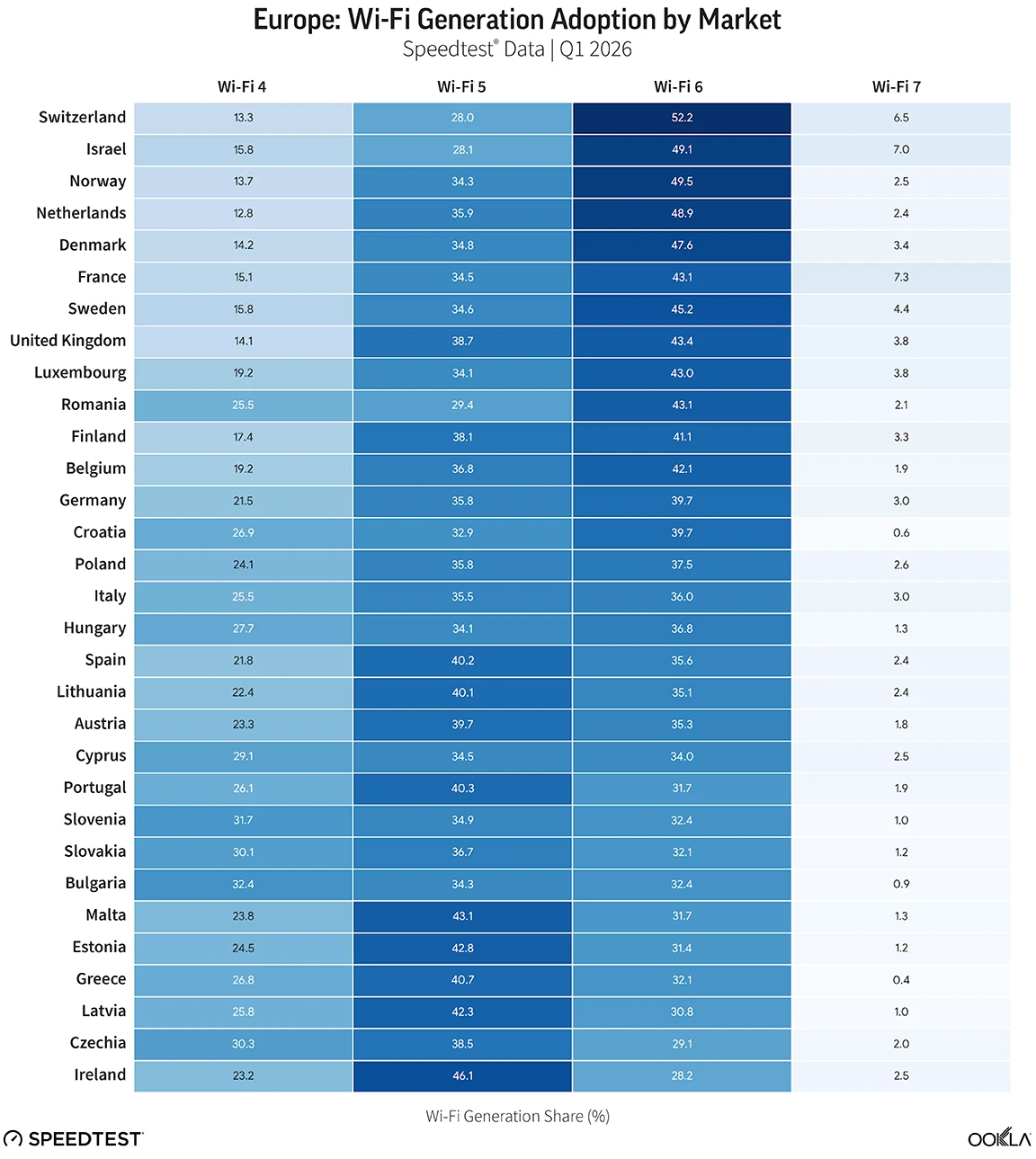
In that sense it’s good to see the latest Wi-Fi data from Ookla, which appears to show that people in the UK have a “relatively” high level of Wi-Fi 6 / 802.11ax (43.4% share) adoption across Europe, with the latest Wi-Fi 7 (802.11be) holding 3.8%. But some 14.1% still use old Wi-Fi 4 (802.11n) technology and Wi-Fi 5 (802.11ac) remains strong at 38.7%.
Ookla Statement
Europe has largely moved in the same direction in allocating the lower portion of the 6 GHz band for unlicensed use, with some markets following hot on the heels of the U.S. allocation of the entire band in 2020. Within the European Union, this was driven by a regionwide harmonization measure, with the European Commission issuing a binding Implementing Decision in 2021 requiring Member States to update their national spectrum plans to accommodate WAS/RLAN use in the lower portion of the band, specifically 5945–6425 MHz, by year-end.
The UK moved separately and slightly earlier, with Ofcom making the lower 6 GHz band available in 2020, and uses the marginally wider 5925–6425 MHz range. Other non-EU European countries are generally pulled toward the same lower-band framework through CEPT/ECC harmonization, although implementation remains a national matter rather than an EU legal obligation.
The upper half, 6425–7125 MHz, remains the live policy battleground, with mobile operators pushing for it to support 5G and future 6G networks, while the Wi-Fi industry continues to argue for broader unlicensed access closer to the U.S. and Canadian model. The UK has moved toward a more explicit sharing model, while the EU process remains more cautious, with recent policy direction pointing toward mobile priority for much of the upper band rather than a full-band Wi-Fi allocation. Despite this relatively early move to 6 GHz, Europe’s adoption of the 6 GHz spectrum trails North America. According to Speedtest data, as of Q1 2026 just 1.6% of the 6 GHz spectrum band in the EU is being used for Wi-Fi. The majority of Wi-Fi usage (66%) in the EU is being handled by the 5 GHz band and that is an increase from 45.7% in Q1 2022.
At the country level, France has the highest percentage of Wi-Fi in the 6 GHz band compared to other EU countries, with 8.6% of Wi-Fi usage as of Q1 2026, followed by Norway with 6.5%. Some European countries, like Spain, which feature among the highest levels of fibre coverage in the world, exhibit notably lower usage of the 6 GHz band (reflecting the focus on price competition, like in Italy, rather than CPE differentiation and in-home experience, in contrast to the “box war” in markets like France).
We should point out that most people will have a patchwork network of devices that will mix different Wi-Fi generations and capabilities, but obviously the most important ones for performance are your main broadband router and the devices you use to get online for daily tasks and entertainment (Computer, Smartphone etc.).
Overall, the global speedtest data shows Wi-Fi 7 emerging with just a 1.8% share of samples in Q1 2026, but that will change over time. For example, Wi-Fi 6 has risen – globally – from just 6% in Q1 2022 to 27% in Q1 2026, while there has been a gradual decline of older Wi-Fi 5 and Wi-Fi 4 generations, which fell to 39% and 34% respectively.
Advertisement






Mark is a professional technology writer, IT consultant and computer engineer from Dorset (England), he also founded ISPreview in 1999 and enjoys analysing the latest telecoms and broadband developments. Find me on X (Twitter), Mastodon, Facebook, BlueSky, Threads.net and Linkedin.












« Possible Hints of O2 Broadband Revival Surface via New UK Full Fibre Plans

















ISP supplied routers will go a long way towards promoting this. If you move providers or upgrade your package and get a new free box to use with it then you’re going to be using the later standards without realising it, rather than someone who spent hundreds on their own kit years ago and thinks they still haven’t got their money’s worth (and no more security updates either).
I got my router around 3 years ago, it has Wi-Fi 6, until I changed my phone last year it was only my mac that supported it and I never use Wi-fi on the Mac. Unless the router goes wrong I am not going to change it, no point, it works fine, just sit in the corner of the room and left to do what it does. Been no updates since early last year. I don’t think I would spend hundreds, but I did think at one time of making my own, just for a project.
Yes you are right about people getting new routers from ISPs, I do think that they give far too many of these things away.
My brother is with Zzoomm and they now give out a Heights telecom router, Wi-fi 7, not that he will ever take advantage of it, but the router is certainly better than what they used to give out.
As for people using Wi-fi 6 and 7, how do Ookla know this? Speed tests don’t show this.
>> As for people using Wi-fi 6 and 7, how do Ookla know this? Speed tests don’t show this.
I would guess their smartphone apps are able to read the Wifi connection details.
@john_r, I wonder if that is in the T&C of using their app,
I have a couple of tp-link m4r and I’m the exact person you describe, not worth spending to upgrade. I have, however, started using OpenWRT on them and the change is really good! Roaming between the APs is no longer noticeable and speeds are good. Also, my Sony TV will finally connect to WiFi, as having fast roaming enabled on the original firmware would make the TV unable to connect.
Each room has ethernet so I don’t care about WiFi performance. It’s still better than my internet speed.
Customer’s often pester for Wi-Fi 6 & later on an ISP Router but it often leaves their older Wi-Fi 4 devices and IoTs out in the cold. Best practice is to deploy Wi-Fi 6 and later on its own Wi-Fi APs.
What wifi 6+ routers don’t also support wi-fi 4 devices? I’ve never had a problem.
Wasteful practice is to use separate access points, unless you have enough of these older devices where the inefficiency might cause a performance hit and it actually is worth having it on its own channel
Best practice is to use the “compatibility” mode as many ISP routers now offer. Especially important for WiFi 7 because MLO (“bonding” multiple bands together) does not permit split SSIDs as so many people blindly insist on doing, but also because it provides better switching between bands.
What? High adoption? My router is still WiFi 4/5 and Virgin sent it out to us about half a year ago (upgrade from Hub 3 to Hub 4).
I also come across quite a lot of WiFi networks that are still on 4/5. BT’s city centre WiFi network mostly is here, I think my college uses mostly that as well.
I’ve never even come across a 6GHz connection personally. I have a 6e phone (although not entirely sure if Google is locking 6GHz out) and now a 7 laptop.
The Hub 4 was released in 2019, so of course it won’t have Wi-Fi 6 or 7.
The Hub 5, released in 2021, has Wi-Fi 6 though.