Scientists Overcome Atmospheric Turbulence in Open Air Laser Data Links
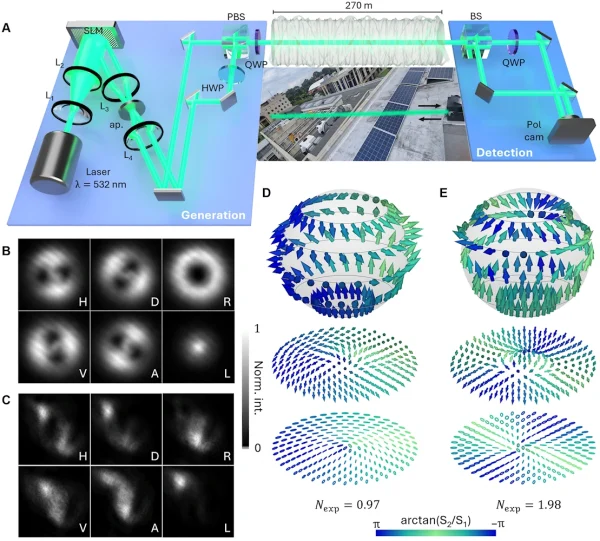
One of the biggest problems with using direct optical (laser) links in free space (i.e. out in the open air) between sites is that atmospheric distortion (turbulence) over distance can create interference, which causes the data speeds to slow and stability to weaken. But a solution may have been found by a joint team at Wits University (South Africa) and the University of Bordeaux (France).
The research, published in Science Advances, demonstrated how it is possible to send a 270-metre free-space optical link between two points without needing complex systems to correct for atmospheric distortion. In this case, the test shot a laser beam across a university campus in Johannesburg.
In order to achieve this the researchers found a way of encoding information using particle-like topologies of light in the form of skyrmions (i.e. tiny, vortex-like magnetic swirl structures), which were found to be “highly resilient to the effects of real-world atmospheric turbulence“.
Advertisement
The idea itself isn’t what’s new here, but rather the fact that this team were able to demonstrate it working in a practical setting.
Study Summary
We create and transmit these particle-like topologies of light through a 270-meter free-space optical link, revealing their robustness across a wide variety of conditions and turbulence strengths. While we observe severe distortion in the states’ underlying degrees of freedom, we show that the topological numbers are preserved in all cases.
We account for fast changes to the medium, where the channel produces statistically averaged outcomes, by probing the state’s decoherence, showing that while the degree of polarization consequently decays, the topology remains intact. Using topology, we show that information can be transmitted through the channel with almost perfect fidelity (>98%) in most cases, only decreasing to 86% in the most severe conditions tested.
This work demonstrates the potential for optical topologies as reliable and robust information carriers in a real-world environment and points to the potential for other complex channels too, offering attractive features for classical and quantum communication alike.
In the modern world we tend to get around a lot of the problems caused by atmospheric distortion by sending our laser signals – using the different properties of light (including colour, intensity and polarisation) – through fibre optic cables. But the new method suggests it may soon become possible to send open air laser signals at faster speeds and over longer distances than before, using a much simpler approach.
Conventional free-space optical communication systems often need to measure atmospheric distortion and then compensate for it using specialised hardware and complex calculations. The new approach does not require the distortion to be measured or corrected before the information can be recovered.
“To explain its benefits, we can liken it to how a coffee mug can be reshaped into the form of a doughnut,” says Prof Andrew Forbes, Head of the Structured Light Lab in the Wits School of Physics. “Despite their very different shapes, both have a single hole. You can stretch or distort them without changing that fundamental property. In the same way, the light beam can become badly distorted while its topological information remains unchanged.”
Advertisement
The researchers also explored applications for both conventional and quantum communication, where maintaining the integrity of information is particularly important.






Mark is a professional technology writer, IT consultant and computer engineer from Dorset (England), he also founded ISPreview in 1999 and enjoys analysing the latest telecoms and broadband developments. Find me on X (Twitter), Mastodon, Facebook, BlueSky, Threads.net and Linkedin.
























Privacy Notice: Please note that news comments are anonymous, which means that we do NOT require you to enter any real personal details to post a message and display names can be almost anything you like (provided they do not contain offensive language or impersonate a real person's legal name). By clicking to submit a post you agree to storing your entries for comment content, display name, IP and email in our database, for as long as the post remains live.
Only the submitted name and comment will be displayed in public, while the rest will be kept private (we will never share this outside of ISPreview, regardless of whether the data is real or fake). This comment system uses submitted IP, email and website address data to spot abuse and spammers. All data is transferred via an encrypted (https secure) session.