NASA Tests Space Laser Network to 267Mbps with Cat Video
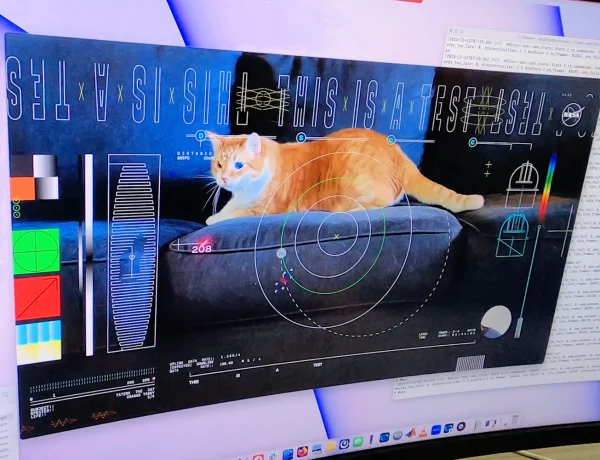
Space cat! Nasa’s Jet Propulsion Laboratory (JPL) in California claims to have recently conducted the first video stream from deep space using lasers via their new Deep Space Optical Communications (DSOC) network, which naturally consisted of a 15-second video featuring “Taters” the cat chasing a laser cursor.
The 4K video itself was transmitted on 11th December 2023 from nearly 19 million miles (or about 80 times the Earth-Moon distance) away. The signal took about 101 seconds to reach Earth. The video was sent at the system’s maximum bit rate of 267Mbps (Megabits per second), although the stream itself actually varied a lot – between around 1Mbps and 100Mbps – due to compression and the changeable nature of the content being displayed.
Capable of sending and receiving near-infrared signals, DSOC’s flight laser transceiver – a cutting-edge instrument aboard Psyche – beamed an encoded near-infrared laser to the Hale Telescope at Palomar in San Diego County, California, where it was downloaded. Download performance is more relevant for research missions like this and the test video only shows a miniscule upload speed of 1.6Kbps (Kilobits per second).
Advertisement
The tech demo is designed to transmit data from deep space at rates 10 to 100 times greater than the state-of-the-art radio frequency systems used by deep space missions today, which would make it useful for sending complex scientific information, high-definition imagery, and video back home.
This latest milestone comes after “first light” was achieved on Nov. 14. Since then, the system has demonstrated faster data downlink speeds and increased pointing accuracy during its weekly checkouts. On the night of Dec. 4, the project demonstrated downlink bit rates of 62.5 Mbps, 100 Mbps, and 267 Mbps, which is comparable to modern home broadband speeds.The team was able to download a total of 1.3 Terabits of data during that time.
As a comparison, NASA’s Magellan mission to Venus downlinked 1.2 Terabits during its entire mission from 1990 to 1994.
Bill Klipstein, the tech demo’s project manager at JPL, said:
“One of the goals is to demonstrate the ability to transmit broadband video across millions of miles. Nothing on Psyche generates video data, so we usually send packets of randomly generated test data. But to make this significant event more memorable, we decided to work with designers at JPL to create a fun video, which captures the essence of the demo as part of the Psyche mission.”
One obvious risk here is that a sophisticated enough alien race might intercept the transmission, decode it, and asses that Earth is populated by a highly intelligent species of feline. Just imagine their surprise when they find out it’s actually populated by lesser intelligent humans who have long since enslaved felines, or perhaps that’s just what cats want us to think?
Advertisement
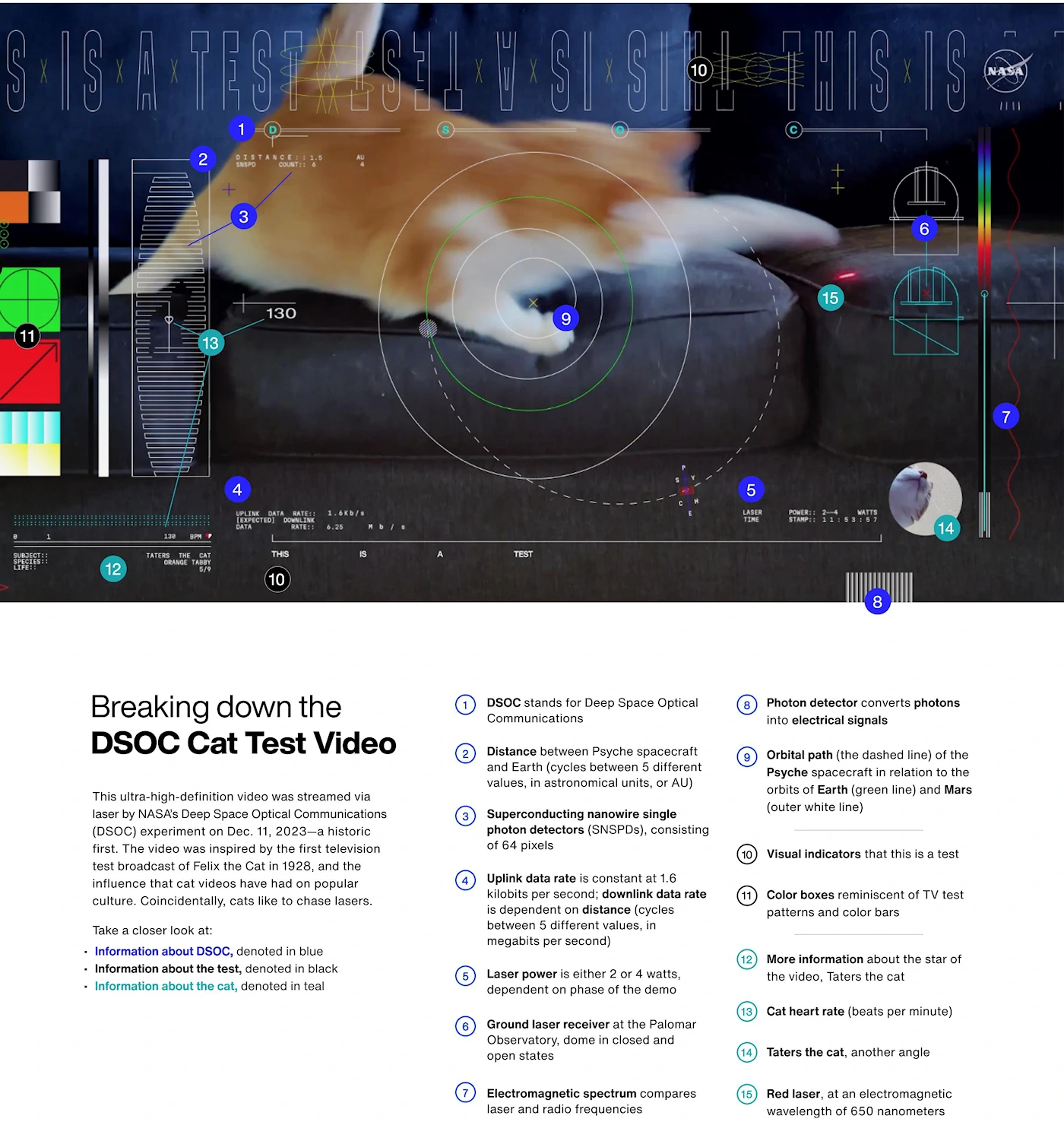
Now, if you fancy learning what all those figures in the cat video actually mean, then take a gander at this cheat sheet.






Mark is a professional technology writer, IT consultant and computer engineer from Dorset (England), he also founded ISPreview in 1999 and enjoys analysing the latest telecoms and broadband developments. Find me on X (Twitter), Mastodon, Facebook, BlueSky, Threads.net and Linkedin.












« Wessex Internet Start Project Gigabit Broadband Build in New Forest

















Good to see that NASA know what the Internet is for.
Avenue Q were right in 2003 but, 20 years later, NASA know.
The internet is made of cats after all.
“the test video only shows a miniscule upload speed of 1.6Kbps (Kilobits per second).”
Cue all the people complaining about asymmetric connections again.
But cats.
The BBC’s writeup says
“Despite transmitting from millions of miles away, it was able to send the video faster than most broadband internet connections,” said JPL electronics lead Ryan Rogalin.
The video was received by the Hale telescope at the Palomar observatory, where it was downloaded.
From there it was streamed to the JPL and played there in real-time.
Mr Rogalin said the connection over which the video was sent from the Palomar observatory to the JPL base was actually slower than the signal transmitting the clip from space.
Source = https://www.bbc.co.uk/news/technology-67721671
19 million miles away – makes all the whingeing about installing the last mile of fibre sound a bit pathetic.
Is there a secondary function ascribed to this NASA device ? . . . .one which would focus on warming the backsides of CEO’s of slow moving terrestial consumer communication companies in the UK ?
Please, please, let it be so !
It makes me laugh
They can achieve a connection in outerspace better connection what I can get. 19 Millon miles away
I’m getting 10M uso and still on copper cabling,5 miles from the exchange, progress in the UK.
Can you not get Starlink? Fair bit cheaper than this link.
Frickin sharks with laser beams attached to their heads.