AzurePCS Develops UK Community 4G Mobile Broadband Network in a Box
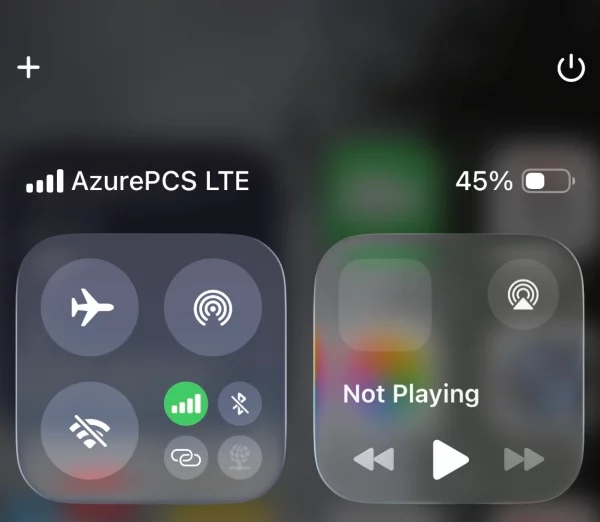
Fancy setting up your own private 4G mobile broadband network? A hobbyist club of UK mobile network enthusiasts has banded together to create AzurePCS, which enables individuals or small communities to legally deploy indoor 4G mobile data coverage using Ofcom’s Shared Access spectrum (LTE Band 40 – 2300MHz).
The idea is partly to give people an alternative to relying on WiFi or unlicensed solutions. The network itself is said to be based around LTE [4G] Baicells femtocells (i.e. mini-indoor base stations for mobile signals), which connect back to their centrally hosted core network over standard broadband. The LTE EPC (core network) setup they’re using also harnesses an open source project called Open5GS.
Naturally, each femtocell operator must also be able to obtain their own Ofcom Shared Access licence (currently £80/year for 10 MHz or £160/year for 20 MHz). “We can help guide them. In most cases, people can obtain an indoor-only licence, unless they are located close to Ministry of Defence sites, as the MoD are the incumbent users of this band,” said Alex of the AzurePCS project.
Advertisement
So far as community driven UK telecom projects go, this one is really quite interesting, but it’s worth noting that there are some limitations to this approach. The network that is established is only able to deliver a 4G (LTE) data / internet connection because they don’t have an interconnection with public networks, which means no external calls or text (SMS) messages to mobile users on other networks (or emergency calling).
However, you can send internal SMS (text) messages between other AzurePCS users, while external SMS is being looked at as a future development. Voice-over-LTE (VoLTE) is also under testing for internal calls, although at present it’s intermittent and only seems to work reliably on Samsung phones.
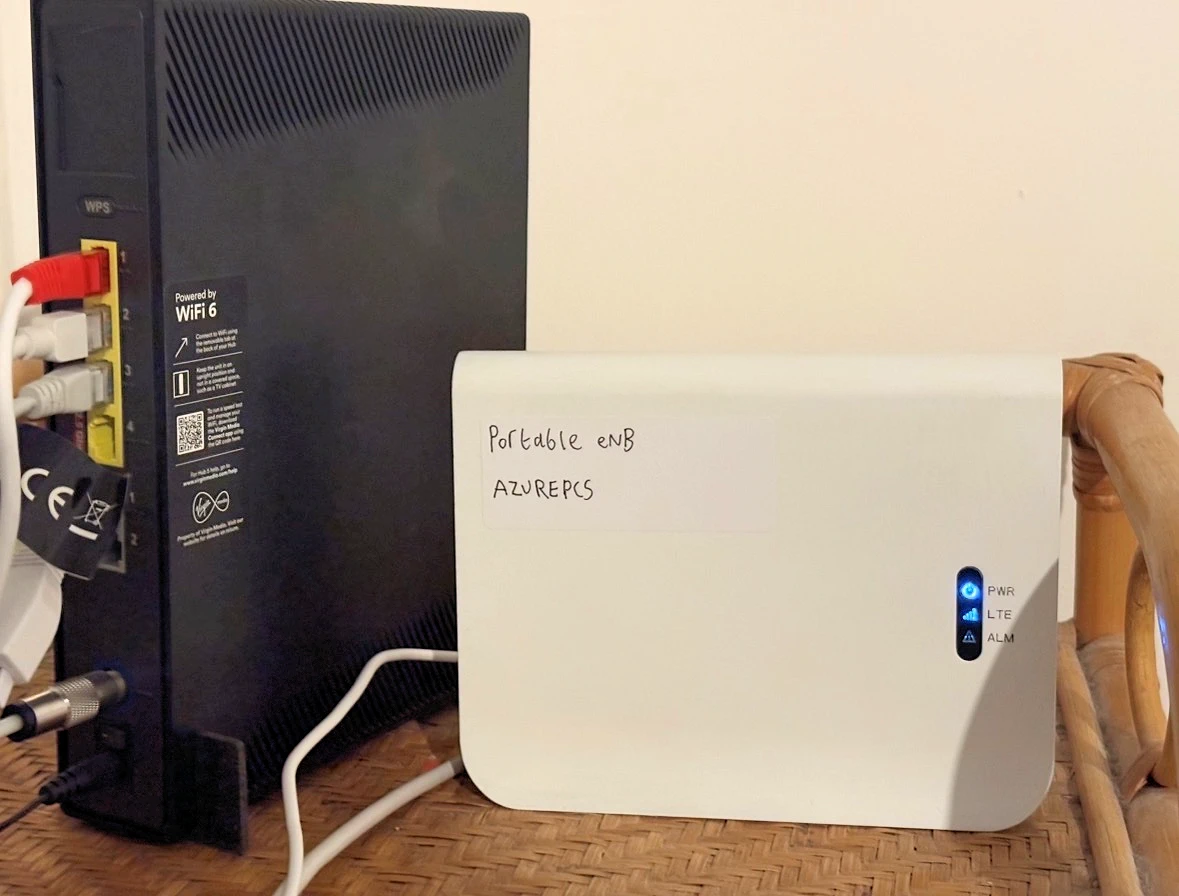
“It’s very much an experimental, evolving project for people to join and have fun with,” said Alex to ISPreview. In other words, anybody looking to deploy this network won’t be doing so as part of a professional service, but more as a hobbyist platform for experiments or unique community projects; it is clearly not designed to replace a real mobile network.
Advertisement
Alex said:
“We’re actively building and testing a 2G core network by osmocom, with the longer-term aim of supporting combined 2G + 4G femtocells to enable internal circuit-switched calls and CS fallback, improving device compatibility and resilience.
Importantly, this isn’t a commercial MVNO or ISP product. There’s currently no usage fee, and in future we may introduce a voluntary £2/month membership tier purely to help cover hosting and operational costs. The goal is experimentation, education, exploring how shared spectrum and community cellular networks could be used in the UK alongside general fun for fellow hobbyists like myself.”
At the time of writing, AzurePCS hadn’t yet launched their shop with the necessary hardware for purchase, but that’s expected to happen very soon (due next month). One other thing to be aware of is that this setup should work on most fixed broadband connections, but some ISPs (e.g. Vodafone) may adopt parental or network-level restrictions that cause connectivity problems.
For example, some ISPs block UDP port 500 and 4500, which are required for the IPsec tunnel used by the femtocells to securely connect back to the AzurePCS core. If these ports are blocked, the femtocell cannot establish a connection. Equally, some consumer broadband connections may have restrictions in their T&Cs that could forbid running certain types of hosted networks or servers , although this is rarely enforced (business packages usually allow it).
Finally, the network will work on almost all devices (Smartphones) that support LTE Band 40, although there is one exception for some Apple iPhones (iPhones older than version 12 won’t connect due to the fact AzurePCS use a private (999) PLMN).
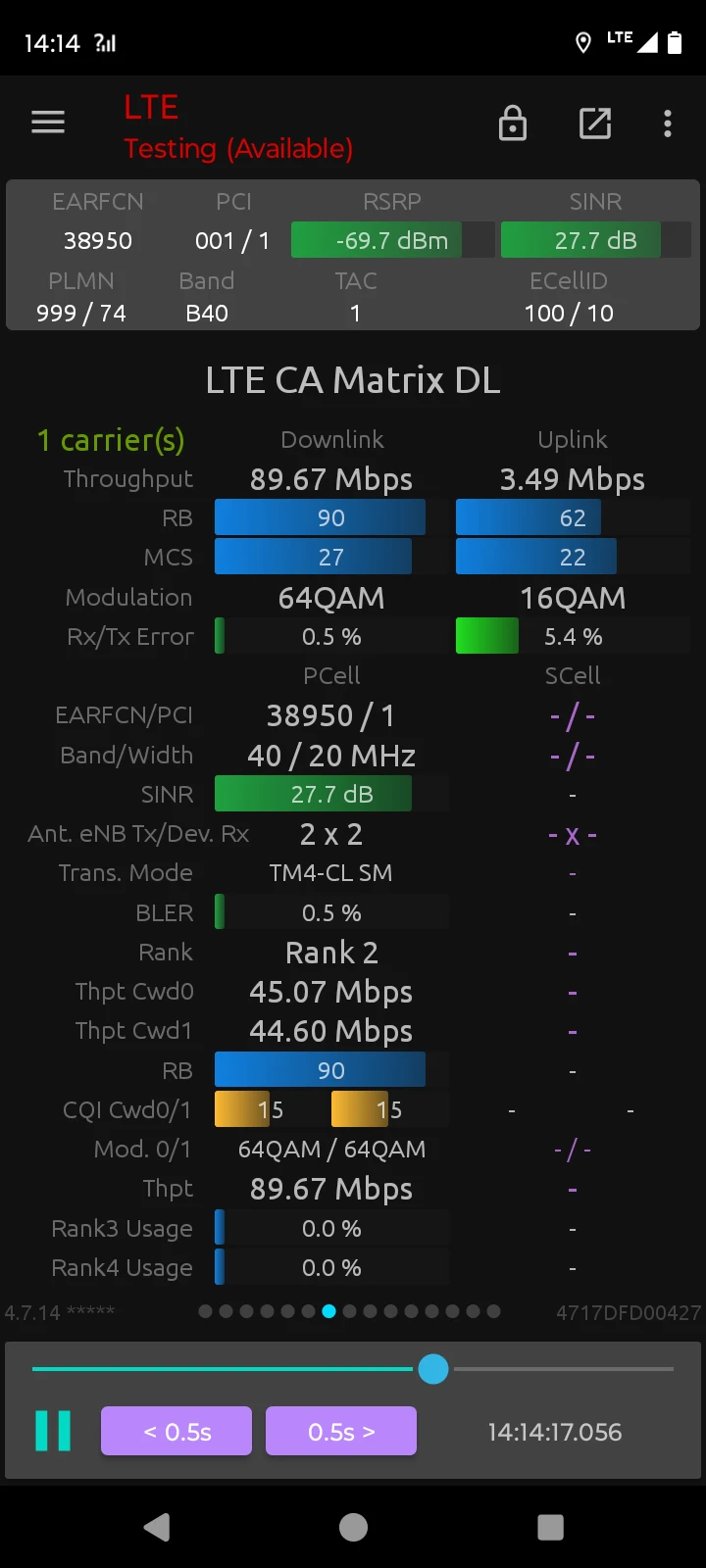
Now, for those who like mobile network stats, here’s a live example of the setup in operation..
Advertisement






Mark is a professional technology writer, IT consultant and computer engineer from Dorset (England), he also founded ISPreview in 1999 and enjoys analysing the latest telecoms and broadband developments. Find me on X (Twitter), Mastodon, Facebook, BlueSky, Threads.net and Linkedin.









« Wiltshire UK Council Take Openreach to Court Over Broadband Permits UPDATE













Covering this too mark?
Sky has announced a “world-first” single TV subscription combining some of the biggest streaming services for only £24 per month
HBO Max, Netflix, Disney+ and Hayu will all be included in the package. The Sky Ultimate package comes with ad-versions of Disney+, HBO Max and Netflix.
Covered that on 11th.
Fair enough – sorry couldn’t find the address to mail you on
I would like this to be pretty cheap standard setup now what we have Starlink and you can carry your mini-tower anywhere you are or go. Years ago you could buy cheap inhouse repeater over broadband.. why all these disappeared rather than flourished?
Also why shouldn’t every router have a basic microchip that does smart 100meter software defined radio like femptocell for the house/garden/neighbours? That would do so much for resiliency now all that talk about prep for war pandemics etc.. Would solve lots of connectivity issues at little cost.
I think WiFi calling rather put an end to femtocells.
Actually someone on YT did a video about something like this 304 years ago. It was wifi in a box and it was Either Zac or Linus – I will try and find it – but this has been out there for a while now so not sure AzurePCS should take the crown.
That’s quite the word salad. Fascinated by what kind of useful comms can happen in the 3Mhz band.
I think that concept (femtocell in every CPE) was in Peter Cochrane’s mind when he pushed for universal FTTP back in the 80’s.
But we got mini cable franchises instead, because reasons.
Looking at the open5gs.org project, everything is nicely described, there are diagrams, the hardware you need to buy is specified, and the software you need to install is listed along with the configuration.
In contrast, AzurePCS looks like some kind of mysterious project that very little is known about. It’s unclear what hardware to purchase or what software to use to get started. It feels more like they want to start selling ready-made products right away.
Do you know what app the screenshot at the end of the article is from?
Hey Jim! It’s called Network Signal Guru. Your phone needs to be [unlocked and] rooted for it to function. An alternative could be ‘Cell Mapper’ & ‘LTE Discovery’ for network information. Those are the two I use.
Network Signal Guru (NSG)
Might be the Network Signal Guru (NSG)