Virgin Media O2 UK Trial More Cost Effective Rural 4G Small Cells in Scotland

Broadband and mobile giant VMO2 (Virgin Media and O2) have teamed-up with the Scottish Futures Trust (SFT), University of Glasgow, VoltServer, ATS and KTL to demonstrate how mobile connectivity, power delivery, fibre backhaul and IoT services can be combined into a single unified infrastructure at a “fraction of the cost of traditional approaches“.
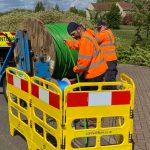
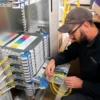
The demonstration, which has been part-funded by the Scottish Government, essentially involved deploying a more cost-effective 4G Small Cell at Cochno Farm, the University of Glasgow’s teaching and research farm. Using VoltServer’s Digital Electricity technology, the solution also safely delivered power and fibre over a single small-diameter cable across distances of up to 2km, “removing one of the most significant barriers to rural small cell deployment“.
The 4G base station being used, developed by the University of Glasgow and built to the Joint Operators Technical Specification (JOTS), also operates as a multi-operator neutral host, meaning it can serve customers across multiple mobile networks from a single piece of shared infrastructure. As another bonus, the same power backbone also supports an on-site EV charger.
Advertisement
David Owens, Head of Technical Trials at VMO2, said:
“Following our successful 5G Drive Project, this initiative was driven by our ambition to find practical, scalable ways to reach customers wherever they are. Working with the Scottish Futures Trust, VoltServer and the University of Glasgow, we’ve shown how mobile infrastructure, power, fibre and IoT can be deployed as a single, cost-effective solution.”
Business Minister, Richard Lochhead, said:
“This innovative pilot at Cochno Farm shows how collaboration between industry, academia and government has the potential to deliver practical and affordable advanced wireless connectivity solutions for our rural communities.
“I’m pleased that Scottish Government funding has supported the University of Glasgow, Virgin Media O2 and partners in making it possible. Initiatives like this represent an important step towards a more connected, resilient, and energy-efficient Scotland, giving businesses and communities greater opportunities to benefit from the digital economy.”
The new connectivity at the trial site underpins a broader programme of agricultural research, linking livestock monitors, environmental sensors and farm management systems into a single connected network. But it’s clear that this approach could be expanded to make certain rural deployments of 4G and 5G Small Cells more viable in the future.






Mark is a professional technology writer, IT consultant and computer engineer from Dorset (England), he also founded ISPreview in 1999 and enjoys analysing the latest telecoms and broadband developments. Find me on X (Twitter), Mastodon, Facebook, BlueSky, Threads.net and Linkedin.











« BT to Close Older UK Contact Centres in Accrington, Blackburn and Doxford

















That’s stupid.
This statement: “Joint Operators Technical Specification (JOTS), also operates as a multi-operator neutral host, meaning it can serve customers across multiple mobile networks from a single piece of shared infrastructure”, is a little disingenuous. A JOTS based cell isn’t truly Neutral Host, it is actually a network extension at S1 for each operator that wishes to connect. It’s ultimately under the control of the host operator, and isn’t really neutral at all except perhaps by ownership.
By far the biggest barrier to MOCN based NH being a thing is the lack of a block of spectrum that’s shared by all operators to facilitate hand-in/out. With this, even though the cell itself would be owned by a neutral party, all operators could join via an S1 gateway.
Either way, well done to David and the team. Good to see O2 taking rural coverage seriously.
“Digital Electricity technology”
I just want to point out that 1 April is next week!
The VoltServer stuff is actually pretty cool – think PoE on steroids. There’s no IP routing on that cable, but it’s regular CAT6 and can carry kilowatts of power safely.