Council Tell Openreach to Remove External UK Broadband Boxes from Homes
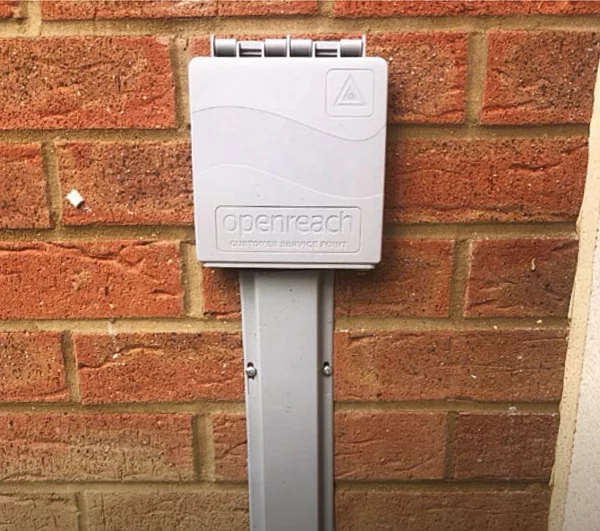
The City of Bradford Metropolitan District Council (CBMDC) in West Yorkshire has told UK broadband and phone operator Openreach (BT) to remove their external wall boxes (CSP) from homes within the World Heritage Site area of the city, such as those around the Saltaire UNESCO area and possibly others. Such boxes are usually installed as part of copper and fibre deployments.
According to locals in the affected area (special credit to ISPreview readers Danny and Chris for the tip), residents recently began reporting that men dressed as Openreach engineers had been dropping letters into homes where they’d previously installed the wall boxes (these are better known as ‘Customer Service Points‘ – CSP).
The letters state that Bradford City Council recently advised Openreach that, during local customer installations of their new copper and full fibre (FTTP) broadband services, the operator had installed a CSP “on the front elevation of your property … As you may be aware, Saltaire is a designated World Heritage Site, and properties within this area are classified as listed buildings. Bradford City Council have asked, given this is a heritage site, that the apparatus [pictured above] needs to be removed from the outside of the building.”
Advertisement
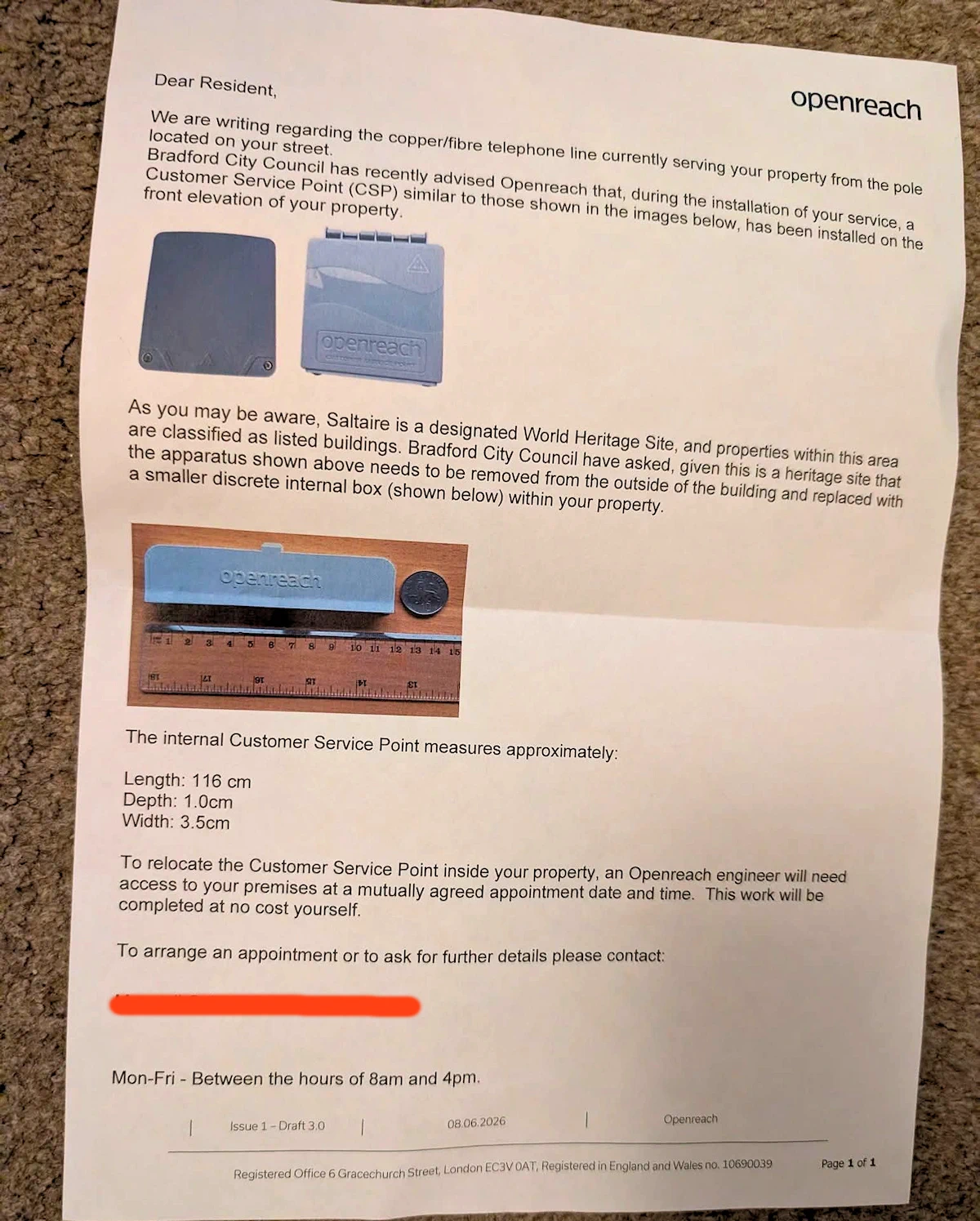
The notice goes on to state that Openreach would then install a “smaller” and more “discrete internal box” within impacted homes. A copy of the letter can be found below (article continues below) and promptly caused some residents to question whether it was legitimate or not via local Facebook groups.
Picture of Openreach’s Letter to Local Homes
A spokesperson for Openreach told ISPreview:
“The letter is genuine, we’re dropping all properties with an external CSP within the World Heritage Site area with a view to changing the install, so it has a small internal CSP. The plan is to give them all a letter and follow up in person to try and arrange appointments.”
The good news is that the perhaps mildly embarrassing episode will be corrected free of charge by the operator, although arranging all that work to take place across local homes is naturally a bit of a chore and one that may put some unexpected short-term pressures on local engineering resources.
Advertisement
Otherwise, it’s not the first time that we’ve seen network operators being asked to shift a piece of their infrastructure in protected areas, although only very rarely have we ever seen this take place across multiple homes at the same time (it normally occurs due to singular incidents).






Mark is a professional technology writer, IT consultant and computer engineer from Dorset (England), he also founded ISPreview in 1999 and enjoys analysing the latest telecoms and broadband developments. Find me on X (Twitter), Mastodon, Facebook, BlueSky, Threads.net and Linkedin.











« UK Wireless Internet Services Providers Association Set to Close Down

















116cm seems rather tall for an internal box..
It’s about as long/wide as the first CSP pictured with the obvious hinge is tall. The one on the left in the letter is about 80mm x 90mm.
@Steven I think you’ve missed that there’s a (hopefully) typo on the letter, it does indeed say 116Cm (or 1.16 meters!) in length.
People buying homes in this area likely knew that they’d be subject to planning restrictions on listed buildings but I doubt they ever thought their broadband boxes would cause a problem.
This almost seems.. petty, given the boxes are already there.
how high up the wall is the capping from the UG feed to the box ? why are the new houses built then called a Heritage site ?
You are misunderstanding, there are no new builds involved, these are all stone houses built between 1851 and 1871. They are listed and protected because of the heritage of the village, also they are beautiful and totally surrounded by buildings from the same era. It’s a beautiful village and UNESCO rightly protected it. These installations are an oversight by someone not familiar with the area, even Openreach are giving no push back. Nothing petty about it, they are enforcing long standing planning laws to protect a very beautiful and significant place.
I live in this area (although not in the World Heritage site), you can’t even have double glazing in the heritage area homes. Houses in Saltaire are noticeably cheaper than similar homes in non-affected areas because of all the onerous restrictions.
@BPCJames Yes, broadband boxes on the outside of a house are a significant modification to a building that completely ruins the character of the entire building.
Talk about precious.
Looking at Saltaire from Google, including property’s for sale and so far, at number 19 I can see the OpenReach fibre termination box, but no capping. The OpenReach box is also grey, I suspect it could be painted or with a sticker(which will probably fade)…
Typical of local planning Nazis. God forbid a listed building be dragged into the 21st century. Absolutely petty. If I were in charge of open reach I’d remove all the cables and tell them to find some other provider.
Not really up to local councils, Rakesh. Heritage England will be all over them. With vociferous language like that take it you’ve had some planning application declined?
Should block out the phone number
Shame Openreach didn’t make their CSP boxes available in black or dark brown (as VMO2 does). Would have been much less intrusive.
its the capping over the UG feed that makes the installation worse but that only comes in grey
Openreach only supplies grey capping, but other colours and materials available from 3rd parties as an “after market” swap.
Ditto connector bend 4 and cap (when openreach failed to supply one for me I got a brown plastic equivalent online).
May I suggest that rather than removing these and replacing with cables clipped to walls etc that OR could come up with brick coloured boxes (or paint the existing ones) for use on heritage buildings ie camouflage them
ref making the boxes blend in, indeed a top idea, I’ve heard of people colouring satellite dishes fo the very same reason. Aren’t these Open reach boxes essential infrastructure, that are normally fitted by the builder or developer?
Brick colour matching is much harder than you think.
I’m sure a tin of paint could have done the job (with or without the box – they’ll still want to camouflage the cable?).
I doubt the billions of people who flock to Saltaire every year, which I’m sure everyone knew was a world heritage site before reading this article, will stop doing so if they see a grey box on a few houses.
That said, I do wonder why the operators don’t use different coloured boxes and cables in instances where there’s a close enough match eg a reddish-brown for red-brick premises. Virgin do/used to do it with brown boxes for their cable entry point.
Virgin defo still do. I’ve seen a brand new Nexfibre install in Banbury with one.
I was going to bring my multil billion pound company there – but after seeing a house with a brown VM box on whilst walking up Titus Street, I am now pulling out!How dare they do what the rest of the UK/world does! – what sort of victorian model village is this!?
I know -the council are being a bit pathetic right?
Looking round the area the fibre boxes are by far not the biggest blemish on those houses. Most of them have huge external sewage pipes! A bit petty by the council given that.
sadly that is what councils are like, but when it comes to dealing with on street parking that obstructs buses they do not want to know
Fewer practical/cost realistic options with waste water pipes.
And these can be better colour matched or made to look more “heritage”, will stand out to the eye less.
Even better, the inboound fibre can be attached to these in a hidden way.
If the interior option the for fibre wasn’t possible then the CSP could be hidden behind a fake waste water pipe or guttering downspout. And other possible “hides” (ceramic green man or gargoyle cover?)
Do it, they can re-use one on my house. The area can go back to adsl.
About time Openreach changed the colour of the boxes to a dark colour. The virgin one has a cable going in from the bottom usually and the cable to inside is most often from inside the box so you only see one cable going in. Openreach seem to like two cables being visible as they dont seem to route internal via hole hidden by the box being mounted. This makes most installations look messy,as the cable goes to another hole along the wall. A number of Altnets also do this.
I’ve also had experience with family where Openreach were told no external CSP at all else service install would be cancelled, and they installed direct into building without one.This wasn’t a busy street proeprty, but rural and the cable only entered for maximum of 2 metres before going into an ONT. No doubt someone will claim this broke install rules, but a house is property of the owner NOT Openreach to decide to litter the outside. If you have a stone built house or some other historic built house, you don’t want flimsy plastic boxes that look terrible after a couple of years weathering with branding all over them.
There are lots of houses around us where the VM, Alt-net (and to a lesser extent – OR) technicians and contractors seem to be having a contest to see how big a mess of boxes / wires they can get away with haphazardly splatting across property frontage.
Currently VM seem to be winning the contest for biggest box / least neat fibre runs. Having a premium install option for internal CSP would be fantastic if it ever became a standard product from OR.
Ours is very neat – OR technician moved the capping and installed CSP directly above duct bend – fiber enters house via rear of CSP and up though ducting in wall. I did the internal fiber routing (with his approval), met him at the CSP.
A team of three from CityFibre did an excellent installation for me. Extremely clean cable run from telegraph pole, into the box at the base of my house, through the internal hole in the box and into my house. Just one wire on the outside.
I guess installations vary from person to person but I was very happy with that I got.
In some areas they are already being removed where they are shoved on the outside of terraced houses because the installing contractors state things like ‘has to go there mate, regulations’ to the hapless home owners or tenants who no know better (translates to can’t be bothered / too much work). They are being removed by yobbos coming back from the pub with a hefty boot leaving them dangling free. I have seen several instances of this on my travels.
I waqsn’t aware that an “inside” option was available.
Not that I care in my case (white box onto a white rendered wall).
Would have preferred a brown cable exiting the external CSP to where it enters the wall at a higher level (over brick)–the one incoming to the CSP from the street pavement junction box is black
Pretty sure inside CSP is not an option on domestic installs, but that will be based on policy / OR convenience rather than technical impossibility. Commercial installs support the far neater internal option. The CSP at our community centre is in the office cupboard, grey duct comes up out of the floor.
Need an inside option in case for example the installation was for example to an upstairs flat.
@Peter yes they can install CSPs inside, I’ve seen at least 1 Youtube video where the CSP was installed next to the ONT in a cubby hole in a loft conversion.
I’ve got an internal CSP with a domestic install.
The fibre was to come into the house on the upstairs right next to where the overhead cable was attaching, told them I wasn’t accepting a cable run down to a CSP if all they were going to do was run a cable back up, their solution was an internal CSP. Its so small I never notice it, likely helped by the fact the wall is a grey colour.
Also got them to disconnect and remove the copper cable which was more of a challenge than the CSP, but they did it.
From the streetview (Ada St), it looks like all the CSPs are blocked from view by all the cars parked on the footpath. Streetview is from
… March 2025. The smaller ~80mm wide CSP pictured on the left of the letter would be less obtrusive.
But with all the ariel spaghetti going on, does it really have that big of an impact?
And if you go back to March 2022, above 30 & 31 there looks to be a crowbar holding up power distribution cables near the top
Personally, I can’t honestly see why anyone would want to live in a Grade II listed property, particularly one in a World Heritage Site.
Almost all residential properties in Saltaire are Grade II listed.
So, any external alteration (including telephone lines and TV aerials; satellite dishes are prohibited, at least those visible on an elevation), repair, or extension requires listed building consent and standard planning permission to be obtained; ‘normal’ permitted development rights are also strictly revoked.
So this is one thing that Openreach should reasonably have been able to foresee.
The local planning manager and team likely aren’t really local and not familiar with the place. Mistakes happen and OR seem happy to put it right without a fuss.
Indeed, @BPCJames.
However, Grade II properties should show up in Openreach build searches AFAICT. And they know they can’t do anything (apart from use existing entry points) without listed building/planning consent.
I wonder if they subcontracted the work and didn’t pass the info on…
As you say, no argument from Openreach.
Parts of the town, where I live, used a Rediffusion VHF cable distribution system carrying BBC 1 London, BBC 2 & ITV London, with a local bylaw prohibiting the use of roof mounted TV antennas, there was a reception antenna mast/pylon(to receive the analogue signal) on the estate and some houses had the amplification box, built in the side wall of the garage. Added housing I believe used a galvanised metal box and tube mounted outside, generally on the side of the house, but the 1972 new houses, used a flush Rediffusion box in the brickwork, made of some metal casting, they also don’t seem to rust.
Despite been stuck by lightning and a loss of service for three days, by mid 1970’s too many had stopped paying as they were using in-roof mounted antennas. The pylon was dismantled and it’s former site is just grass, now part of the local recreation area.
For UHF TV, a Pye tele converter was used, from the distribution VHF.
Stevenage also used the same type of system, which was still going, when Cabletel did the installation, I understand there was discounts, for these customers to join Cabletel.
This kind of nonsense is what held back Milton Keynes and Westminster amongst other areas from having better Broadband and Cable TV. It’s funny they think this ruins the city but the trash and flytipping isn’t a problem. This is the last place I’d go to again. I wouldn’t even change trains there if I had to.
Planning rules might have banned outdoor antennas in those areas but did not ban advancement of the cable TV networks that spawned from it.
BT became the owner of those networks as an artifact of history, but they couldn’t operate the networks due to the ban on offering pay TV services. The cable industry stepped in to do that. That prevented any further investment to modernise it into (what was then) state of the art HFC similar to the greenfield networks of the 90s as neither side had a reason to agree to assist their competitor.
Pathetic isn’t it, councils just causing issue to look busy, I’d of love if OR said no and said they would take the boxes / services away, they’d soon get grief from residents.
The boxes are small and bend into the houses after a while, I think I’d notice a more smaller one for some reason lol
Saltaire’s cable TV infrastructure conformed to the strict planning rules enforced on Grade II properties (which were in existence long before before it became a UNESCO site) by avoiding boxes on external walls and avoiding public-facing elevations where they couldn’t route into properties underground, something OR signally failed to do with their CSPs.
Also, this is nothing to do with the council except from an enforcement perspective, which they are legally bound to do. Grade I and II listings is a national designation managed by Historic England, not councils.
Bradford has a heritage site
Yet the poles can remain. It makes little to no sense.
It does and a lovely one at that, had the pleasure of lunch and a walk around on a warm day. It’s rightly protected, shame so much of the rest of Bradford has been allowed to fall into disrepair and resembling a broken toilet.
@ISP worker The poles pre-date the village properties becoming Grade II listed (at least largely). Old/existing structure can be used/reused/replaced. New stuff has to conform to listed building/planning consent when it comes to curtilage issues and UNESCO stipulations.
Can’t wait till they tell the customers they’ll have to replace the entire cable from the CBT
From my experience, I have seen multiple different styles of Virgin Media(Broadstairs been particularly brown, deep and with a tendency to fall open), boxes for Fibre or traditional cable and telephone cable.
The General Post Office used round ones on the 1960’s twin semi-detached houses, one in middle, feading both homes. From the late 1990’s BT ran a grey plastic strip and a terminating box on all the new builds, which I have seen and OpenReach still does.
Redifusion ran cables around Margate, Ramsgate and Broadstairs like string, putting a terminating junction box for each property, as they went along, with the most cables still in-situ, probably because they are owed by a company no one can contact.
Even a smaller “conservation area” box, is going to be a problem, inside means making holes ideally to surface mount them and it won’t be small, OpenReach is going to need to joint the fibre outside and run something similar to 10mm copper microbore in to the ground and from the inside of the property, at a angle, inside a deep metal patress box in the style used for a double socket is going to be required, for a small loop of fibre to be hidden in, with the customers fibre coming out of the box, to a fibre plug for the router, unless OpenReach has a integrated design for the plastic patress cover (probably in some heritage brass, to please the conservation officer).
It doesn’t need to be spliced outside (and that splice would need protecting anyway; that’s why they used boxes in the first place). The replacement fibre would be plugged into the CBT and fed through the wall to an internal box, then spliced to the cable to the ONT.
Should be inside
If only the LPA was as diligent in other areas under their control.
Open reach don’t do the work, that is down to the contractors with the lowest quote. I used to work for BT and they got rid of a lot of staff that dig installations, Even faults on phone lines are handled b contractors now. The box, cables etc ., are ordered by the thousands§, so it makes sense to order one colour to get the biggest discount. When I was o if the customer wanted something special that would take longer it had to cleared by the manager or re booked. I had one customer that wanted an extension in a 2nd floor bedroom but no cables through the house. Had to come back as a two man team and run the cable on the outside wall and through holes drilled through it. Took a while, drill got a reprimand for not completing enough jobs that day
In Great Yarmouth, a Victorian house, now sub divided in to seven flats, is been denied fibre boxes outside outright, as covered in the Great Yarmouth Mercury Newspaper!
Spot the letter typo!
At 116cm, that is ‘smaller’ than the external box? Obviously, the ruler shows what it really is but someone didn’t proof-read the letter. Probably dictated by AI that doesn’t like decimal points, lol.
Letter with 116cm instead of mm another reflection of quality, as was checking for any restriction on the property, simple rules. The fact that some people don’t like and or can’t be botherd to have the rules re-assessed is not an excuse for trying to bodge ways around the rules.
No doubt some would rightly complain if rules be falunted, so the correct approaces are to a) get the rules changed, b) comply with the rules. Unless of course we want more anarchy and problems in the future.
BT simply failed to do it right first time and appart from that failure at least got on and corrected the failue.
Suck it up do it right, first time … you know it makes sense. Though GB seems to have a track record of hardly ever doing it right, let alone first time.
Ye, I noticed from a You Tube video taken in Kewferry Road Northwood, Middlesex, . . where the BBC series the “Goodlife” was filmed, some kindly “Service” provider has installed several long runs of vertically displaced bands of five heavy weight fibre cables between the tops of telegraph poles on opposite sides of the road . . for the avoidance of the “Civils” cost ofburying them in the pavement ?
https://youtu.be/ECztccdutro?is=3I0kgRnKvFUAaehj
(See 12:17 to 12:18)
Good old British policy makers and workmen . . consistently inconsistent . . the Patchwork broadband installation shambles continues.
Who remembers Fablon self-adhesive covering plastic – did they do an antique brick pattern covering ?
CORRECTION:I misread, the video reference points are 23:12 to 24:00
Best way to avoid unsightly cabling boxes and conduits on housing, go wireless. 5G in my area, I can now get 300mbps + down for £6 a month less than BTs full-fibre @ only 50mbps down.
And if I go for an 18 month wireless contract, rather than a rolling monthly plan, its £2 a month cheaper than Community Fibre
About time someone stopped open reach putting shoddy looking boxes and cables when and wherever they like, they should consult with the property owner to agree on position and appearance before they start !
Don’t get me started on the constant digging and resigning of the pavement