Vodafone UK start rolling out IPv6 internet addresses to mobile customers

Customers of broadband and mobile operator Vodafone (VodafoneThree) may like to know that the provider has confirmed to ISPreview that they’ve recently begun rolling out Internet Protocol v6 (IPv6) addresses across their mobile network. The move follows a couple of years after they completed a similar deployment to their fixed broadband platform.
Just for a bit of context. Internet protocol (IP) addresses help connect you and your devices or software with others around the online world – like an ID number for your connection. Unfortunately, the IPv4 address space could only handle 4.294 billion addresses and that supply has long since run dry (except for the resale of existing address pools). This means that network providers will increasingly need to adopt the IPv6 standard in order to continue adding new connections without compromise (e.g. IP address sharing / CGNAT is a compromise that can cause problems).
Sadly, the longer form IPv6 addresses are not directly compatible with older IPv4 addresses and so the two usually need to be run side-by-side (i.e. at least until the vast majority of the world has enabled IPv6). The good news is that there are various ways to resolve this challenge. But implementation does take time, as well as money, and some providers have been dragging their feet for years, with Vodafone’s mobile network being one of those.
Advertisement
The good news is that, over the past few weeks and months (since around late August 2026), ISPreview have been noting a gradual increase in the level of IPv6 adopt on Vodafone UK’s mobile network (AS25135). Crucially this doesn’t just reflect a rise in underlying IPv6 network capability, but also a rise in actual deployment to customers.
In short, after several years of not doing much (i.e. Vodafone’s IPv6 capability for mobile remained at a low c.0.5% level), the level of IPv6 adoption has recently started to rise quite quickly – now reaching c.5-6% and continuing to climb.
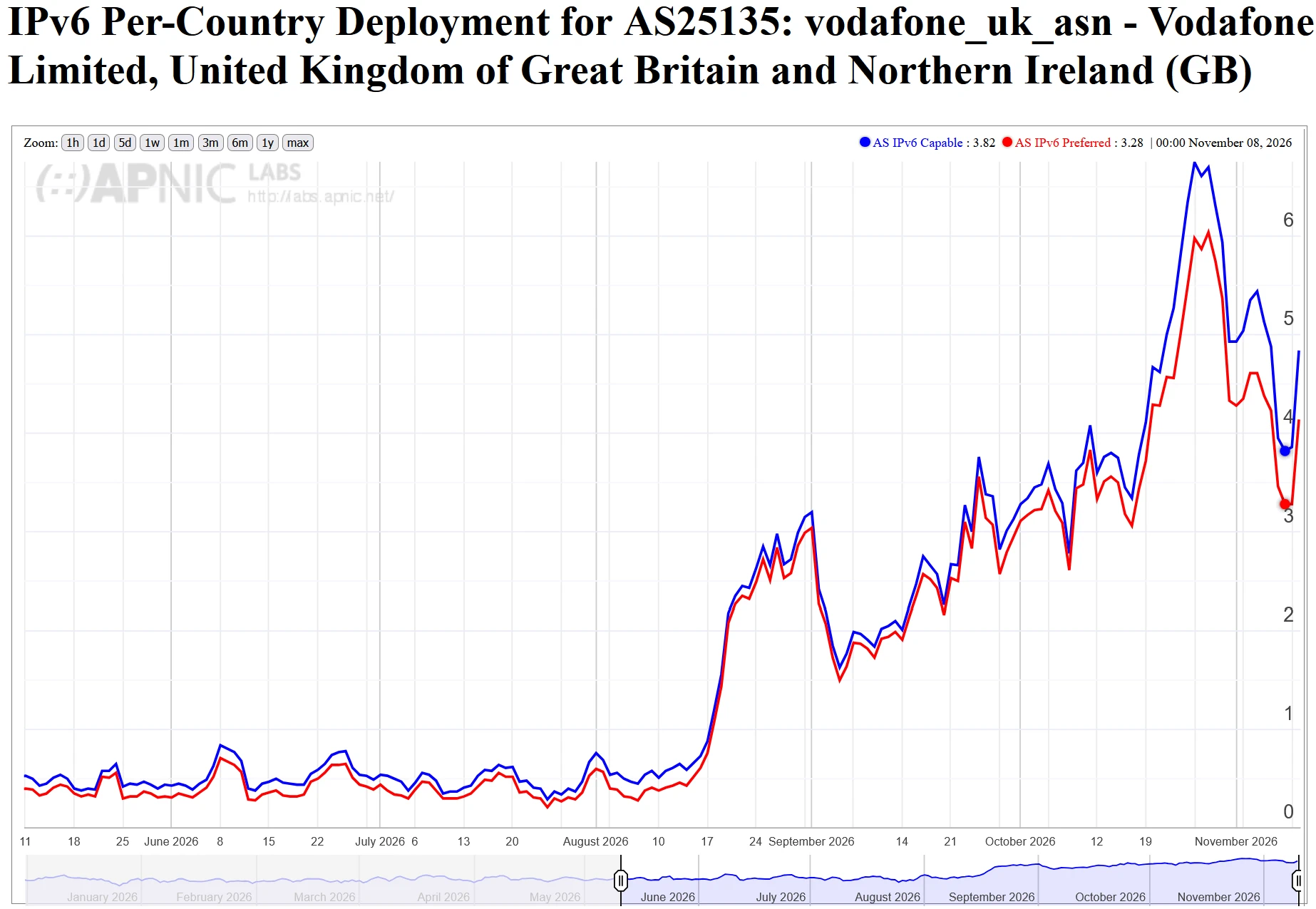
On top of that some of our readers who are also Vodafone mobile customers have, over the same period, reported seeing a working IPv6 address being assigned to their Smartphones.
Advertisement
A spokesperson for Vodafone told ISPreview:
“We have started the official rollout of IPv6 across our mobile network, which will take place gradually over the next year. As the deployment progresses, we will continue to monitor performance and expand coverage as planned.”
The change should come as welcome news, particularly to those making use of Vodafone’s mobile data connectivity, since among other things it means you’re likely to encounter fewer connectivity issues with shared IP addresses – usually stemming from the operator’s use of Carrier-Grade Network Address Translation (CGNAT).



Mark is a professional technology writer, IT consultant and computer engineer from Dorset (England), he also founded ISPreview in 1999 and enjoys analysing the latest telecoms and broadband developments. Find me on X (Twitter), Mastodon, Facebook, BlueSky, Threads.net and Linkedin.










« Openreach prep new Zyxel ONT for 10Gbps capable UK FTTP broadband lines
Advertisement
Leave a Reply
Privacy Notice: Please note that news comments are anonymous, which means that we do NOT require you to enter any real personal details to post a message and display names can be almost anything you like (provided they do not contain offensive language or impersonate a real person's legal name). By clicking to submit a post you agree to storing your entries for comment content, display name, IP and email in our database, for as long as the post remains live.
Only the submitted name and comment will be displayed in public, while the rest will be kept private (we will never share this outside of ISPreview, regardless of whether the data is real or fake). This comment system uses submitted IP, email and website address data to spot abuse and spammers. All data is transferred via an encrypted (https secure) session.















Was with Vodafone over 23 years. Then it stopped working in NE49 9LS.
Would love to come back as Sky is very poor.
Have you re instated the signal here ?
It seems weird you have used your full name and given your postcode in a message. It’s not very good for your online security.
If you want to go back to Vodafone use Talkmobile instead. It’s owned by Vodafone and js basically the same but a lot cheaper
Was with Vodafone over 23 years. Then it stopped working in NE49 9LS.
Would love to come back as Sky is very poor.
Have you re instated the signal here ?
Won’t accept my question !!!!!!!!!!!
Had enough.
This is an industry news site, not a Vodafone support channel. I suggest contacting Vodafone directly, eg. via http://www.vodafone.co.uk.
Go back to bed, Linda
I’m on Three, and I’ve had dual stack for a long, long time on my Android mobile. I find that the IPv6 address is quite sticky, lasting several days. It would be great if it was genuinely static, but at least it’s there. I then use Wireguard or OpenVPN to connect to my Pi or Firewalla for external internet access.
The mobile network doesn’t provide the whole IP address and it can’t be static IPv6. The mobile network provides the first half of the IPv6 address and the mobile then randomly generates the rest, this is known as SLAAC (Stateless Address Autoconfiguration).
Because there are many more IPv6 addresses then there are stars in the universe, for example every square metre on the planet could have 667 sextillion devices with unique IPv6 addresses, the addresses are seen as disposable. To avoid being able to track mobile devices, every so often the mobile disposes it’s IPv6 address and gives itself a new random one.