BT Scrap Pilot to Convert Openreach UK Broadband Cabinets to EV Chargers
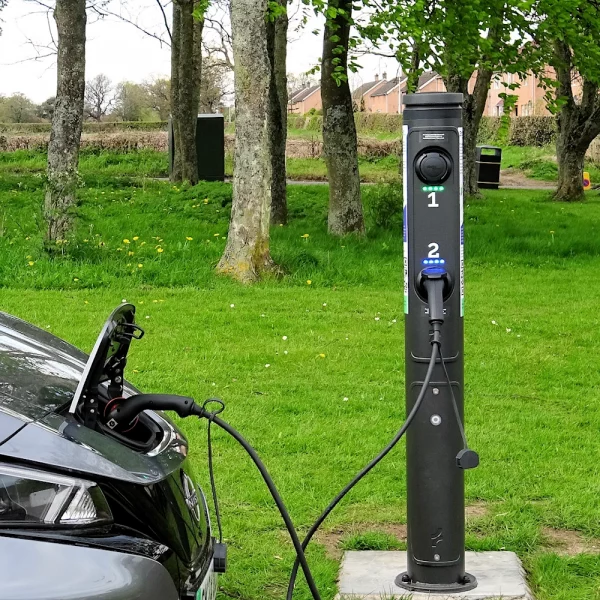
Only a few months have passed since BT’s awkwardly named UK digital incubation team, Etc., “powered up” their first Electric Vehicle (EV) charger under a 2-year pilot, which was one of potentially tens of thousands that could have been established by repurposing Openreach’s old broadband street cabinets. But it’s now being powered down and the whole scheme shelved.
Just to recap. The pilot scheme had been in the works since mid-2023 (here), although the process of actually getting it underway didn’t officially start until January 2024 (here) and the first EV car charger then didn’t do live until May 2024 (here). The core idea was for BT and Openreach to “convert or upgrade” up to 60,000 street cabinets (from a potential pool of 90,000). BT previously clarified to ISPreview that the focus here is on their FTTC (VDSL2) / DSLAM broadband cabinets, rather than older Primary Connection Points (PCP).
The charging solution itself – offering up to 7.8kW – worked by retrofitting the cabinets with a device that enabled renewable energy to be shared to a charge point alongside the existing broadband service, with no need to create a new power connection. EV charging could thus, it was hoped, be deployed to cabinets that are in-use for current copper broadband services, or in those due for retirement, depending on the space and power available to the unit. Such a use case would only grow as more cabinets were decommissioned as part of the wider transitional to full fibre (FTTP) broadband ISP lines.
Advertisement
The first pilot EV charger ultimately went live on Monkmains Road in East Lothian (Scotland) and plans were already in motion for the next phase to focus on the deployment of up to 600 trial sites across the UK, starting in West Yorkshire (England). But Fast Charge broke the news yesterday (credits to Jon for the tip) that the pilot had been “killed” and, according to a notice sent to users of the supporting Evve Charge app, the single pilot cabinet in Scotland would be decommissioned on 14th February 2025.
A BT Spokesperson said:
“Our EV charging trials have focussed on how we might help address the charging needs EV drivers face across the UK. By adopting a pilot process we have been able to test and explore a great deal about the challenges that many on-street EV drivers are facing with charging and where BT Group can add most value to the UK EV ecosystem.
Other emerging needs we’ve identified include the Wi-Fi connectivity challenge surrounding EV’s – our pilots will now shift in focus to explore this further.”
Naturally, this approach was never going to work in every location, since not all cabinets are suitably positioned and there may be other obstacles too (e.g. issues of council approval, road access, physical location etc.). Suffice to say that pilots are useful ways of testing all of the possible caveats and working out whether the business model is viable. But the reality is that such pilots don’t always live up to expectations, as seems to be the case here.
At the time of writing, BT still has not – in our view – provided a proper explanation for specifically why the pilot has been scrapped and so soon after it first went live. But the above statement does appear to be suggesting that one problem could be in ensuring that the chargers and drivers were able to access a reliable data connection (necessary for payments and managing the charge etc.). Nevertheless, this wouldn’t be an obstacle for every location, thus we suspect it simply didn’t make economic sense.






Mark is a professional technology writer, IT consultant and computer engineer from Dorset (England), he also founded ISPreview in 1999 and enjoys analysing the latest telecoms and broadband developments. Find me on X (Twitter), Mastodon, Facebook, BlueSky, Threads.net and Linkedin.













« Ofcom Enforce BAN on Some Mid-Contract UK Broadband Price Hikes
















I suspect the cabinet location is more likely the issue. You can’t have an EV charging cable strung across a pavement as a trip hazard, and most cabinets are mounted away from the road for obvious reasons. Although they could have worked that out without a trial.
Another is whether the cabinet AC connections were sufficiently rated to allow 32A of car charging *in addition* to the cabinet’s own requirements.
The plan was to only reuse cabinets without any active equipment in them – in other words, no “cabinet’s own requirements”.
And one of the things the trial was meant to establish is whether it was practically useful to offer slower charging rates; the standards for car charging allow you to drop as low as 10A, which on the one hand is going to take ages to charge a car (roughly 2 kW into the car, so 30 hours to get 60 kWh into the battery), but on the other hand is considerably better than having no alternative but charging at DC fast chargers.
There was always going to be a separate charging Pilar that was connected to the cabinet by a duct. A missed opportunity but hopefully something else will come about from it.
The rules changed at the end of last year and it’s now allowable to run gullies across pavements to place cables in.
I think a bigger issue is matching cabinet locations to places where parking is allowed. Too many will be close to junctions, sited next to double yellow lines, near the brow of a hill and so on.
Bit of a shame they’re scrapping this. It would have made their investments in building all these powered DSLAM’s still meaningful, long after FTTC becomes irrelevant. But i guess the decommissioning of this pilot would probably indicate BT/Openreach will just take down the cabinets once there are no active connections on them [or if there’s just a negligible number of remaining connections, they get targeted for upgrade to FTTP, then the cab is decomm’d]. Doesn’t Openreach pay a lot of money per month to power these cabs?
They got their investment back and more.
I only hope when they do get rid of the cabinets, they make a better job than the one not far from me which they moved, the place it originally was is like someone dropped a bomb on it.
I’ll conceived idea. Wonder how much money they wasted
What does it matter how much money was wasted?? It’s not your money.
The thing you appear to fail to understand about research and development is that you need to test ideas to see if they work.
That includes testing something to prove that it will fail. In this case, BT have these very valuable assets everywhere and it would be negligent on their part to not investigate whether a scheme like this would work – even if they did not have high expectations from the outset.
This was a commendable project and I hope BT openly disclose why it was not a success. These kind of learnings can help support everybody as we migrate the energy transition.
They only ever installed a single charging point, so they won’t have spent much on this.
As to “wasted”, R&D is not free, and if they didn’t bother with the “R” bit of R&D, then they could have proceeded to actually waste a colossal amount of money on something that didn’t work.
So I would conclude that they’ve wasted nothing.
An interesting trial for sure.
I guess ultimately the EV charging market is moving very fast and there’s not much need or opportunity for these potentially quite niche installs.
Given they were being installed where DSLAMs were being decommissioned too, I bet there was probably just a lot more money to be saved in completely decommissioning rather than keeping the power around.