Openreach Update FTTP Broadband Spec for Future 5.5Gbps and 8.5Gbps Speeds UPDATE

After revealing the pilot pricing for their future 3.3Gbps (3300Mbps) full fibre broadband tier last month (here), we overlooked that network operator Openreach (BT) had also published an updated technical document (SIN) for their Fibre-to-the-Premises (FTTP) technology. This has now added a selection of faster tiers beyond 3.3Gbps, such as 5.5Gbps and up to 8.5Gbps.
As previously reported (here, here, here and here), Openreach are currently in the final stages of preparing to launch their first customer pilot of faster 10Gbps capable XGS-PON based full fibre technology with UK broadband ISPs (Passive Optical Network – the ‘X’ stands for 10, the ‘G’ for Gigabits’ and the ‘S’ for Symmetric speed).
The new technology, which many of Openreach’s rivals are already using, will go beyond today’s top download speeds of 1.8Gbps on their GPON full fibre network and push up to 8.5Gbps, although the initial pilot has so far only published prices for symmetric speeds of up to 3.3Gbps.
Advertisement
The pilot itself is due to get underway in March 2026 and, at present, the only confirmed location for this is 40,000 premises in Guildford (it’s likely to expand). “As part of the pilot, we’re exploring the full range of speed capabilities offered by the technology including symmetric 3.3Gbps and asymmetric options up to 8.5Gbps. This will help us understand how best to support future customer demand,” said Openreach to ISPreview in September 2025.
However, something we forgot to reflect is that last month’s announcement of the pilot pricing for speeds of 3.3Gbps was also accompanied by an updated STIN document from Openreach – STIN 1007 v1.1 (XGS-PON for FTTP), which now includes all the speeds that Openreach could potentially support beyond 3.3Gbps (they’ve listed 3.3Gbps since April 2025).
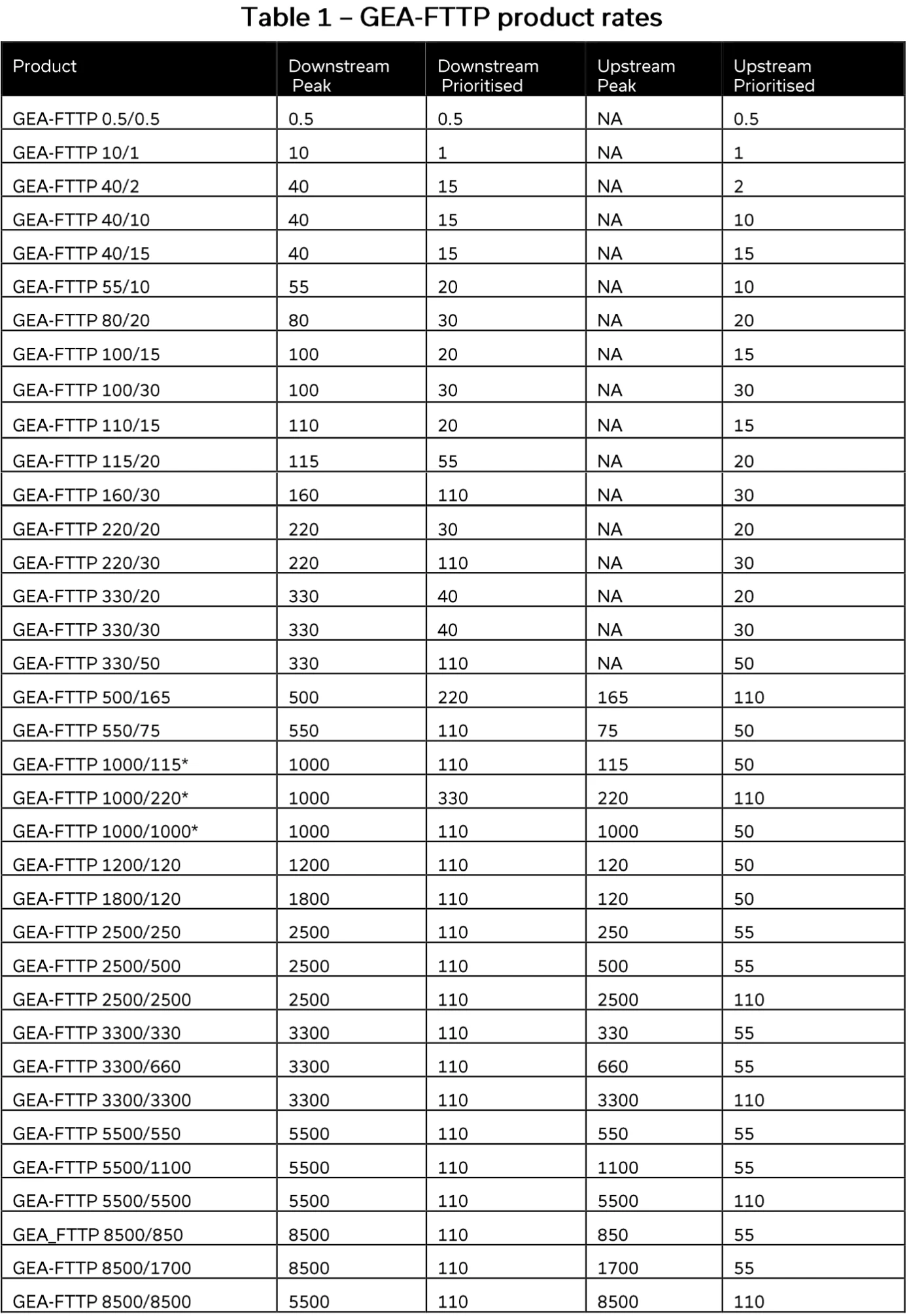
Just a reminder that Openreach’s main consumer products will, for now, focus on the 3.3Gbps speed, while 8.5Gbps will initially more be part of a technical network test. We don’t currently have any pricing details for anything beyond 3.3Gbps (symmetric).
Advertisement
UPDATE 2:35pm
Take note that there’s a slight error in the STIN document on the last entry, which puts 5500 (Mbps) instead of 8500.






Mark is a professional technology writer, IT consultant and computer engineer from Dorset (England), he also founded ISPreview in 1999 and enjoys analysing the latest telecoms and broadband developments. Find me on X (Twitter), Mastodon, Facebook, BlueSky, Threads.net and Linkedin.












« O2 UK Gifts Free 10GB Mobile Broadband Data Boost to Customers

















Incoming stream of people triggered by Openreach offering their customers options on the upload speeds.
No mention of pricing difference on most of them yet and if they get released it’ll be modest given it’s £3 a month to go 10:1 to symmetric on the 3.3 so will probably be a fiver retail across the board but let the pile on commence.
Prioritised rates also a good one. Doesn’t mean anything for the actual performance in use but whether Openreach or CityFibre prioritised/guaranteed triggers people.
Grab your popcorn. ETA of usual suspect: imminent.
Not so sure about the bit talking about Cablelinks. Presume that’ll be updated as gigabit isn’t going to go very far and 10 isn’t great with 5.5+.
Hopefully all the OLTs will connect to a switch or a couple for resilience and those switches will have a trunk between them and 100 gigabit Cablelinks become a thing.
> No mention of pricing difference on most of them yet and if they get released it’ll be modest given it’s £3 a month to go 10:1 to symmetric on the 3.3 so will probably be a fiver retail across the board but let the pile on commence.
Unfortunately you can’t deduce anything like that, because no final commercial pricing has been published – only pricing for the pilot. That pricing even undercuts regular 330/50.
The only official symmetric pricing we have is for 1G/1G (available only in BDUK type C areas), which is £100+VAT per month at wholesale, compared to £39.10+VAT for 1000/115. On that basis, you can expect symmetric products to be approximately 2.5 times more expensive than asymmetric.
Was thinking the same. 1GE cable links are prehistoric and not much use even for the current products and 10GE is going to be horrible for 5.5 and 8.5G services.
I really hope that Openreach are planning a 100GE cable link. If they could also look at multiple port options eg. LAGs would also be good.
I see their proof reader failed to notice the error on the 8500/8500 profile too. Table in the STIN and reproduced by Mark shows 5500 downstream.
The symmetrical gigabit GPON product is not an indicator of pricing. It exists purely because they had to offer it as part of the subsidised contract, it is priced high to deter take up and entirely irrelevant to XGSPON. They don’t want anyone to buy it and have given it a deterrent pricing that is as high as the contract allowed. That’s about it.
Equinox 2 price list, the one showing what companies are actually paying, is more realistic.
Just FYI the price of both 1800 and 1200 are way lower under Equinox 2 than at pilot. They started off at £39.90 and £34.90. Both were cut by a third and as of next February will be £23.28 and £22.24 a month.
Upload on XGSPON is basically free to Openreach and to CPs. The higher upload pricing on GPON is purely to deter businesses from ditching Ethernet services.
There’s a sequence to the prices for high-speed upload services currently:
500/165 £68.76+VAT
1000/220 £75+VAT (reduced on 1 Aug 2025, from £97.78+VAT)
1000/1000 £100+VAT
If they wanted to introduce symmetric, multi-gig XGS-PON services at prices lower than these, then those prices would have to come down too. And then, suddenly, people might lose interest in the higher speeds if they could get 1G/1G at a sensible price.
But if they keep this structure, I can’t see them offering any service with an upload speed higher than 220M for any less than £75+VAT per month.
And why would they change it? Sure, this means they’ll get zero takeup from residential users – but that’s fine as far as Openreach are concerned. They still get to keep the majority of profitable customers, and are quite happy to lose some less-profitable, bandwidth-hungry customers to altnets.
And this, ladies and gents, is why I’ll never do contracts. Whoever offers the better service wins, and when/if that changes, so does my subscription.
Here’s looking forward to more choice.
That seems like … a lot of effort.
I’m with Virgin. The lack of symmetrical speeds is a pain, and the service goes down every once in a while, but mostly it just works. Unless there are regular outages (which are pretty rare on FTTP), what do you mean re best service?
(for me the biggest bugbear of VM is the re-contract shuffle every 18 months. IF they fixed that i’d be happy).
Surely given XG-PON2 is synchronous Openreach can do away with the asynchronous products at those faster speeds now? If anything upload should have higher assured speeds given its lesser used, but it all seems to be downrated for some reason. Wouldn’t having fewer “products” help simplify things and make mistakes less likely, i.e. customers getting incorrect profiles set.
XG-PON2 is an old standard no-one uses, Openreach stated XGS-PON which is what most of the Altnets already use, including CityFibre who have a launched 5.5G symmetrical product.
Upstream is lesser used but each ONT present on the PON (regardless of if it has a service) has a management channel assigned which reduces the overall bandwidth for customer traffic. I’m interested to see if Openreach can really get 8.5G in both directions with all the overheads.
And I agree a crazy number of profiles, all of which they will have to test across all their platforms (Adtran and Nokia? + ONT vendors).
@Phil – symmetric/asymmetric, not synchronous/asynchronous. This is fibre, not copper leased lines 🙂
@anon
Other onts are from zyxel and sercomm
It’s known that adtran, Nokia and sercomm have an xgs-pon ont already in the pipeline.
I suspect nearer the time zyxel might bring one out.
Info was from this very site. An article showing onts and the original doc listed a mystery sercomm model which the revised document removes along with the adtran and Nokia models.
I’ll be all over this as soon as it becomes available…
I’d love to know what the use case is, as I certainly can’t think of one. How much does a 10G-capable home network cost these days? I think I’ll wait for Wi-Fi 9 to be standardised…
I already have 10GbE network at home so no additional cost there. The main use case for this is fast storage.
My bother has a 2.5Gbps symmetric connection and we transfer large files back and forth. Would be nice to have the ability to transfer them quicker. My current upload is 115Mbps so this would be a nice boost in transfer speed.
A Stevens:
A use case would be for using a VPN on a home network for accessing large files from anywhere. Thats just one i can think of. Another would be applying filters in adobe packages where fast upload is needed to keep your sanity. Thats two off the top of my head.
Why is that openreach employ such idiots. That table says 8500/8500 in the description then 5500 Download and 8500 Upload in the actual spec. Come on guys, this isn’t hard.
It’s a minor mistake in a long technical document, we’re all human, it happens.
Similar to missing an entire word from a sentence.
Your first sentence was a question and should’ve ended with a question mark.
In your second the words ‘download’ and ‘upload’ aren’t proper nouns and shouldn’t be capitalised.
We’re all only human.
“Why is that openreach employ such idiots.”
It’s a good job that you didn’t make a mistake in your own comment whilst commenting on another mistake 😉
And it’s Openreach.
I’m more intrigued by the downstream prioritised figures as they reflect the notionally “guaranteed” rate. The fact that they are the same as the GPON products suggests that Openreach may be leaving themselves the option of wider splits than the 1:32 employed for GPON. Either that or there is a limit elsewhere in the Openreach hardware / software which prevents assigning a higher rate.
Or, its an unreleased, *consumer* product and they don’t want to put large guarantees on it? Because if things change or they revise the numbers down people will complain.
Will have to wait and see, but I do wish we’d get some bumps sooner 🙂
The splits on existing cabling is baked in so it’s unlikely that Openreach are going to change that.
Don’t think those numbers have any relevance to the split ratio. Highest residential upload PIR on GPON is 50, highest asymmetric on XGSPON is 55 and symmetric is 110. XGSPON has 7 times the upload of GPON and I can’t see Openreach going 96:1 with a few spare ports reserved.
I’m not sure that’s it’s likely to be a change in the splitting. I believe XGS-PON will be deployed using the same street fibre and passive splitters as are used for GPON, thus no change to existing split rates.
The bequty of XGS-PON and GPON services is that they will run on the same fibres using seperate wavelengths, meaning that the uplift to XGS-PON reuses much of the infratructure that’s already there – essentially it’s perhaps just a change to the kit at either end – or just one end, depending on what’s already in the exchange.
Perhaps there’s limited market for prioritised downstream rates in excess of 110, or perhaps it’s a mechanism to push users who need those sort of performance guarantees onto EAD products
If they maintain the 30:1 split that they use with GPON then that will put them above the altnets who are commonly using 64:1 or above. Mind you, best of explaining contention ratios & why they matter to the general public.
Historically Openreach incorporated optical filtering / splitting in the exchange between the OLTs and the PONs to allow additional frequencies (such as XGS-PON) to be added without disturbing GPON operation. I’m not sure if they still do that with the rise of “Combo OLT” hardware. If they do then it would be easy for XGS-PON and GPON to have different split ratios whilst running on the same fibres.
An alternative possibility is that at some point Openreach might start using XGS-PON to provide comparable services to a leased line where a guaranteed rate is a requirement and they don’t want to eat up the headroom they would need to do that by offering guarantees on more consumer focussed rates.
‘The splits on existing cabling is baked in so it’s unlikely that Openreach are going to change that.’
Baked in as far as how low the ratio can be without lots of work but easy to use a higher one, combine two existing PONs through a coexistence element and feed to one port. Obviously makes less sense if using combo ports as would have alternating optics.
I can’t even get 100Mbps yet!
I’d go back to Openreach in a heartbeat if they’d offer symmetrical speeds.
If BTWholesale offering new product FTTP 330/110 – it a win win for all of us because it will be more popular one!
Do u reckon guys?
ISPs could easily sell FTTP 330/110 today. All they need to do is buy the 1000/115 product from Openreach, and apply rate limiting at their BRAS.
Would you like to guess why nobody offers such a service?
There’s no 330/110 product on the list, Phil.
Are there any guesses based on prior trials openreach have done, how long it may take before it goes to wider rollout?
It’s good to see they are finally catching up somewhat to the altnets. There’s no altnet competition here in Andover (with the exception of Virgin in some pockets) so an expansion of the OR offering is welcome .
Openreach activity in Andover now.
I’d settle for more than 110 up on my 1.6Gbps OR link.
I’m with you on that one brother
More competitive pricing would be great as well.
EE are doing 1.6 down and 115 up for £41,99 a month = how much more?