Community Helps EE UK Bring 4G Mobile to Rural Village of Penmachno
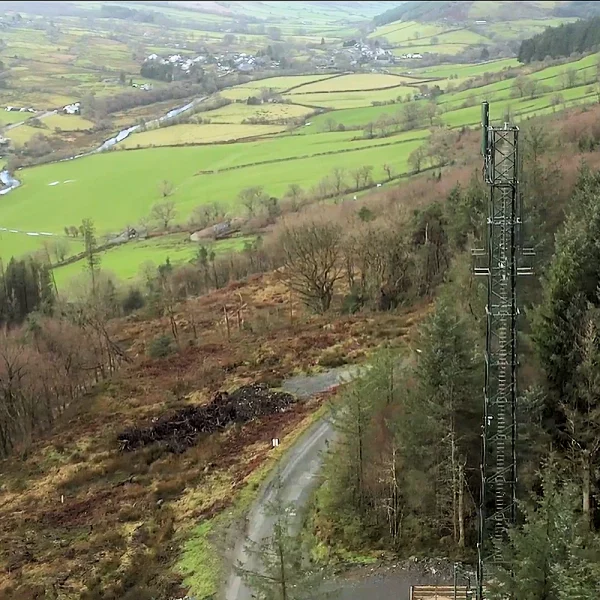
Telecoms giant EE (BT) has just become the first UK operator to deliver a “reliable” 4G mobile (mobile broadband) signal to around 600 residents in the remote upland Machno valley (Conwy) village of Penmachno in North Wales. The project was strongly supported by the local Bro Machno Community Council, which helped with planning, placement, and local acceptance.
Until now the village of Penmachno had been considered part of the “forgotten” 4% percent of the UK that is without reliable mobile signal from any operator. Due to this, EE claims that some residents have had to travel to nearby villages to make phone calls, while also struggling with organising home deliveries of food and medication; not to mention some difficulties with accessing secure online banking and other digital services etc.
However, this does rather overlook that fixed line FTTC and ADSL based broadband connections are available to the community, albeit often with fairly poor speeds. Nevertheless, EE have now discreetly built a new mobile mast at the edge of a forest on the slopes of the Machno Valley.
Advertisement
The new mast is now said to be providing fast and reliable 4G connectivity to the village, as well as critical signal for the emergency services as part of the Home Office’s Emergency Services Network (ESN).
Greg McCall, Chief Security and Networks Officer at BT Group, said:
“As part of our work to connect the unconnected, we’re going further and faster than anyone else to ensure every rural community in the UK has the reliable connectivity they need. There is more to do to completely eradicate the UK’s digital divide but our collaboration with the local residents of Penmachno is a shining example of what can be achieved when mobile operators and communities work together to tackle the issue head on.”
Take note that there will be a total of 20,840 new and upgraded sites to facilitate the coverage needed for ESN across Great Britain. This will include the current EE network of 19,795 existing sites which have been updated, as well as the construction of 1,045 new 4G masts (figures correct as of January 2026). Of the 1,045 new masts being built, 753 will be built by EE to support the existing network. The Home Office is also building 292 additional masts, known as the Extended Area Service (EAS). EAS is a critical part of ESN and will supplement EE’s ESN coverage.
Meanwhile, EE states that their investment has seen it expand and strengthen its network in more than 1,800 rural locations across the UK in the last five years, including some of the most remote and hard-to-reach communities – taking its mobile coverage in Wales to record levels, with signals now covering more than 90% of the country’s landmass.






Mark is a professional technology writer, IT consultant and computer engineer from Dorset (England), he also founded ISPreview in 1999 and enjoys analysing the latest telecoms and broadband developments. Find me on X (Twitter), Mastodon, Facebook, BlueSky, Threads.net and Linkedin.










« Jan 2026 Contract Delivery Progress for UK Project Gigabit Broadband Rollout

















I’ve always thought while they’re building a new site, why not 5G as standard then they won’t have to come again it a few years to upgrade twice?
4G tends to have a better range than 5G so is more suitable in rural areas. Smart meters are currently only starting to be upgraded to 4G so it’s going to be with us a long time yet.
Big Dave – no radio access technology (or “G”) has greater or worse range than any other, this is driven by frequency band and not the radio technology.
The reason that EE’s 4G coverage exceeded that of 2G was because of the use of low-band 800Mhz. EE use 700Mhz for 5G, which has similar coverage characteristics.
Given that the antenna system for 700Mhz is the same as that of 800Mhz, one common reason for installing 4G but not 5G in this scenario would be backhaul restrictions.
I think big Dave’s comment it is incorrect, 5G travels a little bit further than 4G B20 because of the lower band (n28 version), which EE displays on coverage maps insinuating they have vast areas of proper 5G when it isn’t. (700mhz n28). So the suggestion to go 5G straight away is very sound and very, very sensible. But I’m sure the British taxpayer will be expected to pay again in the future, so that there’s 5G “equality” or whatever the badge will be by then in the future. However, that theory (a cynical one) will quickly be dispelled when Mr Musk launches his own Sat2Cell service, which will make building / upgrading masts in rural areas, very difficult to justify (irrespective of who will be footing the bill) – or will it?
5G courtesy of it’s higher bandwidth has a lower sigtto noise ratio than 4G hence the distance at which it can be useful received is lower. You are effectively trading off distance for increased bandwidth. Consequently in rural area the increased coverage is more importance than bandwidth as due to lower population density and thus number of users mast their is enough available bandwidth to go around.Henxe the use of 4G. Quite why anyone would do a smart meter in anything other than LoRaWAN I am unable to fathom.
Brilliant news. I regularly work in this area where the signal was a nightmare (only EE had very partial signal in the area)