Rodents Hungry for Fibre Disrupt County Broadband Lines in Norfolk UK
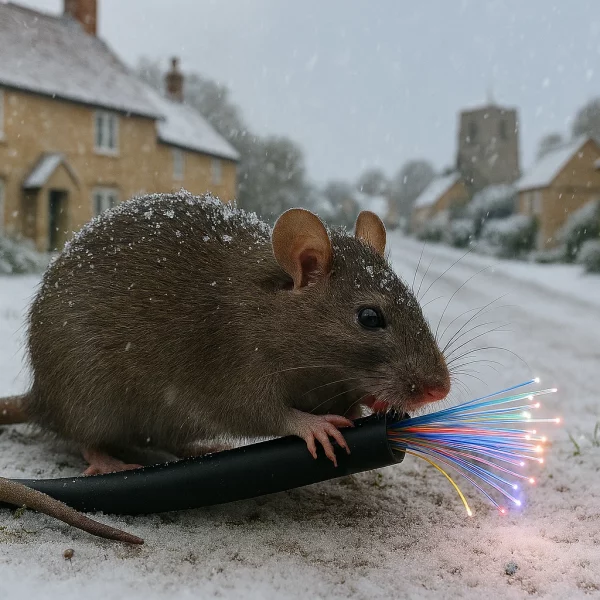
Hundreds of customers connected to the internet via rural full fibre ISP County Broadband (Truespeed) in Norfolk (England) have finally been reconnected after suffering several days of disruption. The situation began after rodents decided to avoid the snow storm and instead adopted a high fibre diet by chomping through both a main and backup fibre link.
According to feedback from some of those impacted by the connectivity loss and the ISP, the problems appear to have started on Saturday night (provider puts it at 9:10pm) after a spokesperson said that an “unusually persistent rodent somehow managed to damage both the main and backup fibre” for an area that served 442 of their customers.
The internet promptly dropped faster than a wheel of cheese in a mouse trap, with the rodents avoiding the need for a WiFi password by simply gnawing their way directly into the network. None of this should come as a surprise because rodents often target telecoms cables (another recent example), with their favourite part being the byte (sorry.. I’ll stop the puns now).
Advertisement
A spokesperson for the provider told ISPreview:
“Our teams worked through Saturday and Sunday but because of the weather, issue complexity, (needed to re-plug 600 metres of optical fibre), location (single track road, rural area, road closure needs etc.) and weather conditions / visibility, we had to suspend work on Sunday night. The repair work resumed on Monday AM and all customers were online by 1400 hours on Monday.”
The provider said they kept customers informed by SMS every 3 hours regarding the status of the issue until resolution (not everybody within this area may have had working access to a mobile signal). But they do acknowledge and apologised for the fact that their call-centre (support) was closed on Sunday, which likely caused some frustration.
Conducting such repairs during snowy conditions often adds an extra layer of considerations, such as the need to operate within health and safety guidelines, which can sometimes – as in this case – cause delays to new network builds and also repair work.
However, feedback from some residents in the area suggests that a few users were still offline until yesterday evening (Tuesday), partly because they apparently needed to conduct a factory reset of their broadband router before it would reconnect; for some reason a simple power cycle wasn’t enough.
At this point, people often comment that network operators should try to do more to stop rats from getting into ducts in the first place, which is a fair point. However, such things are often easier said than done across a large network, where operators often share some of the same physical infrastructure. Rats are also notoriously difficult vermin to stop, like mini tanks with teeth that often seem able to cut through almost anything.. even concrete.
Advertisement






Mark is a professional technology writer, IT consultant and computer engineer from Dorset (England), he also founded ISPreview in 1999 and enjoys analysing the latest telecoms and broadband developments. Find me on X (Twitter), Mastodon, Facebook, BlueSky, Threads.net and Linkedin.













« Mobile Operator Lebara UK Continues to Reject Mid-Contract Price Hikes

















Bird, Rat, Mice can eat for full fibre cable! Openreach need to learn lesson from it. Not surprising really.
Openreach?
Bet it would rather be feasting on ratatouille. That rat has a lot of sense, not looking down all those lit Fibre strands. 🙂
Its the kevlar inside that they like to taste
The backup cable and the main cable were in the same duct, and simultaneously broken?
More likely the backup cable had been broken for weeks or months, but no monitoring system was in place to notice it.
I wonder if the lack of RF emissions, makes the cables more attractive as nesting material?
Clearly the rat needed more fibre in its diet.
It is the grease filling inside the cable they like.
Rats are very clever, more than most people think. They are masters at digging, chewing and chomping cable to shapen there teeth. They are relentless when they get hold.
Cable with glass yarn inner and bittering agent in the jacket