Ookla Benchmarks Apple’s C1X Mobile Broadband Modem in the iPhone Air

Network testing firm Ookla, which collects broadband performance data from consumers via their popular Speedtest.net service, has today published a report that examines the mobile broadband (5G) performance of Apple’s new custom C1X modem in the iPhone Air. The results are then compared against the Qualcomm X80-based iPhone 17 Pro Max and the previous C1 modem in the iPhone 16e.
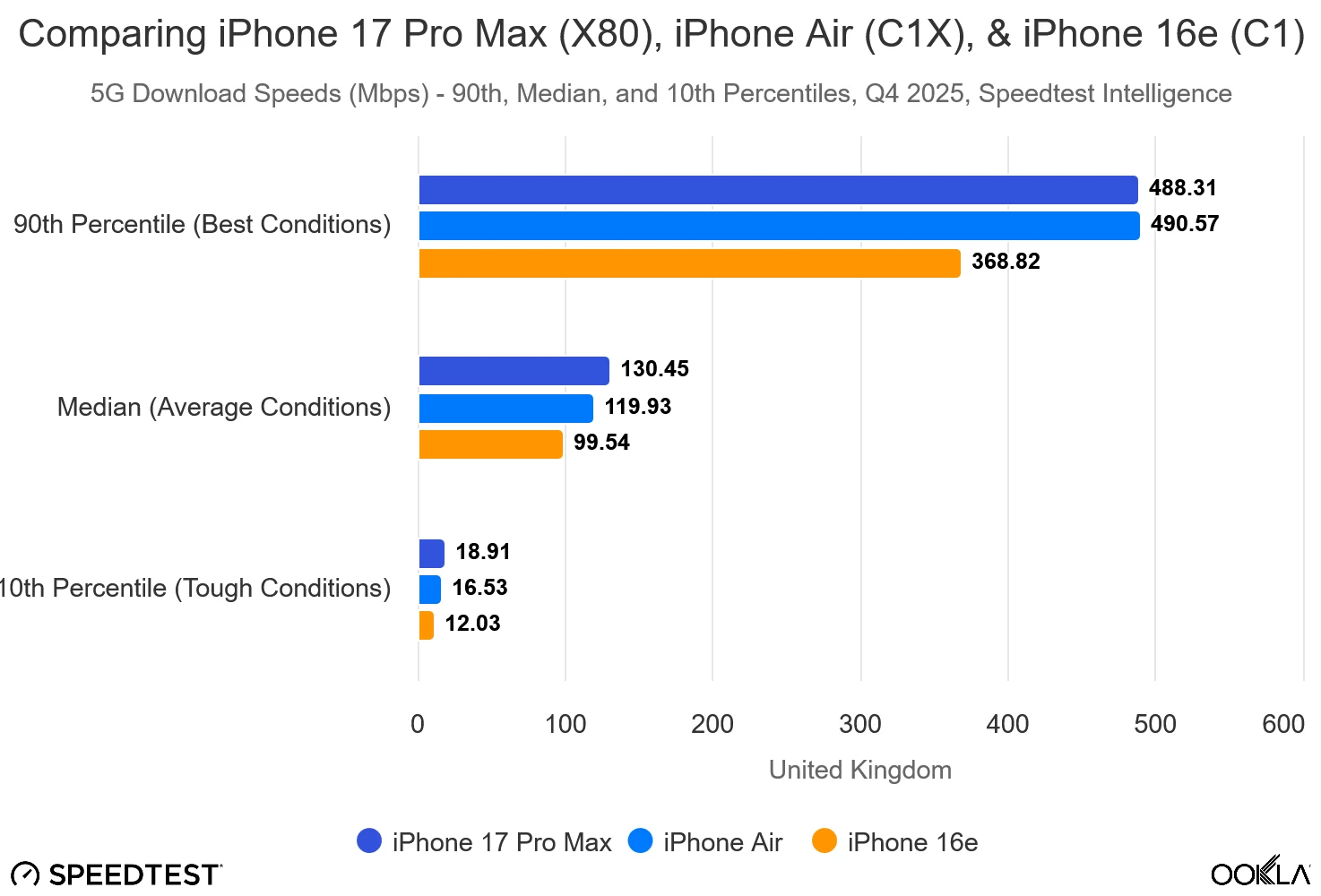
According to the data, which was gathered during Q4 2025 across multiple countries (see full report), Apple’s new in-house C1X 5G modem in the iPhone Air represents a generational leap over the previous C1 modem in the iPhone 16e that enables it to achieve “real-world parity in download and latency performance with the Qualcomm X80 across numerous networks in both ideal and challenging conditions“.
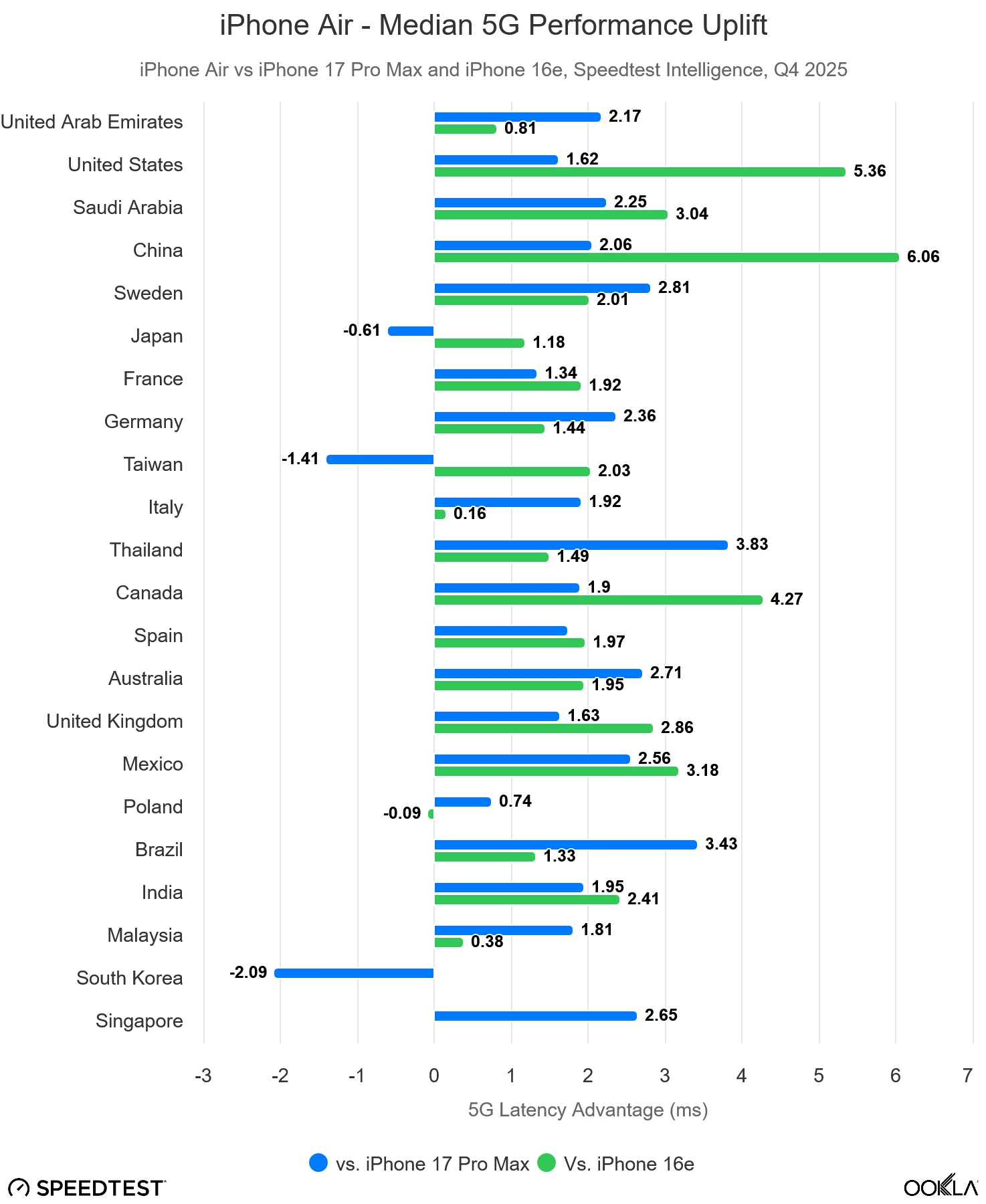
The iPhone Air also outperformed the Qualcomm-based iPhone 17 Pro Max in latency metrics across 19 of 22 analysed markets. The difference here is relatively small, although 1-3 milliseconds here or there may become more relevant as mobile experiences increasingly harness real-time generative AI and cloud computing etc. Not to mention the slight advantage for fast-paced multiplayer gaming.
Advertisement
The C1X modem also consistently provides a responsiveness upgrade over the C1 modem, which is particularly noticeable in China (+6 ms advantage), Indonesia (+6 ms), and the United States (+5 ms). It also provides a latency boost over the iPhone 17 Pro Max across the vast majority of markets, except for Taiwan and Japan.
However, the Qualcomm X80-equipped iPhone 17 Pro Max still maintains up to a 32% lead in upload speeds, highlighting that Apple’s cellular modem “may be held back by limited uplink carrier aggregation capability“. But it’s important to note that the next round of Android devices are likely to harness Qualcomm’s X85 modem, which will almost certainly bring some performance upgrades over the X80.
Advertisement
Otherwise, the C1X managed to deliver a more equitable upload experience compared to the iPhone 17 Pro Max with the X80, with the variance between +/- 5Mbps for most markets, except for Taiwan (-8.6 Mbps), Malaysia (+5.6 Mbps), India (-5.2 Mbps), Poland (-7.3 Mbps) and the UAE (-9.2 Mbps).
Overall, it’s an interesting report that helps to highlight how important ongoing improvements to internal chipsets can be to mobile network performance.






Mark is a professional technology writer, IT consultant and computer engineer from Dorset (England), he also founded ISPreview in 1999 and enjoys analysing the latest telecoms and broadband developments. Find me on X (Twitter), Mastodon, Facebook, BlueSky, Threads.net and Linkedin.




























Good news that the same modem is in the 17e:
https://www.apple.com/uk/iphone-17e/specs/