Analysing Broadband Traffic Impact of England v Croatia – 2026 FIFA World Cup UPDATE4

Last night at 9pm saw England take on Croatia in their first FIFA World Cup 2026 match and, given the growing prevalence of TV streaming solutions and the fact that the match took place outside of normal working hours, we were keen to learn whether this would have a noticeable impact on internet traffic. ISPreview has thus examined the impact on several networks.
In the past such events, when taking place outside of working hours, wouldn’t have moved the network traffic dials all that much because people have tended to tune in via more traditional terrestrial TV signals. But these days video streaming-based TV platforms are much more common and thus live sporting events might now have a more noticeable impact.
However, weighing against that is the fact that broadband and mobile providers usually prepare for such events in advance, often by delaying routine maintenance and laying on extra capacity (example). Internet providers also use sophisticated Content Delivery Networks (CDN) and systems to help manage the load, which caches popular content closer in their network to end-users (i.e. improves performance without adding much strain to external links).
Advertisement
As usual ISPreview were monitoring to see what kind of impact the match would have on data traffic (i.e. we asked several broadband and mobile operators to monitor the event) and the first of several results have now come in. We’ll kick things off with data from the London Internet Exchange (LINX), which handles a large chunk of UK and global traffic through their switches via around 900+ members (ISPs, mobile and CDN providers etc.).
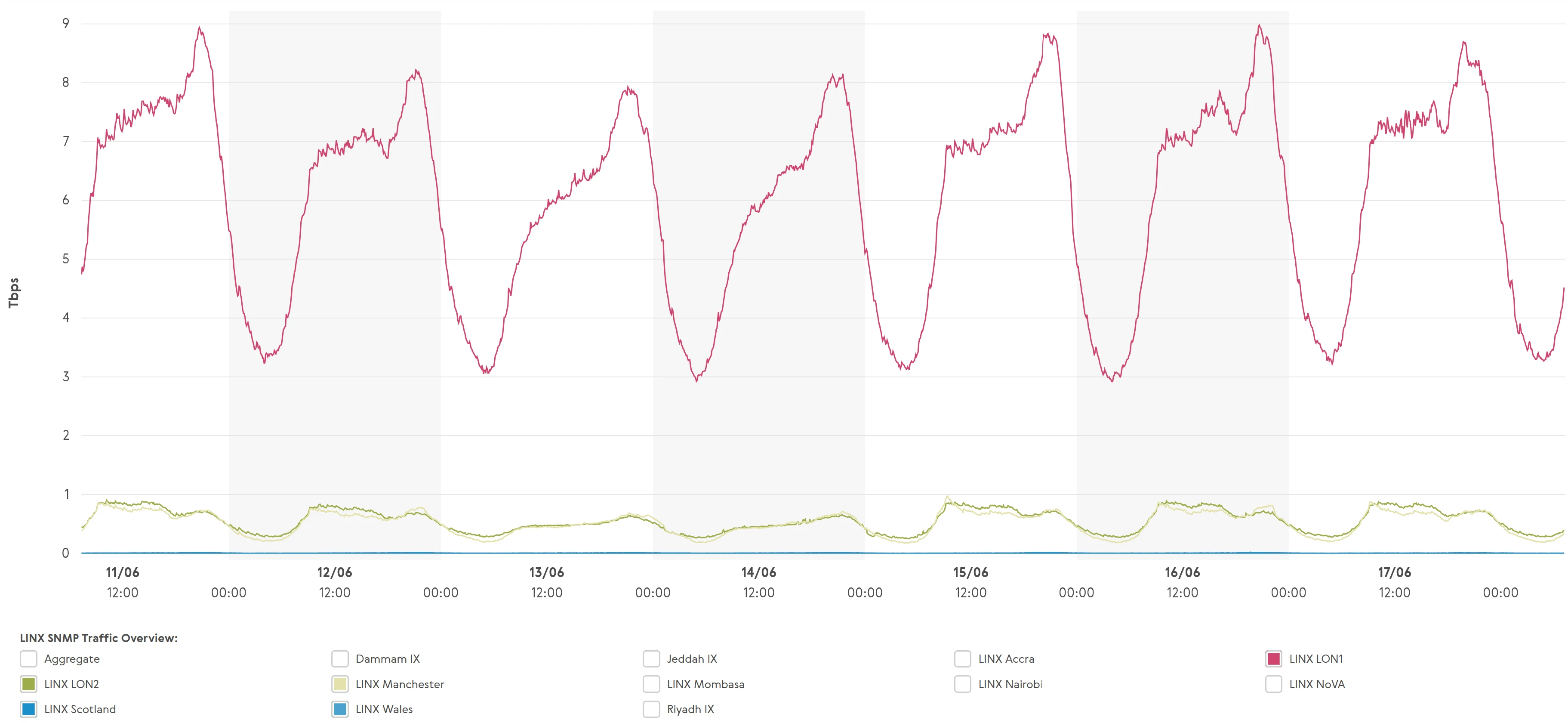
The traffic levels for 17th June 2026 across all of LINX’s UK exchanges (depicted on the right side of this chart), particularly their largest LON1 IXP, don’t show anything remarkable. The daily peak was actually lower than the day before, although the length of time that traffic levels spent above the 8Tbps (Terabits per second) mark on LON1 was longer than on prior days – possibly reflecting the length of the match.
Netomnia has similarly reported that “there wasn’t any noticeable increase in traffic levels” during the match, when traffic across their alternative broadband network actually dropped a little when compared with the same peak on Wednesday night (consistent with LINX above). We’re currently awaiting feedback from several other operators and will update this article when that arrives.
Advertisement
The situation may of course be different for events held during working hours.
UPDATE 10:24am
According to Virgin Media and O2 – compared to a normal week, mobile data traffic was up 9.16% during the game (likely reflecting greater use of social media). But fixed broadband traffic saw no significant change.
UPDATE 1:06pm
Advertisement
BT has sent in some more granular detail, which looks at the impact on specific services, rather than overall. According to the data, the match sent streaming demand “soaring” across BT’s broadband network, at least in terms of a 363% increase in peak traffic through ITVX compared with an average evening. BT also saw ITVX traffic increase by 60% between kick-off at 21:00 and England’s first goal by Harry Kane at 21:51, showing more fans tuning in as the excitement built.
The match also drove a 109% increase in peak ITVX traffic compared with the previous most demanding ITV match on BT’s network, the opening match between Mexico v South Africa last Thursday. BT’s network data also reveals the locations driving the biggest ITVX broadband traffic for the England v Croatia match, with Croydon (CR0) coming out on top, followed by Camborne (TR14) and Milton Keynes (MK10).
UPDATE 19th June 2026 @ 7:09am
Hyperoptic’s early analysis shows a typical early June Wednesday evening peak was around 1.4Tbps. By comparison, the biggest tournament match night so far peaked at around 1.8Tbps, nearly 30% higher, while England’s opening fixture on the 17th June, peaked at approximately 1.6Tbps, around 15% higher.
The England match also created a distinctly “match-shaped” evening on Hyperoptic’s network, with a clear dip at half-time and traffic remaining elevated after the final whistle. Much like BT, Hyperoptic is also pausing non-essential Planned Engineering Works during England and Scotland matches throughout the tournament to help maintain network stability during key fixtures.
The provider will continue monitoring its network around major match moments, with teams on hand to respond as the tournament progresses.
UPDATE 22nd June 2026 @ 11am
Openreach informs us that they didn’t see any major spikes and there was no change to the expected volumes on Wednesday night (i.e. it was like a normal Wednesday).






Mark is a professional technology writer, IT consultant and computer engineer from Dorset (England), he also founded ISPreview in 1999 and enjoys analysing the latest telecoms and broadband developments. Find me on X (Twitter), Mastodon, Facebook, BlueSky, Threads.net and Linkedin.













« Virgin Media O2 Satellite UK Mobile Service Extended to Google Pixel Users
















Or the fact that the World Cup has become such a vile cesspit of dirty money some of us are now just tuning out.
Surely the majority of content is now streamed via IP, therefore if it wasn’t the England game, the population would’ve been watching something else therefore the traffic would remain similar.
The ITVX stream is pretty much unwatchable, I dusted off the Freesat box when I saw how bad it was. They should let Sky Sports co-stream it and show how it’s done.
Following on, maybe streaming delays are still so large that the public even saw sense and watched it via DTT or DSat.
I know a majority of my flat block did, after each of us on DTT or DSat spoilt for the ones streaming so they plugged in the aerial feed which everyone has access to.
….it being so late in the evening made it easier on the networks, maybe because more were gathered round one device instead of multiple ones which you’d see during a daytime match.
Interesting read.
Yep, the delay for us was at least 10 seconds and after hearing the cheers from the neighbours next door after the first goal I went and found a coax cable, plugged back into TV and retuned to DTT, first time I ahve done this since the Euro’s.
Not having 4k was better than the delay. Still don’t understand why now that the feeds are all digital anyway they don’t care there is so much of a delay compared to DTT
Guessing the National grid still use the radio times to map their power spikes! But as other have said if you already stream to your TV is there going to be any gain in usage.
Live streamed content can be less efficient for networks compared with cached content like netflix
No such figures for the Scotland v Haiti match?
Didn’t get any. But I must admit, I’m not as into Football as I was when I was younger, and didn’t even know the tournament had started until Monday :).