Opensignal Q1 2026 Study Ranks UK Bottom for 5G Mobile Performance in Europe

Network benchmarking firm Opensignal has this morning published their latest analysis of 5G non-standalone mobile (mobile broadband) and 5G Standalone (5G+) availability and performance across Europe. The results rank the UK last in Europe with average download speeds one-third of Denmark’s and the lowest Excellent Consistent Quality score in the region.
As usual the data in this report is based off crowdsourced testing, which has been gathered by users of Opensignal’s app on millions of devices (Smartphones etc.). The analysis draws on data collected during Q1 2026 – covering 29 European markets, encompassing the EU-27 (excluding Malta), plus the United Kingdom, Norway and Switzerland – collectively referred to as the European region in this study.
Overall, the study found that the “vast majority of connectivity time” in Europe is still over 4G, while wide-scale 5G+ deployment in Europe are localised to just 11 networks and its “most tangible impact” is on network responsiveness. As for the UK, we rank just 29th out of 29 European markets in Opensignal’s Global Network Excellence Index.
Advertisement
The UK ranks last in Europe with average download speeds (84Mbps), coming in at just one-third of front-runner Denmark’s speed (226Mbps), and we also have the lowest Excellent Consistent Quality (ECQ) score in the region (80% in the UK vs 93.1% in Denmark). In addition, 5G Availability in the UK is also low at 57.4%, although people in this country do spend more time connected to 5G+ networks (5.2%) than most of the other countries, except Spain on 9.3% and Switzerland on 10.4%.
In short, 5G+ is only just beginning to take hold, and only among a select group of operators. Across the region, 5G users spent just 1.8% of their connection time on 5G+ in Q1 2026, a figure that masks a wide gap between a handful of leaders and everyone else. Looking at individual mobile operators in the UK, the ‘Time on 5G+‘ score for EE’s (BT) customers was 8.3%, then 5.3% for O2 (Virgin Media) and 4% for Vodafone (Vodafone and Three UK).
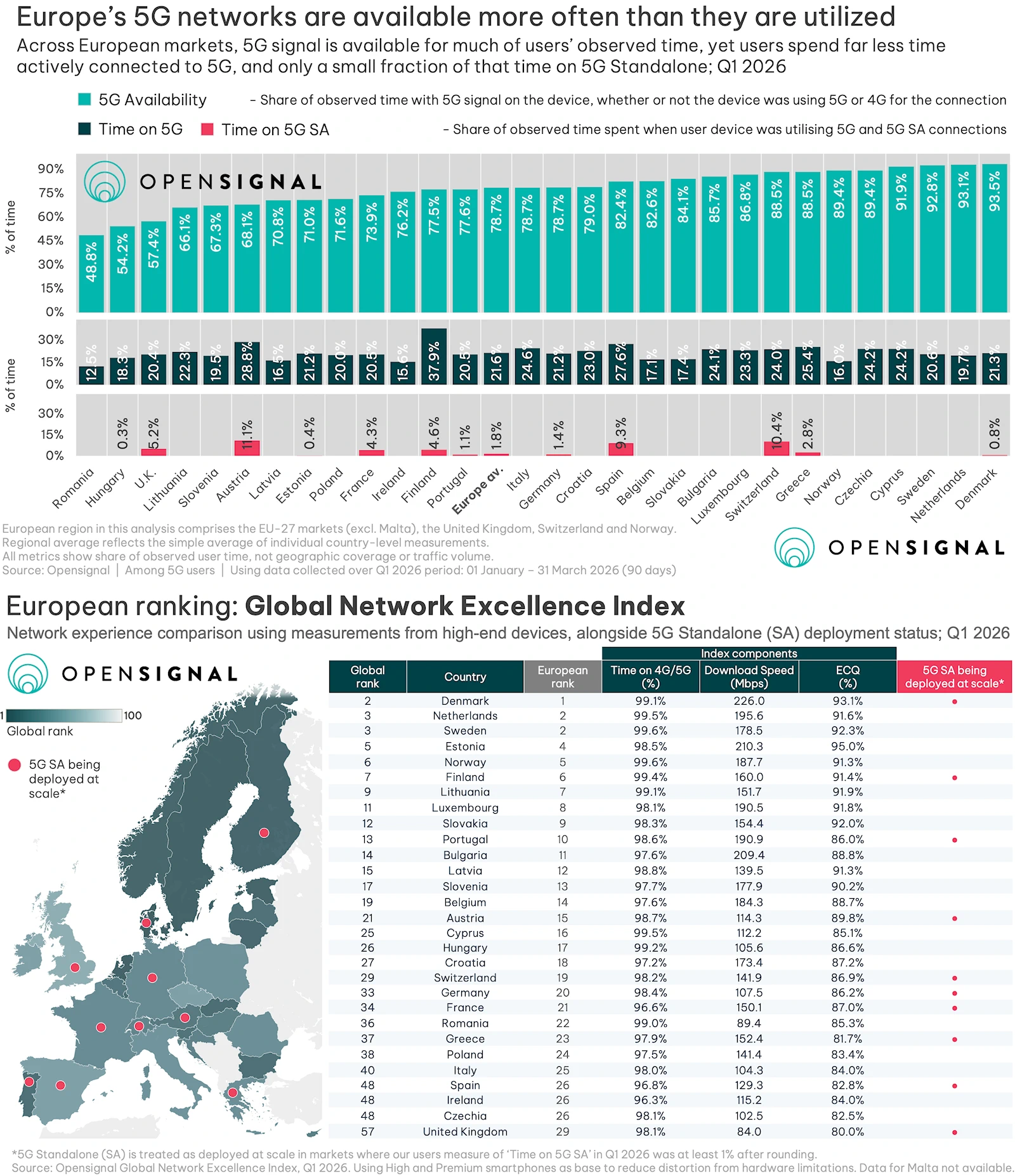
The study also examines what kind of mobile broadband performance improvement 5G+ delivers when compared with 4G and regular 5G (NSA). Overall, 5G+ users recorded average download speeds of 180.2Mbps against 153.2Mbps on 5G NSA, an 18% download uplift; with latency being 17% faster (39.5ms vs 32.6ms); and Consistent Quality (CQ) improving by up 1.6 percentage points (87.8% vs 89.4%).
Advertisement
Sadly Opensignal did not examine upload speeds, which is an usual thing to leave out when considering 5G+. Otherwise, the study noted that the scale of the 5G+ rollout is driven by commercial strategy, not technical capability, and the availability of radio spectrum is no longer considered the limiting factor (most operators now have plenty of it).
Opensignal’s analysis suggests that operators making the strongest moves on 5G+ are disproportionately the ones with the most ground to make up on overall network quality, which certainly seems true for the UK.






Mark is a professional technology writer, IT consultant and computer engineer from Dorset (England), he also founded ISPreview in 1999 and enjoys analysing the latest telecoms and broadband developments. Find me on X (Twitter), Mastodon, Facebook, BlueSky, Threads.net and Linkedin.











Advertisement
Leave a Reply
Privacy Notice: Please note that news comments are anonymous, which means that we do NOT require you to enter any real personal details to post a message and display names can be almost anything you like (provided they do not contain offensive language or impersonate a real person's legal name). By clicking to submit a post you agree to storing your entries for comment content, display name, IP and email in our database, for as long as the post remains live.
Only the submitted name and comment will be displayed in public, while the rest will be kept private (we will never share this outside of ISPreview, regardless of whether the data is real or fake). This comment system uses submitted IP, email and website address data to spot abuse and spammers. All data is transferred via an encrypted (https secure) session.
















Probably not as many rooftop sites, fewer standalone masts and the ones we have aren’t as tall as elsewhere so less ability to pack them with more focused beams to compensate.
Fewer radios serving more people so lower quality inevitable.
Pretty sure my SIM with EE is hard capped at 100 Mbit/s. Not 100% sure as work pays for it but I’ve never seen speeds faster than that. If a lot of plans are capped like this and with EE being the biggest provider it’s going to pull down the average a lot. 5GSA is available here but my phone doesn’t use it.
In any case speed is not the problem, it is geographic coverage.
Yes ee restrict a lot of their Sims to 100 megabits
As if anyone needed reminding about the pathetic state of UK Mobile speeds/infra state.
Corporate greed and lack of investments compound our misery.
So nothing to do with planning regulations or local authorities that deny 90% of applications for new masts? Oki doke.
not to worry, vodtrash are going to save the day with their 5 billion investment all whilst keeping the prices the same for 3 years.
yeah right…..
Playing devil’s advocate….
To what extent is the following statement true for the UK
“Go as fast as is necessary (at any point in time), not as fast as is possible”?
What exactly is being prevented (in a generalised sense) from a lack of speed? What is the precise GDP increase we could assert if UK was top quartile? Is the increase the best way to increase GDP vs. say improving the employability of the population and the availability of high quality jobs, housing, etc.
To quote Steve Jobs “Well, let’s say you can shave 10 seconds off of the boot time. Multiply that by five million users and thats 50 million seconds, every single day. Over a year, that’s probably dozens of lifetimes. So if you make it boot ten seconds faster, you’ve saved a dozen lives. That’s really worth it, don’t you think?”
The poor state of UK infrastructure is both a symptom and a cause of the sate of poor UK infrastructure. You don’t need to put a price on it to know we can do better when it’s demonstrated we are bottom.
The Steve Jobs argument is precisely the same argument used in the business case for HS2 resulting in vastly expensive overengineering, but that’s not a discussion topic for this forum.
And as Rory Sutherland has pointed out in various scenarios, minor delays and friction, when contextualized correctly, can lead to a better outcome overall.
I would assert reliability, consistency to expectations, and universal coverage of services that provide lower quartiles of bandwidth matter more initially than expanding higher speed coverage. So: Better 4G/5G coverage for people on the move in all transport modes (including in cuttings and tunnels) rather than outright speed (backhauls, 5G+, 5GNSA)–connections and calls that don’t drop even if the data bandwidth is a bit slower. then improve from a solid base.
I’ve just been in the Netherlands and I know it’s flat, but the quality of the signal in urban and rural areas puts us to shame. The 5G symbol never disappeared from my phone on KPN, and all rail tunnels that I passed through had perfect coverage. I didn’t have any issues with “full signal, no data throughput” in busy city locations or railway stations like I do on Three UK.
If that is accurate, and I normally take these things with a pinch of salt, but if it is, I am not surprised. I disable 5G on my phone as it is useless and one I lose 5G signal it doesn’t change to 4G quick enough. So since I don’t need the speed, may as well stay with 4G which is more reliable.
In the article above, Sadly Opensignal did not examine upload speeds, reliability is more important than speed.
I find this very strange the fact that I’m with talkmobile (Vodafone) never off 5g speeds of 300mbps to 500mbps down 65mbps up we have 5gsa here bot Vodafone restricted to Vodafone contracts only which is a bit sad