Kearney’s Global Telecom Health Index Ranks UK 33rd out of 34 Countries

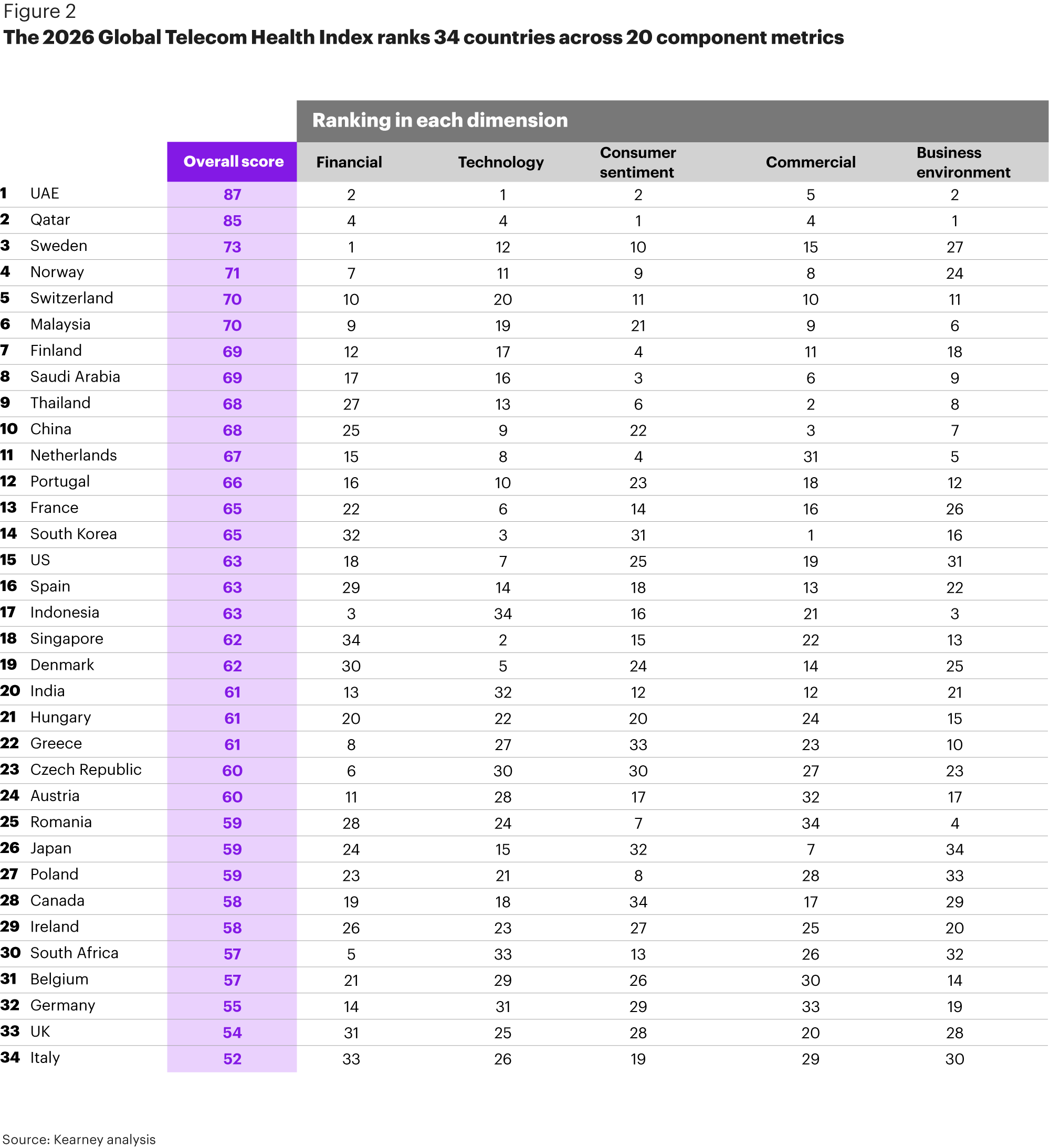
Management consulting firm Kearney has today published their latest annual Global Telecom Health Index, which ranks 34 countries across various metrics in order to measure and compare the health of the telecoms (broadband, mobile etc.) sector on a country-by-country basis. Overall the United Kingdom placed near the bottom on a rank of 33rd.
The index broadly considers five core dimensions (or categories, if you prefer) and 20 individual metrics on a country-by-country basis, including technology (network coverage, speed etc.); customer satisfaction with fixed and mobile services; financial returns (capacity for investment, EBITDA etc.); commercial (spend relative to income, convergence, pricing etc.) and the business environment (level of competition, talent pool etc.).
Unfortunately, the UK ended up ranking in the bottom 10 markets, where low financial scores were common, which typically lead to poor technology deployment and, in turn, lower customer satisfaction. Canada and the UK were thus found to be examples of markets that “rank particularly low on customer sentiment and also rank in the bottom half on technology deployment and commercial dimensions“.
Advertisement
The above is perhaps a nod to the UK’s long delay in deploying full fibre broadband at scale and the many challenges mobile operators have faced in expanding 5G coverage. In the UK, the index also highlights that “mid-contract price rises have become the norm, leading to customer discontent and a value perception gap when paying more for a service that is not seen as having improved” – few of our readers would disagree.
The report goes on to add that government and regulatory intervention, coupled with negative press coverage, has made these price increases particularly visible. “There is an opportunity for operators to revisit their pricing and bundling models to drive higher value perception, especially in markets with the potential for higher service convergence,” said the report. But we’ve seen no sign of mid-contract pricing policies being reversed.
Kearney’s report then goes on to indicate that some markets would benefit from more market concentration, which it suggests would support larger consolidated operators to “invest more effectively in a single network infrastructure (or work more closely with a wholesale partner in the case of retail Internet service providers)“.
Advertisement
The above is certainly something that could be said to reflect the UK’s fixed line broadband market, which is still chocked full of many financially struggling alternative full fibre networks – those that have been hit hard by rising build costs, high interest rates and competition that often spreads customers too thinly across multiple networks.
“In both mobile and fixed, financial and commercial health scores are higher in markets with fewer than four operators,” adds the report, while admitting that the difference is still smaller than might be expected. We’ve seen a fair bit of consolidation in the UK already (ISPreview’s Consolidation Tracker), although that does seem to have slowed a bit in 2026 and there are strong differences of opinion on which is the right consolidation partner for whom (e.g. VMO2/nexfibre’s £2bn move to acquire Netomnia vs CityFibre’s attempt to acquire Netomnia). Speaking of which..
Rajiv Datta, CEO of nexfibre, told ISPreview:
“The results of Kearney’s inaugural Global Telecom Health Index offer clear counsel; the research finds that more concentrated markets achieve higher fibre coverage and take-up, as well as more positive customer outcomes.
The UK’s telecoms market is fragmented and fragile. To deliver greater choice and quality for consumers and businesses alike, it requires a scaled financially-secure, wholesale challenger. Consolidation will be crucial as the route to sustainable competition and a healthier sector.
The UK now has an opportunity to move beyond fragmentation and build a competitive, resilient fibre market that can support the country’s digital and economic ambitions for generations to come.”
The full report is worth a read, although it does seem to generalise a lot of its points and doesn’t include a detailed breakdown of each country and its scores, which would have been useful to get the proper context for how they arrived at some of the scores.






Mark is a professional technology writer, IT consultant and computer engineer from Dorset (England), he also founded ISPreview in 1999 and enjoys analysing the latest telecoms and broadband developments. Find me on X (Twitter), Mastodon, Facebook, BlueSky, Threads.net and Linkedin.













« EE Gives UK Mobile Customers an Early Phone Swap at No Extra Cost
Advertisement
Leave a Reply
Privacy Notice: Please note that news comments are anonymous, which means that we do NOT require you to enter any real personal details to post a message and display names can be almost anything you like (provided they do not contain offensive language or impersonate a real person's legal name). By clicking to submit a post you agree to storing your entries for comment content, display name, IP and email in our database, for as long as the post remains live.
Only the submitted name and comment will be displayed in public, while the rest will be kept private (we will never share this outside of ISPreview, regardless of whether the data is real or fake). This comment system uses submitted IP, email and website address data to spot abuse and spammers. All data is transferred via an encrypted (https secure) session.

















Datta is a stuck record on this stuff now, seemingly whatever a report says he will give a statement saying the fix is to let VMO2 acquire other networks
VMO2 is not acquiring other networks.
They never publish their methodology or data. What’s the point of all these “trust me bro” reports that keep coming out… An excuse for vested interests such as nexfibre to push their agenda, no doubt.
Kearney’s is a global-scale management consultancy; they are hardly going to give anything away.
There is enough detail in the reports to justify their conclusions.
The wretched planning system in the UK does not help. It takes weeks even if there are no objections to get planning permission for anything, months if at all – if there are objections.
This means that our roll-out of technology is awful and does not help the business, commercial and competitive scores.
Question on who funded the report given the quick comment from Nexfibre? …not that I disagree
Nexfibre’s comment wasn’t that quick. The report did the rounds a day before they commented, but I waited to cover it until the full report was published yesterday (the initial release was a limited preview). If we’d covered it on Monday then there would have been nothing from nexfibre either.
With respect to the UK market, the report is essentially repeating what others have been saying for several years now.
There are too many players for the market to function efficiently. Excessive regulation is preventing the shake-out of the dead businesses that are holding back the entire sector. The regulator has opened the market but has not taken steps to ensure that competition is healthy.
To correct this, something should be done to require players to charge prices that put their businesses on a financially sustainable footing. That would improve the returns of healthy businesses while pricing out those that are already dead.
I say something because it is not fully within the remit of Ofcom to impose such changes. However, in the event of another global financial event such as that of2004/2008, and if something along those lines does not happen, the UK will be at risk of multiple failed players that can not be taken on by operators of last resort simply because of the scale and cost of the problem.
Well put, we can all see this why can’t the lords and masters, Gov, BDUK, OfCon, CMMA.
OfCon , the clue is in the title Office or Communications ‘Regulator’ then they should be leading with common sense and well considered consequences, including of their long overdue demise, or a stiff refocussing (with new ‘leadership’ and senior management) on integrity of regulating and protecting the end users from corporate abuse.
@SicOf
I would point out that the bodies you mention are actually Ofcom and the CMA.
I do not think there is any suggestion that the government and its various agencies are not aware of the way the market in the sector is functioning, nor that they are not aware of the risks.
There are at least two factors in play:
– The government’s desire to moderate inflation through price controls, &
– The absence of enabling regulatory instruments which could be used to require players in the sector to put their businesses on a sustainable business model.
The latter is usually imposed, if the option is available, when a player enters a market, such as in the case of a financial institution. That regulatory option, as far as I am aware, is not currently available for businesses operating in the telecoms or private infrastructure sectors.
@Far2329Light
Hmm sarcastic irony on OfCom. More a Con.
One might have thought we’d want a homogenous sustainable national infrastucture
servicing all,
equally,
even with no low hanging profit or geographic discrimination,
but evidently not.
Q by shoddy administration or ‘design’.
Just view.
@SicOf
We live in the real world, not one driven by fantasies and playground humour.
“There is an opportunity for operators to revisit their pricing and bundling models to drive higher value perception”
Not irrefutable truth or honesty then, just ‘perception’, that you can ‘get away with’, spin, pull the wool over eye’s etc.
Or they could just do an honest job of cost effective service, not screw eachother, the government, taxpayers and consumers over trying for grandiose profits.
Ofcon have been nothing but meddlesome and dare I say stupid, either go socialist have 1 national infrastructure operated on costs or go capitalist and let the makrket / consumers decide withing a framework of clear contact points and prevent any weaseleeze .But either way if you’re having a ‘fixed’ contract it should just be that, fixed service for a fixed prixe for a fixed term. And watch like a hawk for any ‘cartel’ like colusions, and treat violation with prejudice targtting those resposible, the execs, not just fine and an organisation , which ultimately is paid for by the customers.
Who ever thought openning up a desired national infrastructure up to a pack of opportunistic piranhas feeding on government monies was going to provide a homogenous infrastructure, when for e.g. decades ago they rightly merged rail networks to a common standard from a fragnet of individual operators, there might have abeen a lesson?
And well Kearney, another ‘business’ telling others how to run their businesses, but then if they were so good at the businesses they advise on one might think they’d actually run such a business brillianty themselves.. And they were so good they had to keep renaming/rebranding themselves, Do what I say not what I do…
Which players in the broadband sector are the ones making “grandiose profits”?