London Full Fibre ISP G.Network Prep 10Gbps Home Broadband and New Funding
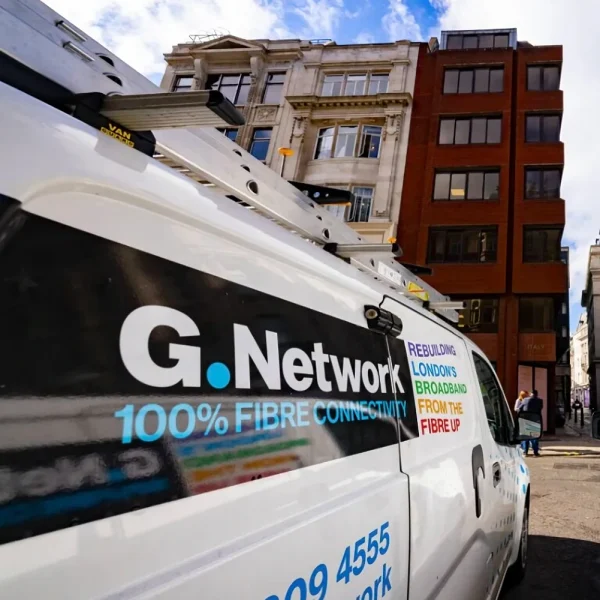
The CEO of alternative London-focused UK broadband operator G.Network, David Sangster, has issued a progress update – the first since the ISP was reorganised through administration earlier this year. The business is now said to be “EBITDA and cashflow positive” and plans to launch a 10Gbps speed package for homes next month. Fresh funding has also been secured.
Just to recap. G.Network finally came out of a brief period of administration in March 2026 (here), after being acquired by distressed debt specialist FitzWalter Capital (here and here). At the time the internet provider (G.Network Holdco Limited) said it had been “successfully reorganised through administration“ and would now move forward on a “debt-free, well-capitalised, growth-oriented footing“.
The operator originally aspired to expand their FTTP lines to cover 1.3 million premises in London by the end of 2026, but ultimately ended up being impacted by an increasingly competitive environment and rising costs (high build costs, high interest rates etc.); this resulted in job cuts and a greater focus on commercialisation instead of new fibre build (here), which is a not unfamiliar direction for the UK’s many altnets.
Advertisement
The latest update from David Sangster claims that both residential and business monthly sales are “up substantially, as are installations“, while recent price increases are also said to have boosted the Average Revenue Per User (ARPU) on residential lines by 30% in the last four months to over £40. Despite this, new customers can still take speeds of 300Mbps from £29 per month on a 24-month term (rising to £39 for 900Mbps), although you do have to pay between £19 to £29 for the one-off installation.
In terms of the operator’s independent full fibre network, this is now claimed to cover 395,000 premises ready-for-service (up from 375k in June 2026), which is out of more than 420k premises “dug past“. But interestingly Sangster said the central London focused network would also be introducing new 2.5Gbps and 10Gbps residential products in September.
David Sangster, G.Network CEO, said:
“We are fortunate to operate in central London, with limited overbuild and where over 50% of our customer homes are worth over £1m. To better serve this market, we are introducing new 2.5 Gbps and 10 Gbps residential products in September, and expect this to drive up ARPU further.
Business ARPU is up by 50%, with the productivity of our sales teams doubling versus last year. The number and value of renewals have increased, and underlying churn is down.
Throughout this period of transformation and growth, we continue to maintain our Trustpilot score at 4.8 out of 5. I’m particularly proud of the near-perfect Trustpilot scores our industry-leading engineering teams receive for the quality of their installations, which can be challenging in central London.
Turning to the network, we have increased the number of RFS’d premises to 395k out of more than 420k premises dug past. In parallel, we continue to reduce our network opex, which was already low given the geographic concentration of our network.
We have addressed a number of process inefficiencies, especially in the web order journey, where we have seen the proportion of web sales double. Our plans to embrace AI and further standardise our extensive Salesforce stack will also pay dividends in H2.
The new management team and I inherited a company with strong fundamentals but different priorities. An amazing, wholly-owned, ducted network in the heart of central London underpins this rapid resurgence, coupled with the fantastic G.Network team adapting quickly to our new culture. I’m grateful to the whole team for their hard work and embracing this change.”
In addition, Sangster revealed that their main shareholder, FitzWalter Capital, had agreed to commit a “substantial further investment to accelerate growth in H2“, although he wasn’t yet ready to provide any details but believes the “refocused” operator now has a “bright future” as they embark on a new “3-year journey“.
On the subject of that proposed new 10Gbps package, it’s worth noting that G.Network’s infrastructure is based on the XGS-PON standard for Fibre-to-the-Premises (FTTP) lines. In practice this means that their average advertised package speeds – after the usual caveats and overheads – will probably need to be promoted to consumers at around the 7-8Gbps mark.
Advertisement
Otherwise, the newly restructured business is naturally now also a lot more attractive as a consolidation target for other altnets and such an outcome would probably suit FWC, which normally prefers to be more of a short-term holder of the businesses they rescue.






Mark is a professional technology writer, IT consultant and computer engineer from Dorset (England), he also founded ISPreview in 1999 and enjoys analysing the latest telecoms and broadband developments. Find me on X (Twitter), Mastodon, Facebook, BlueSky, Threads.net and Linkedin.













« Starlink Reveals Forthcoming Wi-Fi 7 Satellite Broadband Router














Privacy Notice: Please note that news comments are anonymous, which means that we do NOT require you to enter any real personal details to post a message and display names can be almost anything you like (provided they do not contain offensive language or impersonate a real person's legal name). By clicking to submit a post you agree to storing your entries for comment content, display name, IP and email in our database, for as long as the post remains live.
Only the submitted name and comment will be displayed in public, while the rest will be kept private (we will never share this outside of ISPreview, regardless of whether the data is real or fake). This comment system uses submitted IP, email and website address data to spot abuse and spammers. All data is transferred via an encrypted (https secure) session.