Ookla Maps Size of Starlink’s Direct to Cell 4G Mobile Satellite Beams
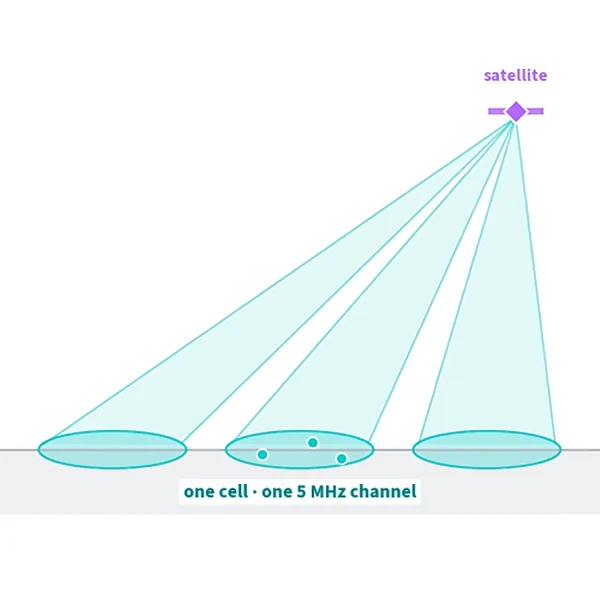
Network benchmarking giant Ookla (Accenture), which collects data from consumers via their popular broadband and mobile Speedtest.net service, has cleverly used data collected from Smartphones using Starlink’s 4G mobile satellite data connectivity to map the size of their individual Direct-to-Cell (DTC) beams in the real-world.
Granted, this is probably more of interest to those with a strong technical interest in such things, but if that’s you then read on. Firstly, a bit of context. At present mobile operators that harness Starlink’s network of DTC satellites in Low Earth Orbit (LEO), such as O2 Satellite in the UK, use the service to deliver basic 4G mobile data connectivity via supporting apps to some of the remotest parts of the country.
As part of this each of Starlink’s first generation DTC satellites are equipped with three downlink (download) antennas and one uplink (upload) antenna. Each antenna is capable of supporting 8 beams (wireless signals sent to an area on the ground) and 2 polarizations, resulting in a total capacity of 48 downlink beams sent down toward the Earth and 16 uplink beams directed back up.
Advertisement
However, up until now the only measurements we’ve had of the beam sizes (i.e. how much area they cover on the ground) has come from an estimate modelled from regulatory filings, whereas what Ookla have just done is use real-world tests from Smartphones to actually observe and measure the D2C beam footprint at global scale. Nobody has done this before.
Luke Kehoe, Lead Analyst at Ookla, explained:
“When two phones in our background signal scans report the same decoded satellite ID and beam index at the same time (i.e., decoded from the broadcast LTE cell identity, which embeds the satellite ID and a trailing beam index), we treat them as being inside the same D2C beam. We independently verify each satellite assignment against archived orbital data (via Space-Track) at the time of observation. Thousands of these matches across thirteen markets let us measure the beam footprint directly.
As a robustness check, scrambling the beam indices (within the same satellite and 10 min window, preserving timing/geography) increases the median separation between matched phones from under 1 km to about 192 km.
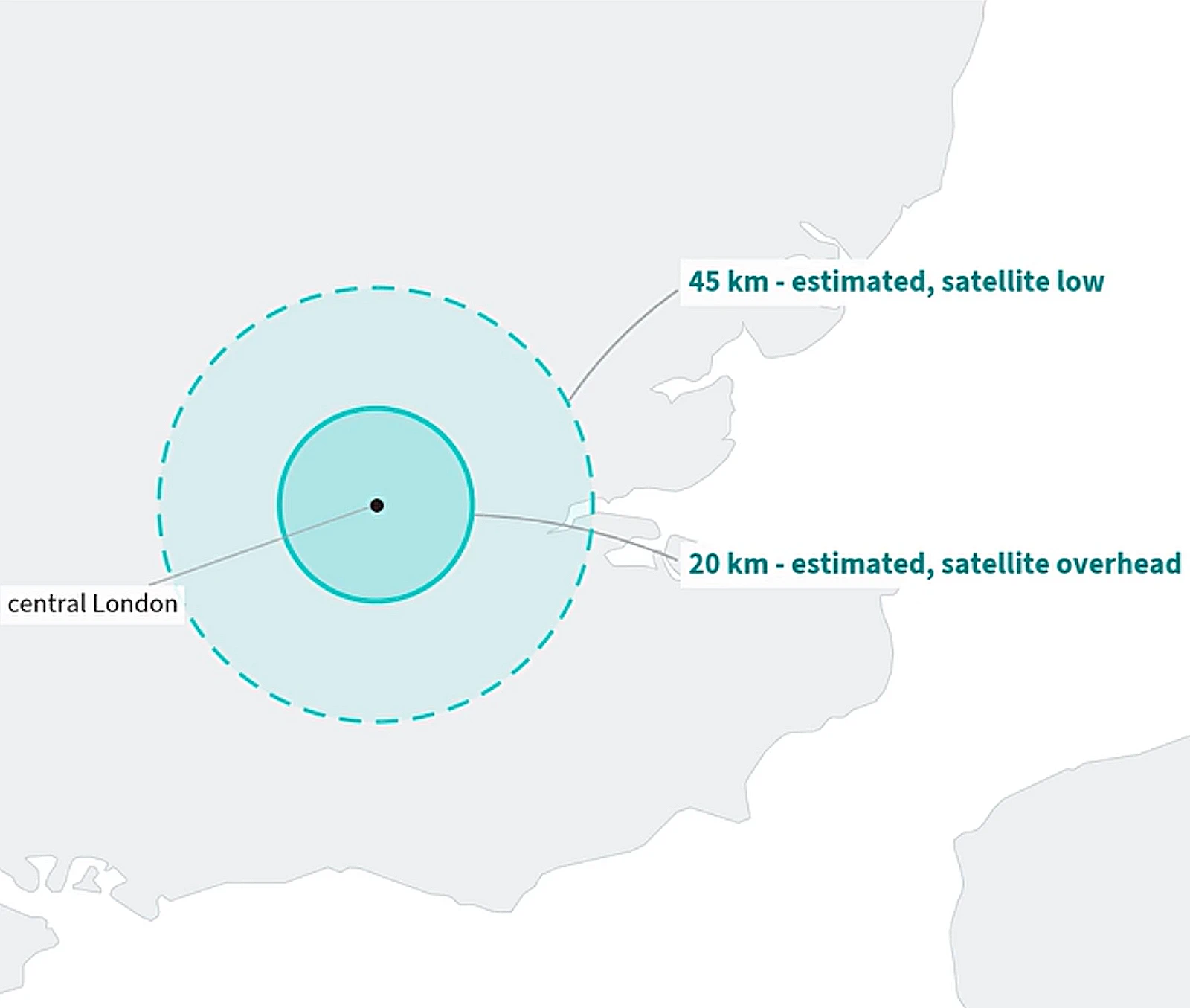
Unsurprisingly, our measured footprint follows the expected geometry here. Its effective radius is about 44 km at a low satellite elevation of ~30°, tightening to around 19 km when the satellite is nearly overhead (with little change from February through August this year). This near-overhead result is close to the roughly 15–22.5 km cell radius implied by SpaceX’s -3 and -5 dB contours in its 2023 FCC filing.
Note that the wider footprint at low elevation reflects the beam being projected onto the ground at an angle.”
Beam size is one of the key capacity levers for such networks, since smaller footprints improve link margin and allow the same spectrum to be reused more densely (i.e. this is also why small cells are so effective for urban densification in terrestrial mobile networks, despite not covering a wide area).
The next generation of DTC satellites from Starlink are expected to combine a phased-array antenna five times larger than the first gen, offering four times more bandwidth per beam, thousands of spatial beams, new S-band spectrum, MIMO and 5G technology. Starlink has previously said that these will start to reach orbit during 2027 and should be ready to go live by the end of that year (here), offering mobile broadband speeds of around 150Mbps per user.
Advertisement






Mark is a professional technology writer, IT consultant and computer engineer from Dorset (England), he also founded ISPreview in 1999 and enjoys analysing the latest telecoms and broadband developments. Find me on X (Twitter), Mastodon, Facebook, BlueSky, Threads.net and Linkedin.












« New National Planning Policy Framework Lends Support to Broadband and Mobile
Advertisement
Leave a Reply
Privacy Notice: Please note that news comments are anonymous, which means that we do NOT require you to enter any real personal details to post a message and display names can be almost anything you like (provided they do not contain offensive language or impersonate a real person's legal name). By clicking to submit a post you agree to storing your entries for comment content, display name, IP and email in our database, for as long as the post remains live.
Only the submitted name and comment will be displayed in public, while the rest will be kept private (we will never share this outside of ISPreview, regardless of whether the data is real or fake). This comment system uses submitted IP, email and website address data to spot abuse and spammers. All data is transferred via an encrypted (https secure) session.















Still think ASTS will be better. Have seen and heard reports that the Starlink D2C at least in it’s current form, causes massive battery drain and is generally unreliable. ASTS meanwhile to the user, will be no different to a ground mast, the phone will seamlessly use the AST satellite as if it was a ground mast, and because of the size of the satellite, the phone doesn’t have to “shout”. Plus there is the obvious benefit that it doesn’t require new hardware, it works with what everyone already has. And for those that care about it – it’s your existing operator who handles the data, not a megalomaniac in America.