DCF Estimate 200,000 Engineers Could Leave UK Telecoms Workforce by 2030

A new report from the Digital Connectivity Forum (DCF), an industry think-tank, has today been published that examines the apparently “growing workforce and skills challenges” of the telecoms sector and highlights how 200,000 UK engineers are expected to leave the workforce by 2030 – risking a future “skills cliff“. But quite a few of those may be leaving due to maturity of the full fibre broadband build.
However the report – ‘Expanding the Network‘, which covers a much wider set of telecoms related fields than just network building, notes how recorded telecoms employment fell by approximately 21,000 filled jobs between 2023 and 2024. The good news is that this largely reflects the natural tail-end of an extraordinary full-fibre build cycle, rather than declining need. But if we take a wider look across the industry, the picture is more complex.
According to the study, around 60% of UK telecoms engineers today are over 50 and the sector faces an estimated 30,000-person engineering shortfall over ten years. As many as 200,000 “engineers” across different parts of the industry are expected to leave the workforce by 2030, which sits against a graduate pipeline of 14,000 a year.
Advertisement
The DCF suggests this could represent an approaching “skills cliff“, although it’s unclear precisely how many of that 200k are leaving because they helped to build new fibre networks and will thus no longer be needed or replaced as those deployments reach completion (a long-expected outcome).
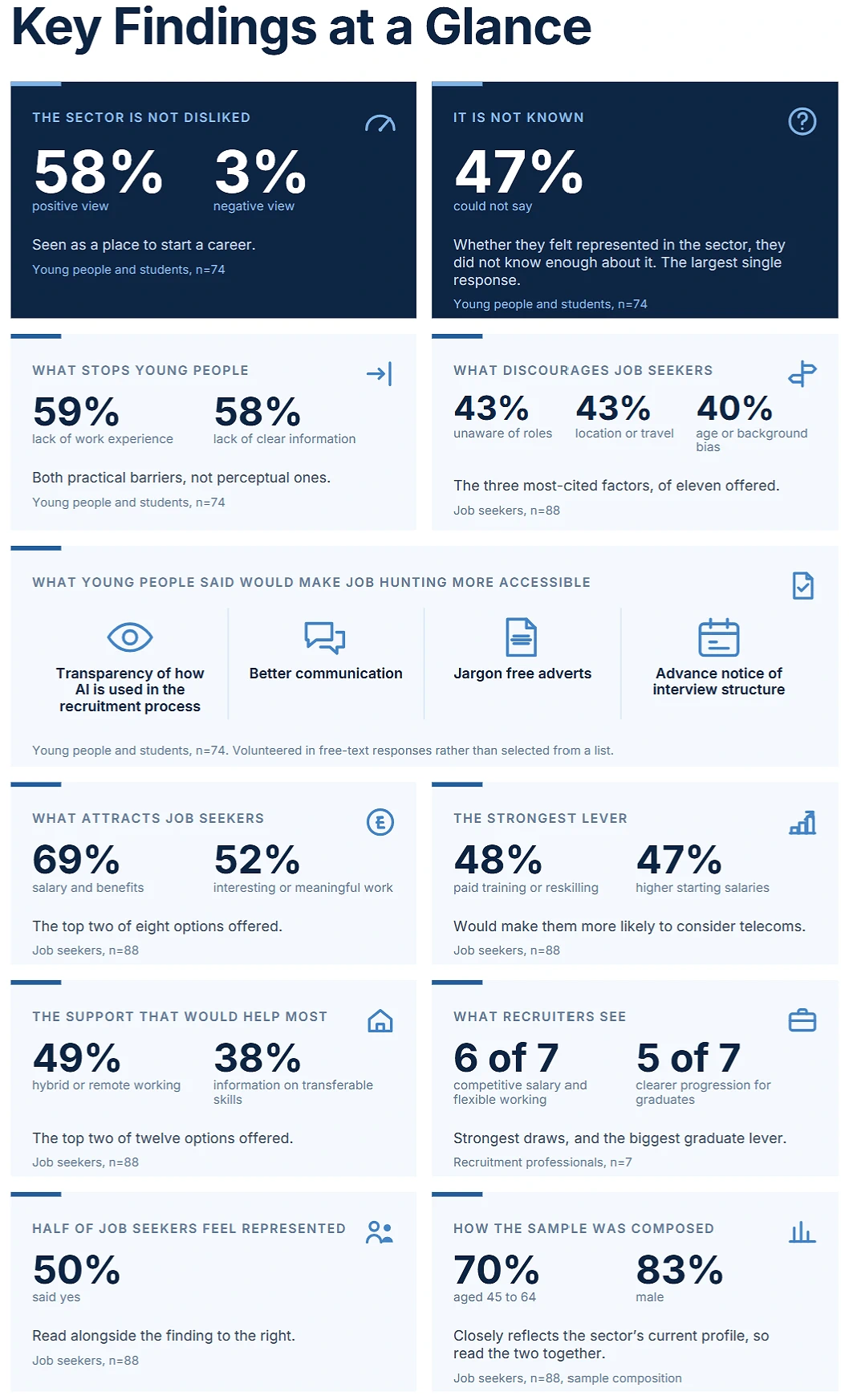
The report then identifies a number of areas that it believes must be tackled. For example, awareness rather than perception is found to be a “key barrier”. Among young people and students, 58% held a positive view of the sector and just 3% a negative one, whilst 38% describe themselves as neutral or unaware. When asked whether they felt represented in the sector, 47% could not comment because they felt that they did not know enough
The report also identifies the recruitment process itself as the single most fixable barrier. Uncertainty of how and to what extent AI is used during the recruitment process was the most frequently raised concern across all cohorts interviewed. As a result, greater transparency about how and where AI is used represents a quick way to build trust with candidates. Alongside guaranteed notification of when candidates are unsuccessful.
Finally, and most hearteningly, the report found that much of what the sector needs is already working somewhere within it. The report flags multiple examples of entry level opportunities, apprenticeship schemes, returnships and inclusive hiring practices already being undertaken by companies in UK telecoms (some operators like BT / Openreach and Virgin Media are particularly good at hiring such groups).
Advertisement
Lindsey Fussell, Digital Connectivity Forum Chair, said:
“The new report from the Digital Connectivity Forum examines claims of skills gaps emerging across the connectivity sector. It also asks whether the telecoms sector is open and accessible to everyone who might want to build a career in it – exploring this question through direct conversation with young people and professionals as well as through review of existing research.
The recommendations that follow are practical and actionable. These include the need for a clearer, shared picture of the careers offered by the sector and where they lead, and better recognition of telecoms within the national careers and skills landscape. None of that will be possible through any one organisation acting alone.
The Digital Connectivity Forum looks forward to working with industry, Government and partners across the sector to take this forward.”
The DCF’s conclusion is therefore that the task is less about invention than about targeting and scaling what already exists and reaching people across all life stages and roles with the information they need to make an informed and aware choice about telecoms as a career.
- Commit to transparency over how and where AI is used in recruitment.
- Publish pay ranges with advertised roles.
- Provide feedback or an outcome to every applicant.
- Move toward skills-based hiring where appropriate.
- Make progression pathways visible and invest in management training.
- Disaggregate telecommunications within official digital sector workforce statistics to help the industry baseline its progress.
- Reflect telecoms pathways explicitly in National Careers Service and Skills England career maps.
- Upskill Jobcentre Plus advisers on the telecoms sector.
- Make employer-delivered returnships eligible for skills funding on the same basis as apprenticeships.
- Extend AI Skills Boost explicitly to mid-career and over-50 workers.
The DCF has also tasked itself with exploring the creation of a shareable career’s framework – covering the full breadth of technical and non-technical telecoms roles. The organisation then plans to produce educational materials pitched at each life stage and to establish shared best practice on company culture.






Mark is a professional technology writer, IT consultant and computer engineer from Dorset (England), he also founded ISPreview in 1999 and enjoys analysing the latest telecoms and broadband developments. Find me on X (Twitter), Mastodon, Facebook, BlueSky, Threads.net and Linkedin.













« Broadband ISP Truespeed Mourns Passing of Chairman Clarke Osborne
Advertisement
Leave a Reply
Privacy Notice: Please note that news comments are anonymous, which means that we do NOT require you to enter any real personal details to post a message and display names can be almost anything you like (provided they do not contain offensive language or impersonate a real person's legal name). By clicking to submit a post you agree to storing your entries for comment content, display name, IP and email in our database, for as long as the post remains live.
Only the submitted name and comment will be displayed in public, while the rest will be kept private (we will never share this outside of ISPreview, regardless of whether the data is real or fake). This comment system uses submitted IP, email and website address data to spot abuse and spammers. All data is transferred via an encrypted (https secure) session.

















This is true of the trades in general. It’s not seen as an attractive job especially now most companies are run by bean counters who have very little understanding of engineering or the people that work in them.
So true Big Dave, we need to value technical workforce more, like Germany.
Not having read the report, and not having the time to read it, I would ask, are those 200,000 “Engineers” leaving employment solely due to approaching retirement age, or because there is no longer a requirement for their skills?
“Telecoms” is another dated term that no longer reflects the nature of the sector.
I suspect they’re leaving becauase they know the FTTP build will be largely complete by 2030, the altnet consolidation will be in full swing and PSTN will be long gone. The telecomms industry will need far fewer engineers and technicians from then on.
@Winston Smith:
Indeed, those factors will play a part, but retirement is also a factor. However, I would also not rely on a survey that is polling so few participants.
You’ve got to love the wording, “Engineers Could Leave UK Telecoms Workforce by 2030”, or do we really mean made redundant, no longer needed, bye. No doubt their employers will be retaining them for the next national endeavours and the cost are in BDUK’s plan?