Feasibility Study on New Subsea Fibre Cable for Shetland Islands Begins
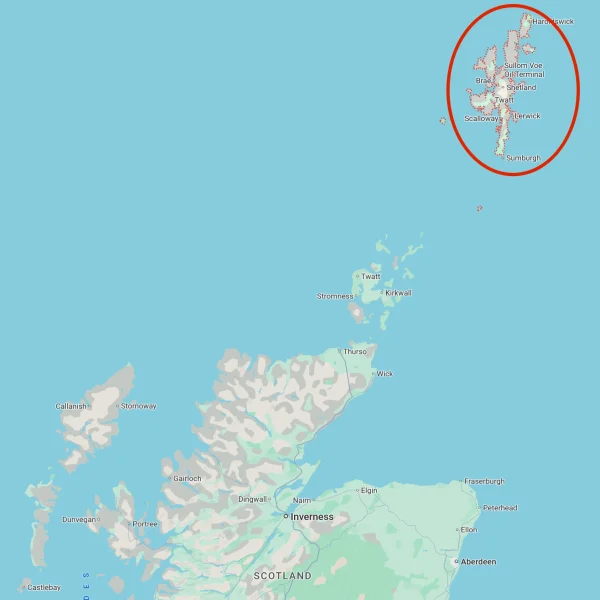
The Scottish Government yesterday set out their work plan for the next five years, which among other things initiated a feasibility study to “identify and evaluate potential options” for deploying a new subsea fibre optic cable between mainland Scotland and the Shetland Islands. The goal being to improve broadband and mobile redundancy, as well as performance.
Shetland is already connected by two major subsea fibre cables, including the SHEFA-2 (Faroese Telecom) submarine (subsea) and the R100 North cable that was recently built by broadband giant BT as part of the Scottish Government’s £600m Reaching 100% (R100) project (here). The R100 project also built a number of smaller subsea fibre links between mainland Shetland and its smaller islands.
Despite this, Shetland occasionally suffers from subsea cable breaks (two occurred in 2025 alone), which cause plenty of disruption to parts of the island’s broadband and mobile services when they occur (often lasting several weeks). The nature of the local network arrangements also means that some operators don’t currently harness all of the available subsea links, which can make the impact of such outages quite variable.
Advertisement
In response the SNP’s previous 2026 manifesto pledged to undertake a feasibility study on the deployment of an additional subsea link to Shetland, although it should be noted that this is NOT the same as making a solid commitment to actually build the new cable. The good news is that this study has now officially begun.
The new Programme for Government document simply states that one of its very first actions is to “initiate a feasibility study to identify and evaluate potential options for a new subsea cable between Shetland and mainland Scotland, with the aim of increasing network resilience and reducing vulnerability to service disruption.” Greater redundancy could potentially also help to attract data centres to the isles.
The feasibility study reflects the Scottish Government’s activity within their first year of their new programme (2026-27), but as above it remains to be seen whether or not this will result in an actual deployment. Running new subsea fibre links is an expensive business (potentially costing around £30m to £60m – educated guess) and that’s to serve a relatively small population.
Lest we forget that telecoms giant VodafoneThree UK are already conducting a “feasibility study” of their own to explore the possibility and cost of deploying a new subsea fibre optic cable system to help transform broadband and mobile connectivity on the Shetland Islands (here). But the outcome of that is just as uncertain and likely to be impacted by the Scottish Government’s own process.
Advertisement






Mark is a professional technology writer, IT consultant and computer engineer from Dorset (England), he also founded ISPreview in 1999 and enjoys analysing the latest telecoms and broadband developments. Find me on X (Twitter), Mastodon, Facebook, BlueSky, Threads.net and Linkedin.













« DCF Estimate 200,000 Engineers Could Leave UK Telecoms Workforce by 2030
Advertisement
Leave a Reply
Privacy Notice: Please note that news comments are anonymous, which means that we do NOT require you to enter any real personal details to post a message and display names can be almost anything you like (provided they do not contain offensive language or impersonate a real person's legal name). By clicking to submit a post you agree to storing your entries for comment content, display name, IP and email in our database, for as long as the post remains live.
Only the submitted name and comment will be displayed in public, while the rest will be kept private (we will never share this outside of ISPreview, regardless of whether the data is real or fake). This comment system uses submitted IP, email and website address data to spot abuse and spammers. All data is transferred via an encrypted (https secure) session.

















Feels like the likely conclusion of the relatively short feasibility study would be that the Shetland’s basic needs are met, and that anything additional would be useful, but a need which can be met entirely by the private sector….
Seems pretty insane when Starlink is available & other competitors rising.
The key 2 words in this are DATA CENTRES. This probably has zero to do with with the needs of the local population.