Virgin Media O2 UK establish £3m fund to encourage local reuse of old tech
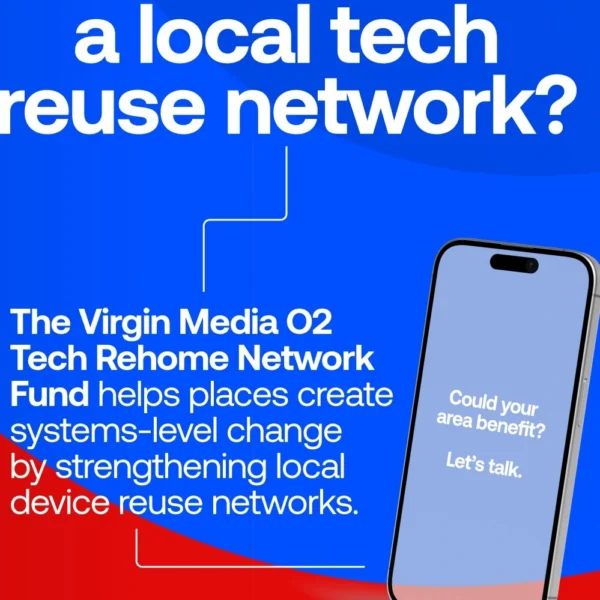
Broadband and mobile giant Virgin Media and O2 have today launched a new £3m Tech Rehome Network Fund, which will run until 2030 to support projects that help improve UK digital inclusion and reduce electronic waste within cities by encouraging the reuse of old technology.
The first £500,000 funding round opens today, which will be made available to councils, charities and community organisations who can apply with initiatives to create local networks that “recover, refurbish and redistribute unwanted devices to people who need them” – while addressing growing e-waste levels in the UK.
The fund is being supported by new research from VMO2, which claims that 460 million digital devices are sitting unused across UK homes and businesses, including an estimated 267 million still suitable for reuse or repair. Businesses were also found to hold an average of 45 unused devices each (compared with 7 for households), yet when staff need equipment, more buy new devices (42%) than reassign existing ones (34%).
Advertisement
Interestingly 58% of people say they aren’t familiar with the term “digital exclusion“, including 31% who have never heard it before. Perhaps that’s why 58% had never considered that an unused device could help someone experiencing digital exclusion.
However, once people understood the role their unwanted devices could play in tackling digital exclusion, the responses changed – 90% people said they would donate an unwanted device if they knew it would help someone in need (82% for businesses). Furthermore, 73% of consumers and 74% of businesses say they’re even more likely to donate if they know devices will stay within their local community, hence the “local” focus of the new fund.
Dana Haidan, Chief Sustainability Officer at Virgin Media O2, said:
“Digital exclusion affects millions of people across the UK, yet our study shows the technology that could help tackle it is already sitting in homes and businesses across the country.
Through the Tech Rehome Network Fund, we’re investing in trusted local organisations to build the networks cities need to keep devices in use for longer. By making it easier for households and businesses across cities to pass on unwanted technology, we can give devices a second life while helping more people get online.”
Strand Partners’ research team conducted two nationally representative online surveys in the UK between 29th July and 4th August 2026 to deliver the above surveys. The first surveyed 1,002 UK adults, nationally representative by age, gender and NUTS 1 region. The second surveyed 1,102 business decision makers, comprising 600 businesses located across six UK cities and 502 businesses nationally representative by size, sector and region.



Mark is a professional technology writer, IT consultant and computer engineer from Dorset (England), he also founded ISPreview in 1999 and enjoys analysing the latest telecoms and broadband developments. Find me on X (Twitter), Mastodon, Facebook, BlueSky, Threads.net and Linkedin.











« O2 UK deploy outdoor 4G and 5G mobile Small Cells in Canterbury
Advertisement
Leave a Reply
Privacy Notice: Please note that news comments are anonymous, which means that we do NOT require you to enter any real personal details to post a message and display names can be almost anything you like (provided they do not contain offensive language or impersonate a real person's legal name). By clicking to submit a post you agree to storing your entries for comment content, display name, IP and email in our database, for as long as the post remains live.
Only the submitted name and comment will be displayed in public, while the rest will be kept private (we will never share this outside of ISPreview, regardless of whether the data is real or fake). This comment system uses submitted IP, email and website address data to spot abuse and spammers. All data is transferred via an encrypted (https secure) session.
















What would help is if hardware manufacturers could continue to supply updates to older “premium” devices which are still otherwise viable–to encourage more donations.
For example, Blackberry Key2.
Still quite a powerful functional device (and the physical keyboard is helpful for people with shaky fingers–very few replacement options for that now!), but many useful Android apps refuse to work because the Android version is too old, and some websites are also starting to refuse because the chrome browser version is too old.
I don’t think there is any fundamental hardware gap that would prevent a later Android version from working, just a lack of commercial interest from the manufacturer (TCL in this case) to release the updates, and lack of operator interest/Google in triggering updates
Of course, if the Government really wanted to “land” ID cards, they would just need to wrap it up in a free low-spec mobile phone, as an “authentication” device with a walled garden of key apps (NHS, HMRC, a MFA authenticator, public transport, etc.).
Just like France Minitel of decades ago to replace phone books.