Biannual October 2026 progress update on BT’s 10Mbps UK broadband USO
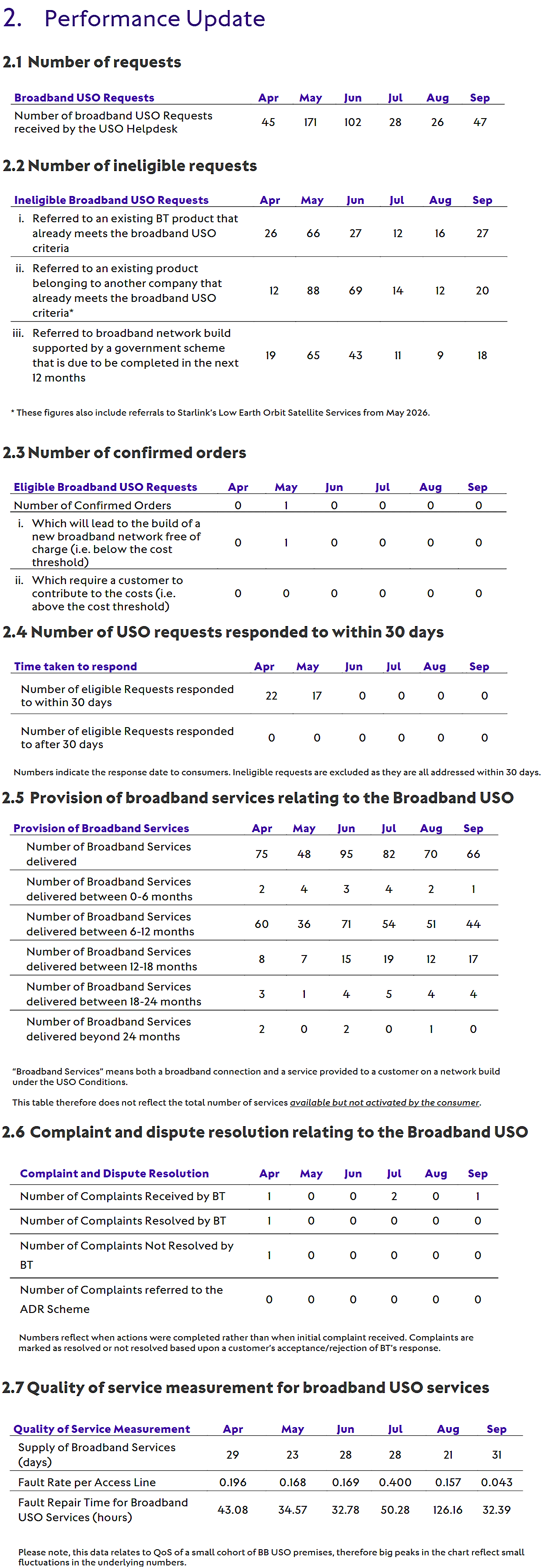
Internet provider BT has published their biannual (October 2026) progress update on the delivery of Ofcom’s somewhat limited 10Mbps Universal Service Obligation (USO) for broadband. The provider has so far helped to build a USO connection to over 9,452 premises (up from 9,089 in Apr 2026) – using FTTP, with 128 further builds in-progress (down from 461).
The USO is a legally-binding and industry-funded obligation that falls on BT across the UK and KCOM in Hull. In short, people living in areas where they can’t yet receive a 10Mbps or faster download speed, and aren’t expected to be covered by such a network in the next 12-months, can request a service capable of 10Mbps+ (1Mbps+ upload) from the aforementioned internet providers.
A cost sharing model also applies here, which means that the providers will “calculate the total excess cost of the build and divide that between the eligible premises. If that amount is below £5,000 per premises (on top of the £3,400), we’ll automatically split the costs“. But some areas can still end up costing hundreds of thousands of pounds, even up to £1-2m, and would thus find the USO route to be unviable (here and here).
Advertisement
Ofcom previously stated that 39,000 UK premises (under 0.2%) currently fall into the USO gap (i.e. those outside of suitable fixed line, fixed wireless or 4G/5G mobile cover). But this is continuing to shrink as a result of upgrades delivered via ongoing publicly funded schemes (Project Gigabit contracts etc.). Ofcom also recently confirmed that Starlink’s LEO satellite broadband service can now act as a viable alternative – technically shrinking the 39k gap to just 4,000 premises.
Just to be clear about this. Many of those who pursue the USO option via BT say they were offered 4G (mobile broadband) connections via EE instead. But those actually considered to have been delivered under the USO itself usually get Fibre-to-the-Premises (FTTP). Commercial builds of the latter have also helped to shrink the USO gap (tackling the first c.80%+ of the country).
The government are still said to be exploring how best to support those who live in “Very Hard to Reach” areas with even faster speeds – roughly equating to the same sort of area as the USO is focused upon. At the same time they were due to review the USO itself (here), but this work seems to have stalled since 2024’s change in government. As above, Starlink now seems to be the accepted quick fix.
BT’s October 2026 Broadband USO Report
The latest statistics confirm that USO delivery is still a slow process – in Oct 2023 there were 185 builds in progress, then 265 in April 2024, 215 in Oct 2024, 349 in Apr 2025, 186 in Oct 2025, 461 in Apr 2026 and now 128. We suspect this may be a combination of factors, such as a lack of consumer familiarity with the USO (apply for it here), new services like Starlink becoming available, the shrinking area of USO eligibility and the fact that the policy may be running into the limitations of economically viable deliverability.
Advertisement



Mark is a professional technology writer, IT consultant and computer engineer from Dorset (England), he also founded ISPreview in 1999 and enjoys analysing the latest telecoms and broadband developments. Find me on X (Twitter), Mastodon, Facebook, BlueSky, Threads.net and Linkedin.













« Culture Secretary pushes for statutory UK broadband supplier of last resort
Advertisement
Leave a Reply
Privacy Notice: Please note that news comments are anonymous, which means that we do NOT require you to enter any real personal details to post a message and display names can be almost anything you like (provided they do not contain offensive language or impersonate a real person's legal name). By clicking to submit a post you agree to storing your entries for comment content, display name, IP and email in our database, for as long as the post remains live.
Only the submitted name and comment will be displayed in public, while the rest will be kept private (we will never share this outside of ISPreview, regardless of whether the data is real or fake). This comment system uses submitted IP, email and website address data to spot abuse and spammers. All data is transferred via an encrypted (https secure) session.















In the world today 10mb is still a struggle to do the majority of things, unreal tbh. Wonder if quality is on the list, 1000ms pings but your good speeds at 10.1mb?
10Mbit is plenty fast enough to get online and stream video (though not to multiple TVs).
The USO has never been about providing a luxury service. BT can therefore use any technology they want (including Starlink once they launch their version of it), though as we keep seeing, they are nearly always deploying FTTP anyway – in which case the end user can have 1.6Gbit if they want
@Ivor
I know someone with a wife and kid who had to live with 10mbps, they hated it and constantly complained about it to me.
Even for streaming, it’s fine for 1 maybe 2 1080p streams but 15mbps is recommended by Netflix for 4K.
God help you if you do large files downloads, something like GTA VI would take approximately 47 hours if all goes well at max speed.
I have a USO build outstanding. ~3Mbps speed available only currently. Paid £2,200 as properties in the area who signed up filled the rest of the pot. That was June last year so nearly a year and a half in now. Everything built apart from one railway crossing overhead. Wayleave agreed but getting Network Rail to agree a time to run the cable is proving difficult. My MP now involved to speed this up. Currently building a house (after knocking old one down) and joke among friends is which will be built first – the house or the completed fibre network!
Based on our experience of getting part of a fibre run under a bridge owned by Network Rail, I would set your expectations low and assume the house will be done first. Plan to Starlink as a stop gap whislt you wait. Think about where you would put it and how it connects in to your home wiring. Annoying as an after thought on a new build!
Good luck
Maybe Network rail and Ofcom should be forced to sit in the same room as each other. They are both government organisations aren’t they?
What will happen when they want to shut the exchange, or at least remove the copper components, will these properties just be cut off completely?
@James The thing is a copper cable already exists overhead and this is just adding the fibre overhead. A wayleave has been granted. It’s just a period for the actual work. The line is closed between midnight and 6am so it can be done then without any issue. My MP has already had a response and asked me more questions so fingers crossed. I agree though we will likely end up with an interim solution such as Starlink.
I don’t understand why Starlink leaves 4000 premises unserved?
Underground premises. MDUs with no right to mount it externally or at roofline.
I’d imagine quite a few are city centre premises on the fringe of the centre, long old wires to exchange other end of city.
Probs also applies to premises you can’t install Starlink on, eg outbuildings alongside a runway for example