Summary of Mobile Travel eSIMs for Cheap Data Roaming Outside UK
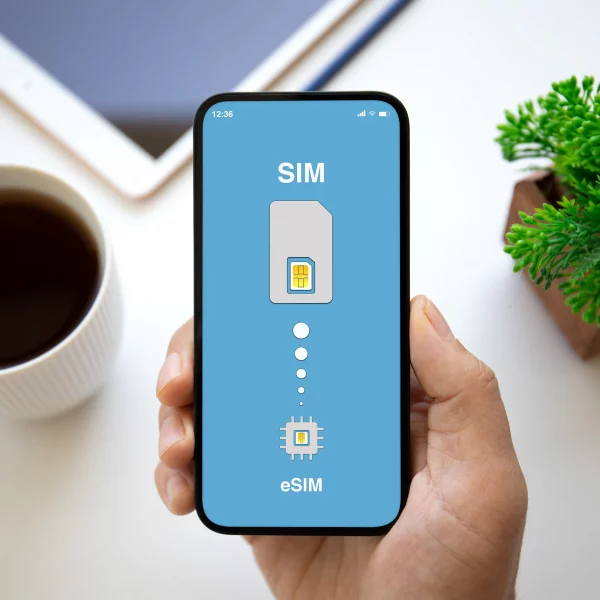
At some point most of us will travel abroad for a holiday or work and during such periods we often need to consider how best to maintain mobile connectivity, particularly mobile data (broadband), while in a different country. The following article looks at some of the options and caveats for those seeking to use a travel eSIM in order to solve this challenge.
Before we get started, it’s important to recognise that a lot of UK mobile operators do offer roaming options, either as an inclusive part of their mobile plan or as a paid add-on. But even operators that still include roaming as a standard feature will impose a Fair Usage Policy (FUP) that often limits your data usage or restricts the countries where it can be used (e.g. O2 limits data to 25 GigaBytes per month and Smarty to 12GB).
In terms of buying an add-on for roaming with your existing mobile operator, the cost of this can vary quite a bit depending upon your needs. For example, Three UK will charge from £5 for a 3-day Go Roam Europe pass (i.e. use your existing allowances in 49 European countries) or the same for unlimited data for 24-hours across 89 countries. But costs soon mount if you stay longer in your destination or travel outside the EU, and you might also want a bigger allowance.
Advertisement
Suffice to say, there are some situations and countries where it may instead make more sense to purchase a separate Travel eSIM and install it alongside your existing mobile plan. One caveat is that most of these only support data connectivity (not calls or texts, although a few include those too), although that’s not really a problem since most people already use internet-based messaging services (WhatsApp, Facebook Messenger, RCS messages etc.).
Let’s Talk Travel eSIMs
Most modern Smartphones already allow you to use both a physical SIM card (Primary SIM / profile) and an eSIM (Secondary SIM / profile) at the same time, which can be useful for travel. Installing a travel eSIM is thus usually as simple as scanning the QR code you get sent (usually just before you’re due to travel) to install the profile, and then activating it when you arrive at your destination.
Take note that some devices, like the iPhone, will ask if you want to install the travel eSIM as your primary SIM profile. Personally speaking, I’d recommend against doing that, as it can make it more fiddly to get things back to normal once you return to the UK; manually messing around with SIM profile settings is no fun for the uninitiated, but each to their own.
Android Phone Screenshot with Two SIM Profiles
Advertisement

Generally speaking, we’ve always found it better when travelling to make the travel eSIM the secondary profile, then turning data off on the primary (domestic) SIM and only activating it on the secondary travel eSIM when at your destination (just reverse this when you return to the UK).
You can still leave your primary SIM active too if you want (with data / roaming data disabled on its profile), but remember that any outgoing mobile calls and regular text messages (not RCS) will then default to using this, so depending upon your mobile plan you might attract extra charges for any non-data tasks while roaming. Now, here are some other things for you to consider, before we get to the comparison of example plans.
Things to consider when choosing a Travel eSIM:
➤ Deals between travel eSIM providers tend to vary by country, so don’t assume that if one provider is expensive for X country that it will always be the same for Y country.
➤ Examine the mobile coverage where you’re going to see which operators give the best coverage in your expected area of usage (e.g. nPerf or Opensignal). This is important because some networks will deliver better coverage and different travel SIM providers may harness different underlying networks (others may also roam across several networks), although sadly not all eSIM providers make their local network partners clear.
➤ eSIMs are usually easy to setup (just scan a QR code), albeit somewhat dependent upon your device and mobile network. But they do sometimes need to be added manually as not all devices will automatically pick up the right details, which can be a pain as some of the codes you have to enter will be quite long.
➤ Some features, like WiFi Calling, are network-based in the UK and may not work when you’re roaming outside the country. Some limited exceptions to this do exist (e.g. customers of Vodafone’s global network may find it still works, so long as the country they’re in has the same operator) and there are sometimes other ways around it, but such things often require a bit of extra knowledge.
➤ A small number of eSIM providers, like Holafly and Saily, claim to offer “unlimited data“. But that doesn’t mean to say there aren’t restrictions. For example, quite a few Holafly users found that their mobile broadband speeds ended up being throttled after they used a certain amount of data (experiences may also vary between destinations). The official website states this on its product page:
“Please note that the operator may reserve the right to apply a Fair Usage Policy, as it applies to all other network users. In particular, if the operator estimates the usage of more than 90GB of data in a month, they may temporarily reduce the speed to between 256-1024KB to avoid affecting other users. This limitation is intended to prevent network saturation and will be removed within 24 hours. If you think the local carrier has limited your speed, please get in touch with us by chat, and we will check if there is any incidence and how to restore your rate to the maximum speed permitted by the network.”
Meanwhile Saily’s website mentions the following: “Unlimited data at up to 1 Mbps” (i.e. speeds are capped to 1Mbps).
➤ Customer support tends to be the weak link at quite a few travel eSIM providers, so if you need help then it may sometimes be difficult to reach a human.
➤ Some providers will restrict usage on WiFi Hotspot sharing and Tethering. For example, Holafly limits daily mobile hotspot data to 500MB or 1GB (varying by location) for its standard travel eSIMs, although this is removed if you take out one of their monthly subscription plans. The catch being that a monthly subscription is usually quite pricey for global travel, but is useful for frequent business travellers.
➤ Google around for any free travel data promotions before you depart. Sometimes you can pickup 1GB of free data in a promotion, which might not be much but it can be handy as a backup. Make sure to Google based on your destination as some offers will be location specific (e.g. “1GB of free travel data in Italy“).
➤ If you have a mobile broadband travel router then remember that most only support physical SIM cards and NOT eSIMs. But you can get around this by using a service like 5ber.eSIM, which rather cleverly stores multiple eSIM profiles on a single physical SIM card (esim.me is another option). In addition there’s the Eiotclub, but this one seems to limit you to using their own data plans.
On the other hand you could just use WiFi Hotspot mode on your Smartphone. Yes this might lack some of the features, security and flexibility of a dedicated router, but for most purposes it’ll work just fine (most people have spare mobiles lying around that they can dedicated to doing this too).
➤ Mobile broadband speeds while abroad may or may not be slower, depending on the roaming agreements in place and the status of local 4G/5G deployments. Some studies have indicated that mobile broadband performance isn’t such an issue (here).
Click over to the next page to see our quick summary of some travel eSIM providers..
Advertisement






Mark is a professional technology writer, IT consultant and computer engineer from Dorset (England), he also founded ISPreview in 1999 and enjoys analysing the latest telecoms and broadband developments. Find me on X (Twitter), Mastodon, Facebook, BlueSky, Threads.net and Linkedin.













« 1p Mobile UK Suffers Another Website Outage and Phone Disruption UPDATE

















WorldSIM charge £1 per month, whether or not the service is used.
I would have flagged when highlighting that your UK SIM WiFicalling might not work outside of the UK, your UK network may also charge roaming rates for a call made over WiFicalling when you’re outside the UK.
Whilst this is a good article the number and variety of eSIMs these days is mind boggling. I usually use esimdb to search for a suitable provider.
I find a key consideration to be the location of the home network of the eSIM provider, and sometimes it can be hard to find this detail. I was recently looking for a eSIM in Asia and almost bought one that had a home network in Australia – that would have been great for an Aussie tourist but suboptimal for me with data going all the way to Australia before heading back to Europe.
The other thing to consider are the regional packages where eSIM providers will offer connectivity across a number of countries. I was able to find a single eSIM package that included Thailand, Vietnam and Kazakhstan (plus others) that matched my requirements for a recent trip.
The other warning is to have a record of the APN settings for the eSIM provider, they seem to be getting better at coming with the APN preconfigured but if it doesn’t come with the APN and you don’t have any other connectivity you don’t have any means of connecting to look it up.
all great advice plunet (from an industry insider)
Also our own service – http://www.iqtravel.net
Honest Mobile, Flexifone, esim.net
Massive list
I’d have to recommend eSIM.sm depending on the country if you’re not planning on using a lot. Spain on their global SIM is £1.24/GB (their global SIM is essentially PAYG with no expiry), US is £1.31.
I use it as a backup here in the UK as rates are reasonable enough at £1.38/GB on all 4 networks.
Whilst travel eSIMs are certainly convenient they’re often not the best deal, especially if you would like to use a lot of data whilst abroad.
First thing to check should be whether a local UK SIM with free roaming is available, some examples:
iD mobile currently offers unlimited data in the EU (up to your UK plan’s data allowance)
Lycamobile UK offers free roaming in India (up to 30GB)
If no free roaming with a UK SIM is available (or you’re locked in to a UK plan with no free roaming) then it’s often significantly cheaper to buy a local SIM.
Some countries have specific “tourist” plans that offer a data bundle (e.g in Italy the dolce vita tourist plan from Vodafone offers 200GB of 5G data for €14.95)
In other countries buying a standard pre-paid SIM offers the best value. For example Lycamobile USA offers a 30 day unlimited data (SIM or eSIM) package for $18.
Lebara also offers up to 30GB inclusive in India.
There are good deals out there for those that travel frequently. I use a Vodafone eSIM (through a reseller) that at home gives 500GB data along with pretty much all you can eat calls, with the added benefit of 25GB when in a roaming country, plus calls to the UK and local numbers in the country you’re in.
Has some downsides, like if you try and use it in an unsupported country they cut you off for the remainder of the billing period, and no support for outgoing sms, but for £22 a month, I’ve made it my main mobile plan.
eSIM.net is the company if interested, it’s currently $29usd per 30 days with auto renew available.