Ofcom Survey Finds Growth in Unlimited UK Mobile Data Tariffs

Ofcom has published the results from a new survey that is intended to help monitor how well the UK mobile market is functioning and whether it continues to deliver good outcomes. For example, the work reveals that unlimited data (broadband) tariffs accounted for 13% of mobile plans in 2023 (up from 5% in 2019), but plans with smaller allowances are now less common.
The survey – ‘Monitoring Consumer Outcomes in the Mobile Sector‘ – similarly noted that consumers typically used only a small share of their mobile data allowance, and 67% of customers did not use their full monthly data allowance at any point during their contract or PAYG tariff.
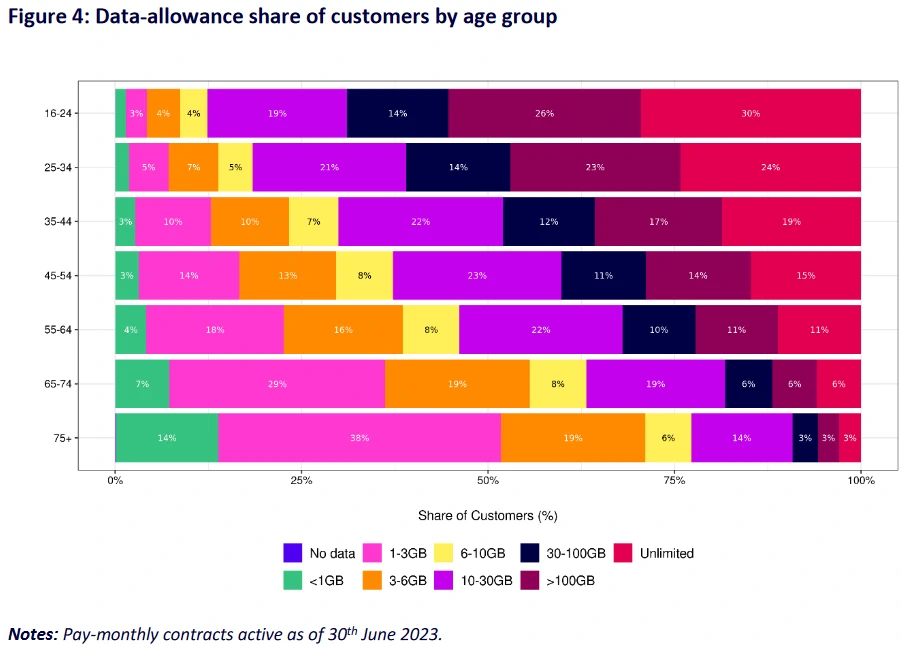
Younger mobile customers also tended to choose tariffs with higher allowances, while older customers typically chose tariffs with lower allowances. Almost a quarter of customers in the 16-24 and 25-34 age groups, for instance, held tariffs with an unlimited data allowance. These customers were also more likely to purchase contracts with higher limited data allowances (>100 GB and 30-100 GB) compared to older customers.
Advertisement
By contrast, less than 10% of customers in the 65-74 and 75+ age group held unlimited tariffs and more than half of customers who are 75+ held a tariff with a data allowance of less than 3GB (GigaBytes). But for the median (average) consumer, data allowances increased from 4GB in 2019 to 12GB in June 2023, which is a threefold increase.

Ofcom also analysed mobile data usage. The median data usage more than doubled from about 1GB in 2019 to about 2.7GB in June 2023. The 75th percentile showed a similar increase from around 3.5GB to about 8.7 GB during the same period.
Advertisement
Elsewhere, the average monthly spend gradually declined between 2019 and 2021, by around £2 (or 7%) (in nominal terms). But after that period the analysis shows prices rising in early 2022 and early 2023 when monthly spend rose by around 5% and 7%, respectively. “These increases were most likely due to the high inflationary environment resulting in high in-contract price rises but also potentially due to higher prices for new tariffs,” said Ofcom’s report.
The full report covers a variety of different areas around consumer choice of package, data usage and pricing. The report is in a format that makes it difficult to summarise and put into a simpler context, but hopefully the above summary offers some insights.






Mark is a professional technology writer, IT consultant and computer engineer from Dorset (England), he also founded ISPreview in 1999 and enjoys analysing the latest telecoms and broadband developments. Find me on X (Twitter), Mastodon, Facebook, BlueSky, Threads.net and Linkedin.












« Wholesale Provider PXC Partners with UK ISP Association

















It never Unlimited data – because of cheat in T&C’s fair usage policy up to 400, 500, 600, 650 in GB in most mobile providers.
Unlimited should be banned if it have FUP on it.
Fair enough on the terminology, although to me you’d have to be trying quite hard to burn that much data through a mobile. Obviously if using it as 5G broadband with tethering, then it’s more feasible to reach the secret limit.
No because some people abuse the networks on which do unlimited data at cheap prices *Looks at Three etc by downloading TBs of data over a connection that is meant for mobile devices not as a alterative to fixed broadband.
Therefore some companies rightly so have a reasonable FUP in place, if you’re constantly using up way more than that than you really ought to be looking at a fixed broadband connection.
The only issue is not all companies have a FUP in place when they ought to as 650GB a month is more than enough for the average user.
Those who complain about FUPs in place or who abuse the unlimited data by downloading TBs simply have nobody to blame but themselves, get over it.
Younger people addicted to HD/4k streaming on the move? I’m a fairly heavy phone user but obviously I’m mostly on Wi-Fi. Even so, I’ve yet to burn more than 3GB of mobile data in a month, despite weekends out and about, etc. You’d have to try quite hard to burn hundreds of GB! But it means I’m happy on a Smarty rolling SIM for just £7/month, which is staggeringly good in my view (includes EU roaming allowance). £21/month for all 3 of us, but you can get a single unlimited SIM for £20.
more likely they don’t want to lose access, so having “no limit” means they won’t be – even if they’re paying a high cost and using barely anything. (and obviously the networks love these users)
I saw this in my peer group but as we’re now all getting older (mid 30s) money goes on more important things which will also have influence. It’s an easy place for a lot of people to cut costs generally.
It’s surprising how quickly it can mount up. If you have a lot of downtime away from decent WiFi e.g. a daily commute on public transport you can easily start getting up to 100+ GB a month on data if you fill the time watching YouTube or whatever.
I tend to stick to higher data limits or unlimited (depends on cost) for peace of mind and flexibility, even if I’m not fully utilizing it most of the time.
so for example, if say out of the blue my broadband goes down, I can tether without too much concern.
Note that with my current plan and some discounts, it’s effectively £11pm for 150GB.
Most have fixed line bbrand services so they are paying more than just mobile tariffs.
I DONT have a fixed line service.
I have UL mobile tariff and use about 400gb monthly.
100mbps download
Works fine
Three don’t have any fair use policies, they say unlimited means unlimited. All others are around 600gb/month.
There’s also a tethering issue that certainly O2 and EE have saying if 12 devices are tethered it breaks their FUP. Also some networks state certain SIMs only may be used in a device they supply and I think Tesco Mobile specifically says no mobile routers.
I’m waiting for a test case or Ofcom to wade in. Their net neutrality rules look very dimly on tethering rules and this is what caused Three to go truly unlimited. Ofcom’s most recent report suggests tethering limits and no mobile router specifications are not compatible with net neutrality. The data use limits they seem more comfortable with to an extent but read their latest report and I think they are just waiting on a case to jump on to say tethering restrictions are a no no.