UK Ranks 6th in Opensignal Study of European Fixed Broadband Speeds

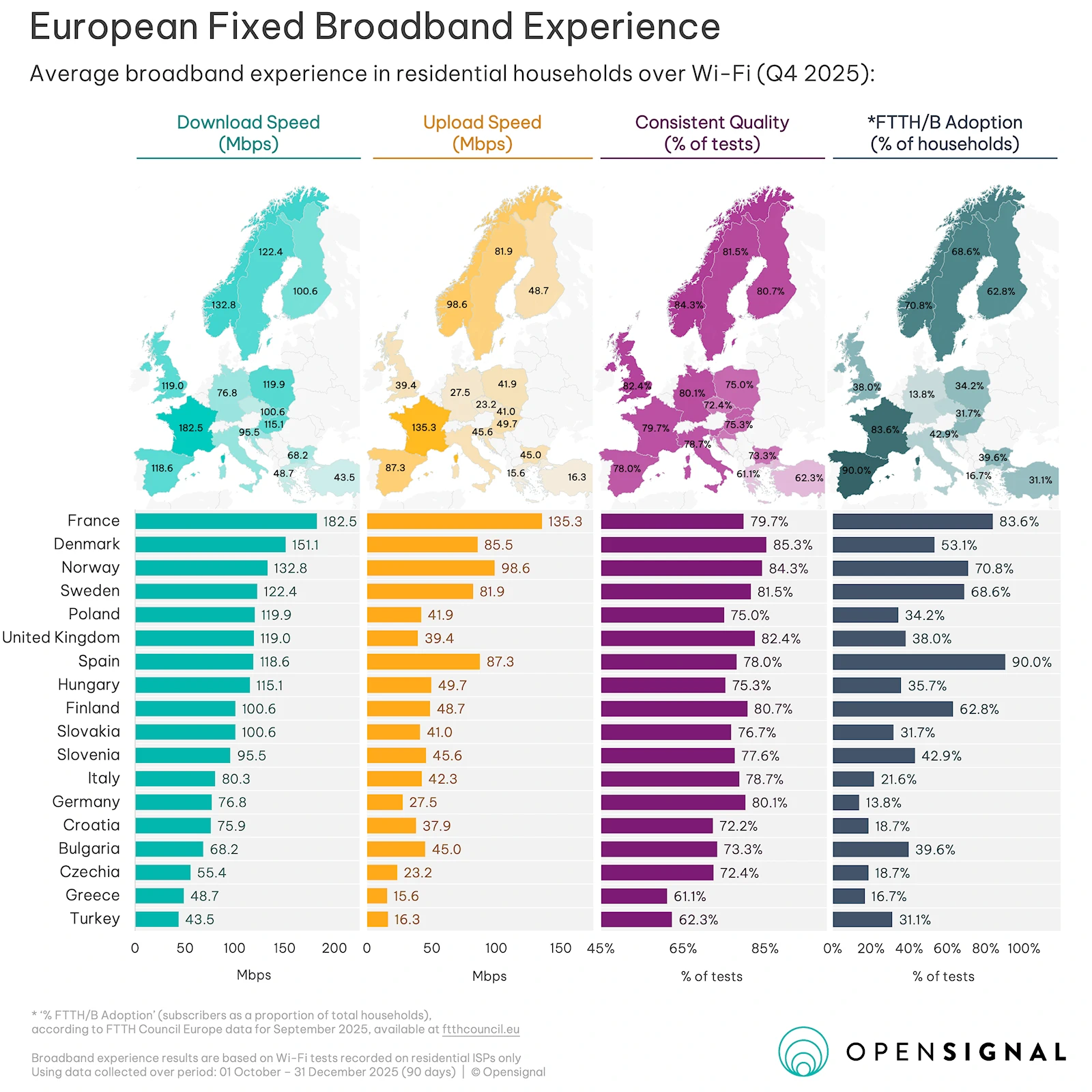
Opensignal, which gathers crowdsourced data via consumer speedtests on its App, has published the results from a new study that examined fixed broadband speeds across 18 European markets, including the United Kingdom and Turkey. Overall the UK ranked 6th for download speed (119Mbps), 13th for upload speed (39.4Mbps) and 3rd for Consistent Quality (CQ).
Most people will already know what download and upload speeds reflect, but we do need to elaborate on Opensignal’s Consistent Quality (CQ) measure. The CQ metric is measured as the share of tests that exceed thresholds needed to support most common everyday online use cases (e.g. watching an HD video, playing online games etc.). The metric is a composite measure of data speeds, latency, jitter, packet loss and time to first byte.
Otherwise, the results show that France stands out with the highest average speeds at 182.5Mbps download and 135.3Mbps upload. The more symmetrical download and upload outcomes are consistent with markets where FTTP has become a much larger part of the fixed broadband base. By contrast, more asymmetric profiles remain visible in Hybrid Fibre Coax (HFC)-legacy markets, such as the UK (119Mbps down and 39.4Mbps up) and Germany (76.8Mbps down and 27.5Mbps up).
Advertisement
Elsewhere, Europe’s most FTTP-advanced markets, France and Spain, demonstrated Consistent Quality scores of 79.7% and 78.0%, albeit below those seen in Denmark at 85.3%, Norway at 84.3%, or Sweden at 81.5% – where in-home Wi-Fi experience comes into play as the explanatory link.
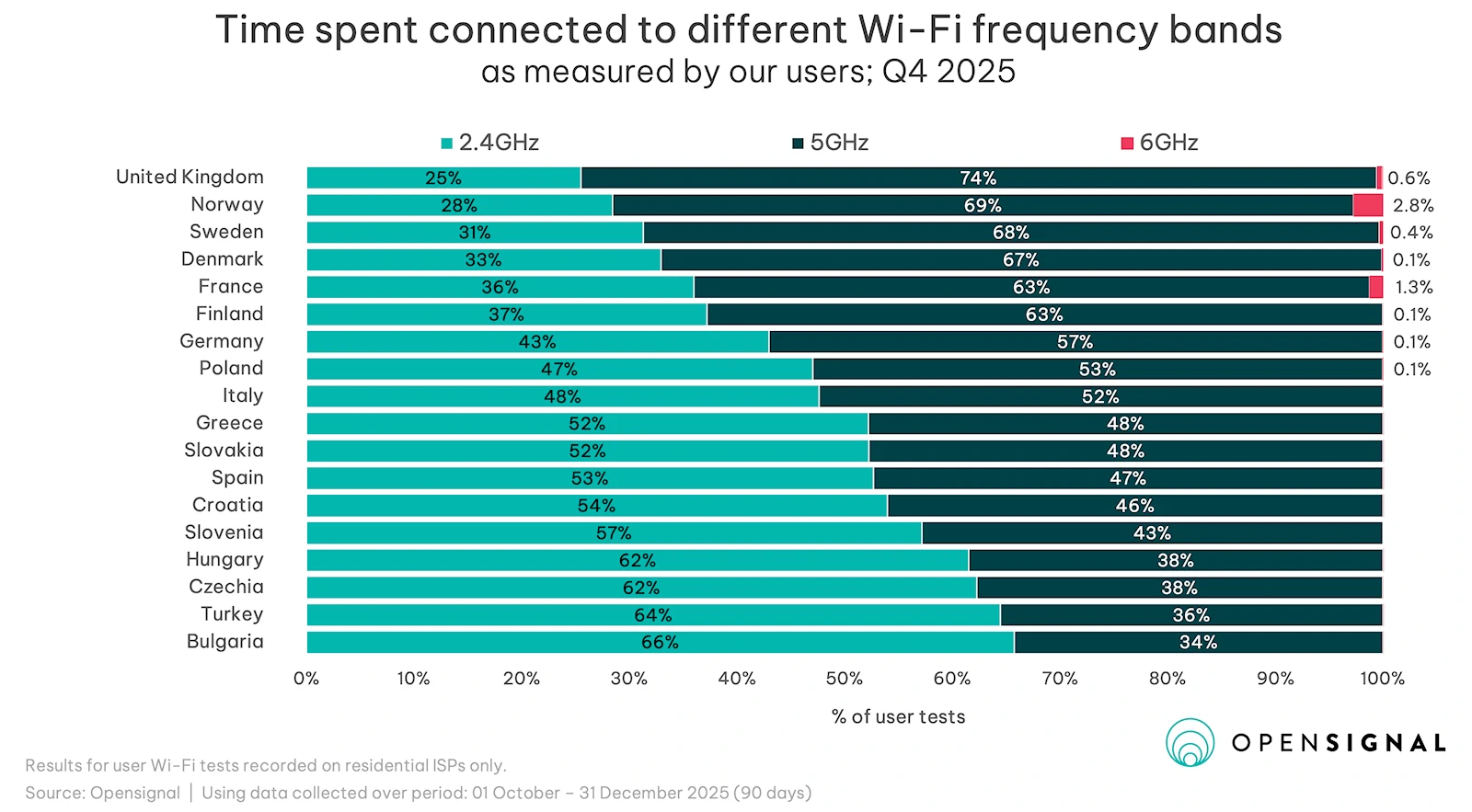
The results can also be impacted by the prevalence of older and slower WiFi standards between different countries, since many people will be conducting such speedtests over their home wireless network rather than using a direct wired broadband connection to their router.
Across the region, average Broadband Consistent Quality rises from 64.9% on Wi-Fi 4 over 2.4GHz, to 73.2% on Wi-Fi 6 over 2.4GHz. Newer protocol generations clearly help. But the larger step change comes when users move onto higher-capacity spectrum, with average Consistent Quality reaching 83.1% on Wi-Fi 5 over 5GHz and 86.5% on Wi-Fi 6 over 5GHz.
Advertisement
Similarly, on 6GHz, Wi-Fi 6E delivers an average of 86.2% across the subset of markets where they had enough observations. “The key point is not that 6GHz is unimportant, but that the biggest practical improvement usually comes from getting users off congested 2.4GHz and onto 5GHz or 6GHz in the first place,” said Opensignal.
In the strongest markets, Wi-Fi 6 accounts for a large share of the time residential broadband users spend online, with 37% of user time in Norway, 32% in Sweden, 29% in Denmark, and 27% in the UK and Germany. Clearly this is one of the reasons why the UK performs better for CQ than some of the more mature FTTP markets.

Advertisement
However, there can be some caveats to crowdsourced data, since such testing is often impacted by a lot of variable factors, such as poor home wiring (on ADSL / FTTC lines), the end-user’s choice of package (e.g. 1Gbps could be available, but people may pick a slower / cheaper tier), local network congestion and slow home WiFi etc. But these same caveats apply to all the countries involved in this study.
Sadly, Opensignal didn’t include any results for specific ISPs in each market, but no doubt they’ll do that in a future study.






Mark is a professional technology writer, IT consultant and computer engineer from Dorset (England), he also founded ISPreview in 1999 and enjoys analysing the latest telecoms and broadband developments. Find me on X (Twitter), Mastodon, Facebook, BlueSky, Threads.net and Linkedin.











« Virgin Media O2 Locking Some UK Accounts for Unclear Security Reasons















Privacy Notice: Please note that news comments are anonymous, which means that we do NOT require you to enter any real personal details to post a message and display names can be almost anything you like (provided they do not contain offensive language or impersonate a real person's legal name). By clicking to submit a post you agree to storing your entries for comment content, display name, IP and email in our database, for as long as the post remains live.
Only the submitted name and comment will be displayed in public, while the rest will be kept private (we will never share this outside of ISPreview, regardless of whether the data is real or fake). This comment system uses submitted IP, email and website address data to spot abuse and spammers. All data is transferred via an encrypted (https secure) session.