O2 UK and Cellnex Deal to Tackle 5G Mobile Not-Spots on Brighton Main Line UPDATE
Mobile operator O2 (Virgin Media) and wireless infrastructure firm Cellnex UK have today signed a 5-year agreement to join the Brighton Main Line (BML) connectivity project, which aims to expand “highspeed” 5G mobile (mobile broadband) connectivity and tackle mobile signal “not-spots” across the route.
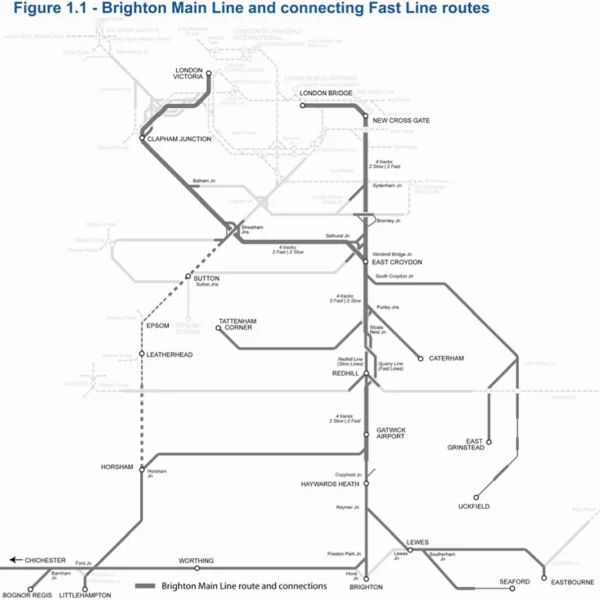
The BML is a 108km long railway corridor in southern England that links London (Victoria and London Bridge) to Brighton on the south coast and handles 300,000 daily passengers (1,700 daily train movements). The route includes major commuter stations like London Bridge, London Victoria and Clapham Junction, as well as connecting into Gatwick Airport. The train operators on this line include Thameslink, Southern, Gatwick Express, Great Western Railway and London Overground Services.
Under the plan, O2 will gain access to Cellnex UK’s new purpose-built neutral host infrastructure, enabling the phased rollout of high-speed mobile connectivity, including 5G, to customers across the entire route over the “coming months“. The move follows Cellnex signing Three UK in 2023.
Advertisement
New indoor coverage solutions are now being deployed to enhance mobile phone connections in three of the most important London stations, London Victoria, London Bridge, and Clapham Junction, which account for roughly 19% of railway passenger traffic to and from the capital from outside London.
Steve Cray, Managing Director of Cellnex UK, said:
“Regular railway passengers will understand the frustration of losing signal mid-conversation or spending whole journeys with buffering videos. With O2 now on board, many more passengers are going to notice the difference on one of the UK’s most important commuter routes. This collaboration stands as one of the most significant end-to-end telecommunications infrastructure deployments in British railway so far, and we are proud to be setting a new standard for the UK’s entire rail network.”
Professor Robert Joyce, Director of Mobile Access Engineering at O2, said:
“Our £700m Mobile Transformation Plan is focused on delivering reliable connectivity in the moments that matter most, and railway lines are a key part of that. By working with Cellnex to improve connectivity along the Brighton Main Line, we’ll be bringing improved coverage and capacity to customers travelling from the coast to the capital over the coming months.”
Cellnex designed, planned, and built this infrastructure in partnership with Network Rail under a 25-year contract awarded in 2021, enabling all UK mobile network operators (MNOs) to access shared connectivity – related coverage improvements being brought live in stages across the route.
Once fully activated, the shared infrastructure is expected to deliver “high speed connectivity” across 99% of the 108 km route, “drastically reducing historical not-spots and ensuring passengers enjoy reliable calls, uninterrupted streaming and stable app performance” throughout their journey. The goal is to bring “seamless connectivity” to a route long challenged by deep cuttings, long tunnels and Victorian-era station infrastructure.
UPDATE 16th June 2026 @ 4:41pm
Advertisement
Just to clarify the status of the new network. Cellnex is close to completing deployment along the Brighton Mainline. Elements of the solution are now undergoing technical testing, with a view to being activated in the coming months. As matters stand, only O2’s services will start to go live as elements of the BML solution come online.






Mark is a professional technology writer, IT consultant and computer engineer from Dorset (England), he also founded ISPreview in 1999 and enjoys analysing the latest telecoms and broadband developments. Find me on X (Twitter), Mastodon, Facebook, BlueSky, Threads.net and Linkedin.












« Spusu UK Gifts 5GB of Free Mobile Data to Celebrate Third Birthday
Advertisement
Leave a Reply
Privacy Notice: Please note that news comments are anonymous, which means that we do NOT require you to enter any real personal details to post a message and display names can be almost anything you like (provided they do not contain offensive language or impersonate a real person's legal name). By clicking to submit a post you agree to storing your entries for comment content, display name, IP and email in our database, for as long as the post remains live.
Only the submitted name and comment will be displayed in public, while the rest will be kept private (we will never share this outside of ISPreview, regardless of whether the data is real or fake). This comment system uses submitted IP, email and website address data to spot abuse and spammers. All data is transferred via an encrypted (https secure) session.












> As above, Three UK customers (VodafoneThree) can already access this
Ha! Three’s coverage on the BML is so poor that I have a backup SIM on EE to provide connectivity through the Three not spots.
I assume this is Mark’s comment, not a comment from VF3/Cellnex. Three haven’t activated any kit on the BML, they couldn’t if they wanted as the Cellnex rollout is still ongoing
The PR mentions Three UK as being signed to the network on several occasions, since 2023, apparently. The PR itself is a little flaky on context in this part, so I may have incorrectly inferred something. But the impression you get is that most of this is already live, and it’s O2 that isn’t yet fully live.
Ah gotcha. Is there any documentation on when the Cellnex rollout is forecast to complete? Do you know if it’s activated in stages as the physical build completes, or are they going to build all the masts etc. and then activate it in a “big bang” release?
Attached is a map of all the infrastructure being installed for this, if you are interested.
https://www.google.com/maps/d/u/0/edit?mid=1Uz2GO1-3lKfr5XtvdVsLfWM5uGUh0Lo
No infra is live for this yet. Coming first will be Station DASes within London, followed by some select tower sites by the end of the year.
Most of the infra isn’t even installed yet!
Ah, thank you. The coverage between Haywards Heath and Gatwick Airport is particularly bad, looking forward to that being fixed!