Study Claims 5 Million Brits on UK Coast at Risk of Accidental Mobile Roaming Charges
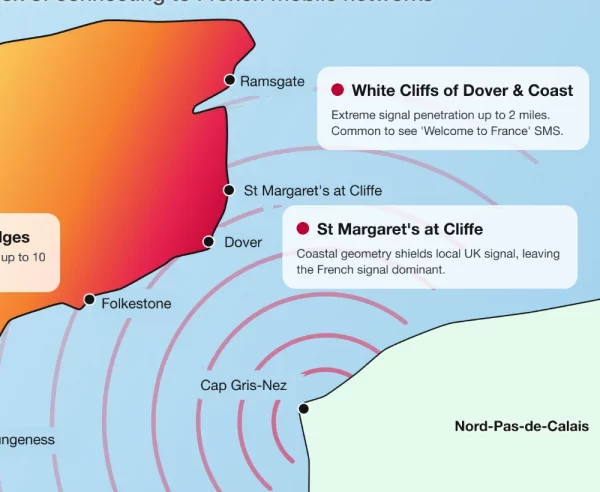
A new Opinium survey of 2,000 UK adults (weighted to be nationally representative), which was commissioned by Uswitch.com, has claimed that more than 5 million people (9.8%) have seen their phone connect to an overseas network while they were still in the UK, triggering a roaming charge or alert. But 76% of respondents still think this is “impossible” or have never heard of it.
In the past we’ve seen plenty of occasions where people living in certain parts of the UK, such as Dover (Kent) or Sussex, have seen their mobile phones automatically connect to a mobile network in nearby France (i.e. certain atmospheric conditions, in the right location, can make French signals stronger than domestic ones). If you aren’t aware of this occurring, then it can lead to problems with dramatically inflated bills for calls, texts and 4G / 5G data (mobile broadband).
So, on the one hand, we’re highly sceptical of Uswitch’s extrapolation, from an opinion survey, to equate such issues to impacting 5 million people. But the issue itself is in fact very real and quite well-known if you happen to live in such locations, where it may occur. The issue is particularly relevant at this time of year, with 51% of respondents said to be planning a UK staycation this year.
Advertisement
Some 26% of respondents are planning a staycation in the South West, along the Cornwall, Devon and the Dorset coast, while the Kent coast and South East England follow in second place (13%). Of those who ended up receiving unexpected charges as a result of accidental roaming, some 39% didn’t know they could dispute the charges – and 52% either took no action or paid without questioning the bill.
The reality is that consumers should always contact their mobile operator when something like this occurs, although a refund isn’t guaranteed, but some operators will do it. Providers are already required to alert customers as soon as they start roaming and to take reasonable steps to stop Northern Ireland customers being billed when their phone locks onto an Irish network. But such things are easily overlooked.
However, whether or not you get hit by a charge can depend upon your mobile plan. Some operators and plans include EU roaming by default (e.g. O2, Sky Mobile, Tesco Mobile, iD Mobile, giffgaff, SMARTY and Talkmobile), which negates the impact from most inadvertent roaming connections. But others (e.g. EE, Vodafone, Three UK) often don’t include this as a default feature, although some of their specific plans may still include it.
Consumers with a concern about this could try manually selecting their mobile network (instead of letting your mobile decide), although this can be a bit fiddly. In addition, most mobiles allow you to disable data roaming features (but not calls/texts as this is a core part of how mobile networks work), which is probably a good idea when you’re in one of these locations.
Advertisement






Mark is a professional technology writer, IT consultant and computer engineer from Dorset (England), he also founded ISPreview in 1999 and enjoys analysing the latest telecoms and broadband developments. Find me on X (Twitter), Mastodon, Facebook, BlueSky, Threads.net and Linkedin.

























I remember us “being very concerned” about this thing 20 years ago as well and the solution is still the same (which is mentioned in the article). I would expect it to be common knowledge and everyone in the affected area using packages which free EU roaming which completely mitigates this problem.
I had this happening to me every time when visited Dover. I find it quite ironic that networks from France are providing better coverage than the domestic providers.
The ultimate “reasonable measure” for inadvertent cross border roaming is for the networks to just not charge a roaming charge if the connection comes from a “whitelist” of transmitter sites near to the border. They have the data.
The cost to the MNO/MVNO would be small in the grand scheme of things, although there will be some setup and administration costs (as transmitter sites change).
Even better if country regulators would “permissively” license (for free) neighbouring country networks at transmitter sites near to borders, so the signal is not seen as roaming at all. That would be quote a lot of work at for regulators as well as operators to set this up and maintain this.
We could just go back to what we had when we were in the EU – free roaming! Make it happen Andy.
This should be trivial for networks to detect (a straight roam from a UK cell site to one in France with no period in between of no connectivity can’t be anything else), and automate the sending of an SMS with details of how to manually select a network, and suppress any roaming charges.
Or better yet – we could regulate to prevent UK networks from charging UK consumers for roaming while they remain on “home” soil. The onus should be on the network to prove, without reasonable doubt, that their customer was legitimately roaming abroad. This should be fairly easy to prove – being connected to France for the day = chargeable roaming, whereas connecting to France for 30 minutes = inadvertent roaming / no charge.
We’d all like free EU roaming to return, but sadly that seems less likely…
This is mainly because poor to none UK’s provider network coverage in those places.
Something I’ve had a couple of times is Isle of Man roaming on ferries from Birkenhead (in the UK) to Belfast (in the UK). It’s a domestic UK ferry, so you wouldn’t expect it to be an issue, but it passes close enough to the Isle of Man in the middle of the night that you will generally get a connection to Manx networks. These can be expensive as they don’t come under EU roaming, even on plans that have it.
Depends on the network. I’m on 1p Mobile and their free roaming includes the Isle of Man (and the Channel Islands), as well as the EU.
Last time this happened to me was at South Foreland Lighthouse near Dover but this was 20 years ago & the French operator sent an advisory text when my phone logged to their network. Does this not happen anymore?
Every time I go abroad, I get a little flurry of texts from Three with information on roaming rates, but these normally come 2-3 minutes after I arrive in the country. For momentary roaming, where you connect to a French tower for a minute, it might come and go before the texts do.
I would have thought that the ‘Timing Advance’ setting in the network handshakes should be set to prevent calls being made even if the handsets can attach to the overseas network.
isn’t dover to calais like 50 miles? i’m surprised a mobile mast works that far to be honest.
No only 21 miles, not too much of a step for a mobile mast with a clear line of site especially when you’re up on the cliffs.
At its closest point, at Cap Gris Nez, France is only 21 miles from the Kent coast.
It’s not just UK either, whilst on the beach on Greek island last week (with EU roaming plan) handsets were connecting to masts in Turkey
This happens a lot in Jersey, you loose signal constantly as it’s flicking between networks on Guernsey & France. Better to lock your phone to a local network (e.g. Jersey Telecom in Jersey).
Not just the Kent coast, SFR and Orange available from Ventnor, Isle of Wight almost 60 miles from France!
Blame the greedy opportunist operators who quickly pulled the plug after BREXIT. EU dictates no mobile borders. Sadly when the country voted there was no idea the UK would loose roaming.
ah so this is EU fault? Are you the one of those blaming everyone around for your own life f*ckups?
@name, he is blaming the greedy opportunist operators. He is right. Most of the networks in E.U are run by the same companies that run ours, so now need for extra charges and now need for admin costs.
As he or she said, greedy opportunist operators
You could say it’s greed but free roaming does come with a cost to the operators. So I don’t blame them for charging if they’re not forced to make it free. I blame the government, they could’ve negotiated that the UK continued to be included in the free roaming area, no reason for the EU to refuse as long as it was reciprocal, they chose not to.
Those costs will be essentially minimal. EU operators have tended to continue to include the UK in the EU roaming zone. It isn’t hard to get a cheap UK SIM with inclusive EU roaming.
So it definitely could be argued that they’re doing it because they can get away with it, not because there are costs to recover
There us a chance if someone say in dover connecting to the French network but that risk is very snall and there are stets you can take to syop it
Are E-U sure that mobile phone setting don’t have one related to roaming?
Not exactly a problem at home when all you have to do is turn roaming off. Mine regularly connects to Manx telecom from the Cumbrian coast and when we were recently in Dover the only network available was French. No problem really as it doesn’t cost anything.
Sadly we got stung when on holiday to Rhodes as every time we connected to the Turkish network we got charged £5.