Global Cable Operators Target 10Gbps Broadband Speeds for All
The Internet & Television Association, which represents the global cable broadband and TV industry (CableLabs, Liberty Global etc.), has launched their new 10G vision. This is their plan for making speeds of 10Gbps (Gigabits per second) and beyond available to consumers across the globe in the “coming years.”
According to the announcement, which was made this week at the annual Consumer Electronics Show (CES), the new 10G initiative will “ultimately.. deliver symmetrical speeds that are up to 10 times faster than today’s fastest networks” (i.e. they’re using the 1Gbps services that are said to be available from most cable networks in the USA as a baseline).
Apparently many cable operators “are implementing the new 10G initiative, with lab trials already underway, and field trials beginning” as soon as 2020. In fact they’ve even setup a dedicated 10G Website to help sell their plan to the wider market and consumers. Promises of “faster speeds, more capacity, lower latency and greater security” are all well and good but, outside of the USA, the picture is a bit more mixed.
Advertisement
The announcement is likely to cause a few giggles here in the United Kingdom, where the best that Liberty Global’s sibling ISP – Virgin Media – can currently offer is 362Mbps (average) and there’s still no sign of their long planned DOCSIS 3.1 upgrade that could in theory make speeds of between 1Gbps and up to 10Gbps available (maybe next year.. we keep saying). At least a 500Mbps tier may be on the way first.
Back in 2016 Liberty Global launched a new initiative called GIGAWorld (here), which seemingly aimed to promote their plans for rolling out Gigabit capable broadband via DOCSIS 3.1 upgrades to all of the European countries in which it operates. At the time it said that most could be done by the end of 2018 but so far only their EU divisions in Poland and Germany have launched real products.
Suffice to say that most of their EU and UK divisions are still waiting for 1Gbps speeds via DOCSIS 3.1, let alone 10Gbps.
Michael Powell, NCTA President and CEO, said:
“With groundbreaking, scalable capacity and speeds, the 10G platform is the wired network of the future that will power the digital experiences and imaginations of consumers for years to come. As an industry, we are dedicated to delivering an exceptional national infrastructure that will power digital advancement and propel our innovation economy into the future.”
Mike Fries, CEO and Vice Chairman of Liberty Global, said:
“While the world is talking about 5G, we’re proud to be part of this extraordinary movement to 10G. We’re already launching entire Gigicities and that’s just the start. We’re building a network that leverages the strategic advantage that DOCSIS 3.1 brings, and we’re excited to utilize this world-class platform to provide a 1G to 10G playbook that will fuel innovation and the economy of the future.”
The announcement mentions symmetrical (same speed both ways) 10Gbps performance a few times and this probably needs a reality check. At present the only way to do that, without completely replacing Hybrid Fibre Coax (HFC) with “full fibre” (FTTP) cables, is to adopt the very latest Full Duplex variant of the DOCSIS 3.1 standard (10g FDX).
Advertisement
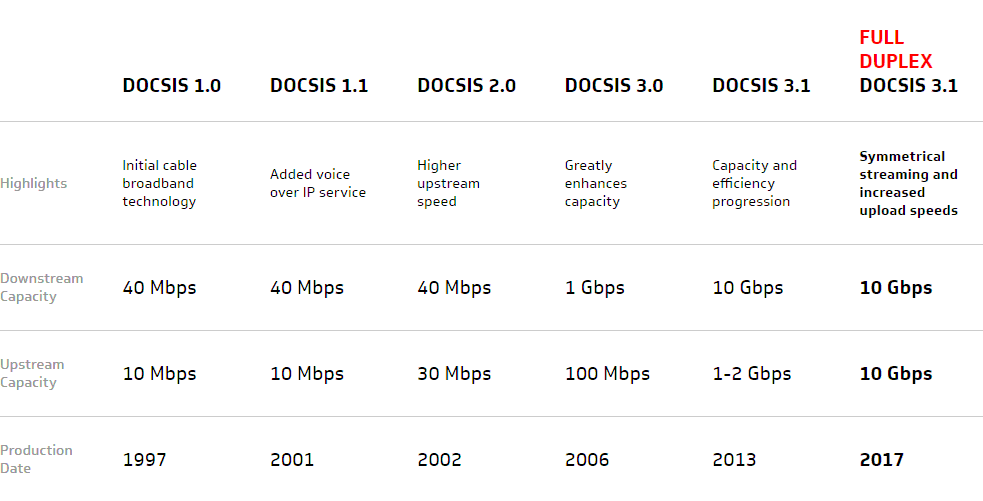
However 10g FDX would not be an easy beast to deploy in the United Kingdom and we don’t expect to see it for quite a long time, which is due to its stiff requirements that would demand a significant and very expensive upgrade to Virgin Media’s existing network. We can’t see that kind of work happening anytime soon.
Mind you at present 10G is really just about marketing and showing that big Cable is still relevant in an increasingly FTTP focused world. In the UK we’d be overjoyed just to see Virgin launch a 1Gbps package but that’s probably still a year or two away (possible trials notwithstanding). For now 10Gbps is just a very distant dream, at least via UK HFC networks.

Mark is a professional technology writer, IT consultant and computer engineer from Dorset (England), he also founded ISPreview in 1999 and enjoys analysing the latest telecoms and broadband developments. Find me on X (Twitter), Mastodon, Facebook, BlueSky, Threads.net and Linkedin.













« Rumour Mill – UK ISP Virgin Media Business Prep 500Mbps Broadband

















Comments are closed