Examining the Attitudes and Fears of UK Internet Non-Users vs Users
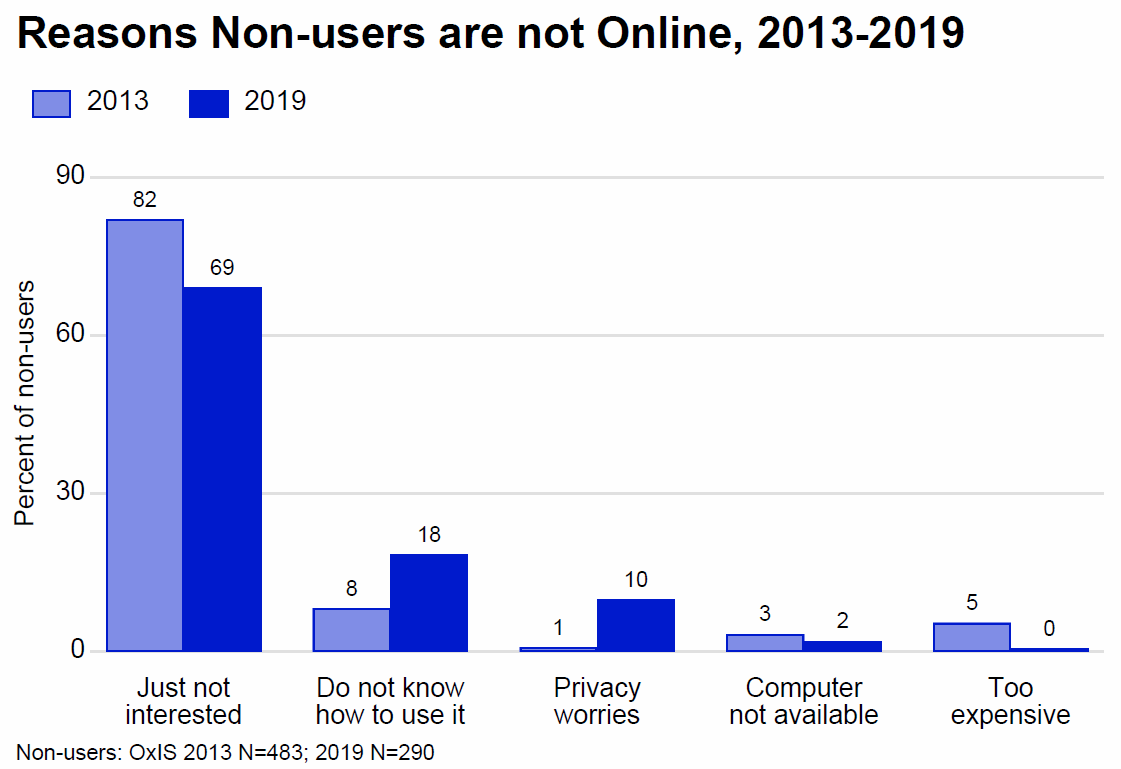
A new survey of 2,000 British people by the Oxford Internet Institute (OII) has helped to shed new light on the reason why some people (18% of respondents) still choose NOT to use the internet. Perhaps unsurprisingly, the biggest reason turns out to be a simple “lack of interest” (69% of non-users now vs 82% in 2013).
As for the other reasons why people choose not to go online, some 18% said they didn’t know how to use it (rising sharply from 8% in 2013), while 10% had worries about online privacy (up from 1% in 2013), just 2% didn’t have access to a computer (down from 3% in 2013) and interestingly nobody said it was too expensive (down from 5% in 2013).
Despite the above findings, the survey noted that a higher proportion of non-users were below the median income (£28,400/year), which stems from the fact that 40% of non-users reported an annual income below £12,500. Likewise there were also disproportionate percentages of non-users among less-educated groups.
Advertisement
Elsewhere harmful experiences on the internet, like viruses or theft of credit card details, have not increased this year, although 72% of non-internet users believe the internet threatens privacy and that compares with 52% of those who actually use the internet. Internet users are also far more likely to believe “technology makes things better” – 79% of users agree with that sentiment, compared to just 29% of non-users.
Dr Grant Blank, Survey Research Fellow OII and Report Author, said:
“The majority of people are having positive experiences of internet use, regularly going online to watch their favourite shows or pay their utility bills.
However there is a widening perception gap between internet users and non-users, with non-users resolutely avoiding the internet. Often these non-users are from low income groups, where being online could potentially improve their quality of life.
There’s an interesting paradox here with internet users being less likely to take action to protect their privacy while non-users tend to be put off by privacy concerns. These concerns could perpetuate the digital divide, with many people missing out on the benefits of the internet, such as access to health information, employment opportunities and reduced prices online.
There is a real opportunity to engage with non-users to address their concerns and help them understand the opportunities the internet can bring. We hope this survey contributes to the public debate about what further steps can be taken to narrow the digital divide.”
The Government’s Minister for Digital, Matt Warman MP, similarly welcomed the report and said that their £400,000 Digital Inclusion Fund had been setup precisely to “help older and disabled people get online and acquire new digital skills.”
Admittedly not everybody wants to use the internet and nobody should force it upon those who don’t want or need it, but equally support should always exist for those who wish to give it a try. This philosophy may become increasingly strained as the Government continues to extend its digital-by-default strategy in order to save money.
We should point out that the 18% figure for non-users cited by this report appears to conflict with the official Office for National Statistics (ONS), which this year reported that 4 million adults have never used the internet (7.4%) and more than half (2.5 million) of those were aged 75 years+.
Advertisement

Mark is a professional technology writer, IT consultant and computer engineer from Dorset (England), he also founded ISPreview in 1999 and enjoys analysing the latest telecoms and broadband developments. Find me on X (Twitter), Mastodon, Facebook, BlueSky, Threads.net and Linkedin.













« Premier League Hail Success of UK ISP Work to Stop Internet Piracy

















Comments are closed