Openreach Sets UK Withdrawal Date for Fibre Voice Access Product UPDATE
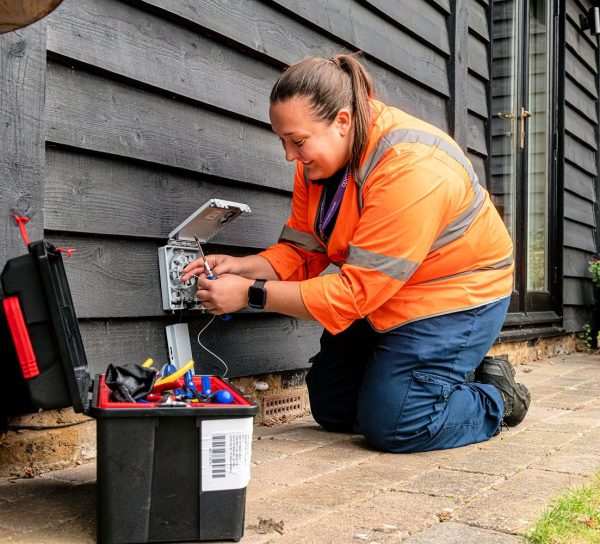
Network access provider Openreach (BT) has revealed that they will finally withdraw their old Fibre Voice Access (FVA) product from 1st December 2024. The service has long since been superseded by retail broadband ISPs launching their own IP / VoIP based digital phone services.
In case anybody has forgotten, FVA enabled a broadband ISP to offer a public switched telephone network (PSTN) quality voice service to customers over their Fibre-to-the-Premises (FTTP) lines. In order to deliver this, they built an Analogue Terminal Adapter (ATA) into the optical modem (ONT) that goes on your wall, which was able to support two analogue phone ports.
However, FVA was perhaps a bit of an awkward and awkwardly timed product and, as stated earlier, retail ISPs have now largely opted to launch their own IP (Internet Protocol) based voice solutions that connect via your router rather than through the ONT – avoiding the need to take a special service from Openreach.
Advertisement
The FVA service never really took off, and Openreach stopped selling it to new customers on 31st March 2020. The change today is that they’re going to completely withdraw FVA from 1st December 2024, which will of course affect any existing customers that remain (virtually all of those should have already been moved to different products by now).
UPDATE 4th October 2024
Openreach has given providers a little bit more time (one extra month) and changed the full withdrawal date of Fibre Voice Access (FVA) from 01/12/2024 to now be 02/01/2025.






Mark is a professional technology writer, IT consultant and computer engineer from Dorset (England), he also founded ISPreview in 1999 and enjoys analysing the latest telecoms and broadband developments. Find me on X (Twitter), Mastodon, Facebook, BlueSky, Threads.net and Linkedin.













« Daisy Comms Adds Paid SafeWeb Service to UK Accounts Without Asking














Won’t some of these be vulnerable customers with the battery backup? I feel more scandals coming on?
CPs should have dealt with that years ago by providing a UPS along with their CPE device that handles the voice part.
Phone handsets seem very last century in an IP Broadband world. My vulnerable users know how to tell their audio terminals to call the contact that they want, or press their wrist alarm in emergency. Obviously wrist alarm calls whenever fall is suspected…
I’d rather have the ATA in the ONT than integrating it into the ISP router, especially when there isn’t a modem mode or SIP details provided, since I prefer to use my own setup.
Maybe in future it will be better to use a third party voip service with your own equipment than tie yourself to one provided by your ISP. Plusnet for example will not be providing any kind of voip service. Most people use a third party for their email (Hotmail/Gmail etc) and I could see the same happening for voip.
@Big Dave
As of now I do.
Problem is the last time I looked, most don’t offer the package I prefer (unlimited/high amount of minutes including mobile) so my options are limited and not necessarily cheap.
In general it seems like allot of VOIP providers are aimed more at businesses.
As if this near monopoly supplier will continue to allow the freedom to use other means of achieving DV over their service once prices start diverging.
If you use the “ATA in the ONT” from FVA, then it’s not a standalone SIP gateway; it trunks the traffic via the OLT on a hidden channel. So whilst you could use your own router for data, it would tie you down to a proprietary WLR-like voice service from Openreach.
Openreach is exiting from voice services entirely, so FVA had to go.
The “near monopoly supplier” (who actually doesn’t have a monopoly at all, assuming you’re directing your rant at BT Retail) has to meet certain Ofcom regulations, which they can only do when you are using their equipment.
Nothing prevents you from taking a broadband only service and taking an OTT ITSP service from a provider that doesn’t need to do this. YMMV, however.
Given the stories – some in this website’s own forum – of people getting weird spam calls that would appear to be due to a SIP misconfiguration in their own equipment, perhaps the BT/Sky/TalkTalk approach is justified.
As a virtual monopoly provider, you can’t be having the situation where the public believe that there are are multiple technical ways of achieving the same outcome or that your organisation is operating well behind the technical curve. You’re prime corporate objective (Apart from muddying the waters of consumer choce) is to squeeze in that oppressive element that only allows “My way” of doing things . . . .just to show ’em who’s boss, whilst at the same time providing the most minimal service you can get away with and still be regarded “Civilized” and “21st Century” – and, naturally, telecomms ain’t the only area this philosophy is applied to.
Must be something associated with being Anglo-Saxon
I’ll admit you’ve lost me here
What on earth are you on about?
There are countless ISPs. Some offer VoIP. Some don’t. That’s hardly some kind of secret Openresch tie-in.
And most people’s definition of monopoly or near-monopoly isn’t one where the vast majority of homes have the choice of at least 2 providers, many more if you include the mobile networks.
Did any CP other than BT offer a service based on Openreach FVA? I can’t think of any offhand.
No doubt BT will make it impossible to port out the existing phone number to a third-paty VoIP provider without it also cancelling the broadband, effectively forcing people to use BT Digital Voice.
No you should be able to port any 11 digit (5 digit std and 6 digit phone number) to a voip provider of your choice. Ofcom would take a dim view if they didn’t.
@Big Dave
In my case when I was with BT DV, I was able to port my number from BT to a dedicated VOIP provider, however, because the number was also tied to my broadband it did result in a disconnection.
I was basically without broadband for ~2 weeks until my new ISP took over.
That said, what was more annoying was BT’s CS telling me this wouldn’t happen, meaning I was ill prepared.
That said, I wonder if the new switching system would fix this?
Why would you think that? Fixed line number porting has worked reliably for decades.
I’m not surprised that FVA failed to take off as ISPs like BT, Vodafone and Sky all provide hubs (with a ATA built-in) with a port for a handset to connect. If it’s an RJ11 port the connection is with an RJ11 to BT adapter. Providing phone via a hub also has the benefit of being independent of network operator for FVA service, important for an ISP like Vodafone which uses both Openreach and Cityfibre.
Isn’t the voice situtation becomming rather propritary, suppliers own routers, not supporting alternative or own equipment / configuration information etc? Far from open, flexible nor forming a consitent national service/standard?
And a perhaps a naive question what about people who do not want broadband, but just a ‘traditional’ phone for friends & familly, how are they to manage the loss of straightforward copper? I would say consumerism support seems to be excluding actual help contacts & staff to speak with, some may see this continual shift as rather ‘digital discrimination / exclusion’?
National communication on who is supposed to what and by when and how – seem to be rather a black hole, thinking of many pensioners etc.